



Last updated: September 9, 2026
Place
Warm Springs, Utah
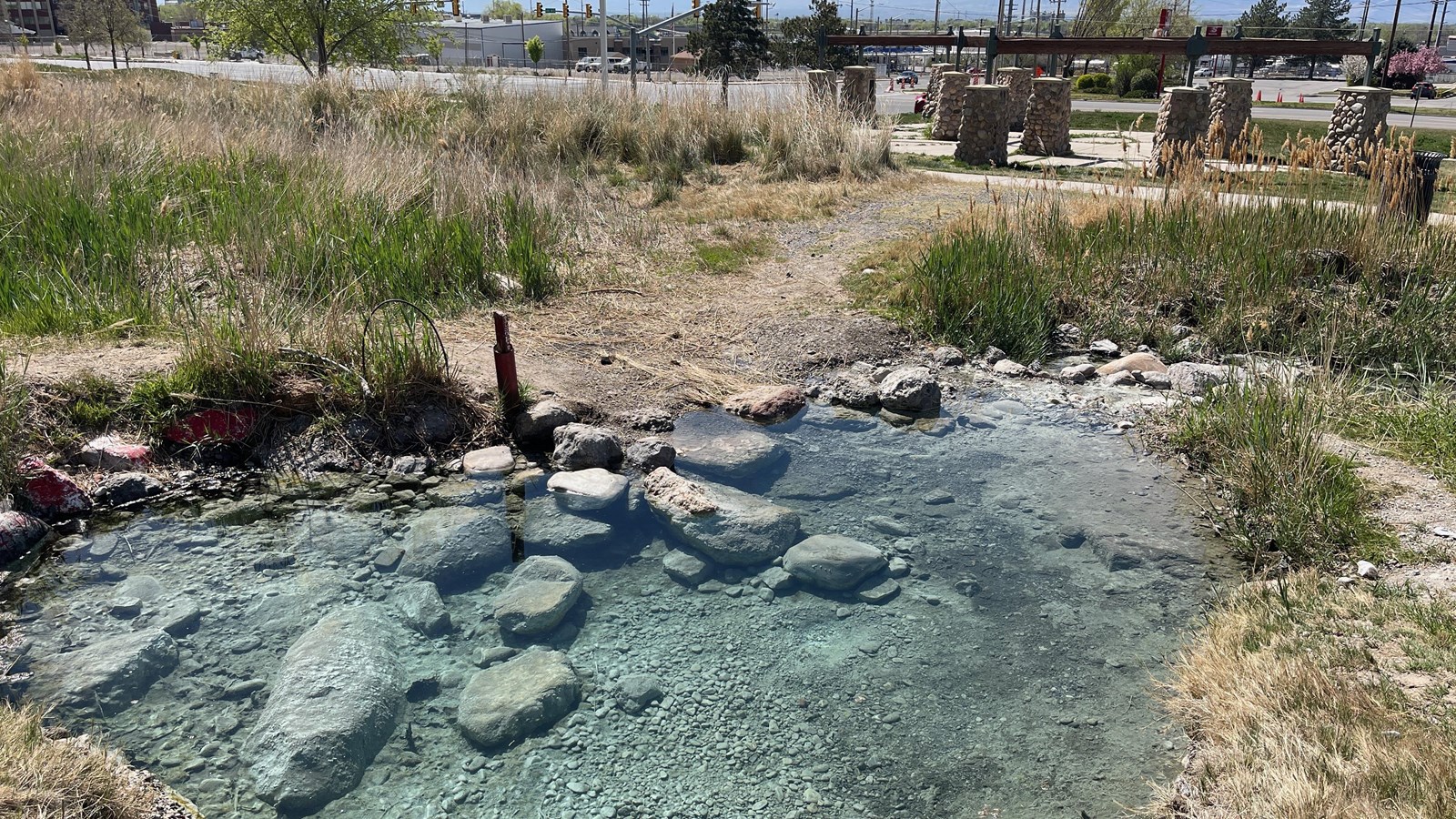
Photo/L. Kreutzer
Quick Facts
Location:
North Gateway Park, 950 Beck Street, Salt Lake City GPS40.791834 -111.899978 (The spring and related trail and interpretation are at the north end of Warm Springs Park, with parking north of the vacant historic bathhouse building)
Significance:
Warm Springs, north of present-day Salt Lake City, UT, was an important wintering site for Shoshone and Ute people until Latter-day Saints settlers displaced them in the 1840s. Developed by settlers for bathing, healing soaks, and social events, the springs drew visitors, including emigrants passing along the Hensley Cutoff to California, well into the 20th century.
Designation:
Historic site on the California National Historic Trail.
MANAGED BY:
Salt Lake City
Amenities
7 listed
Benches/Seating, Cellular Signal, Historical/Interpretive Information/Exhibits, Parking - Auto, Restroom, Trailhead, Wheelchair Accessible
While exploring the Salt Lake Valley in July 1847, Latter-day Saints scouts found a series of thermal springs at the base of the Wasatch Mountains, about 1 ½ miles north of what is now downtown Salt Lake City. Although the steaming springs reeked strongly of a rotten-egg sulfur odor, the settlers believed the hot mineral water had healing properties. Within days of their arrival, they began enlarging one of the basins, known as Sulphur Springs and Warm Springs, for soaking and bathing. Emigrant Thomas Bullock, of Brigham Young’s 1847 vanguard company, wrote that the spring “was very warm & smelt very bad” but would “heal all who bathe, no matter what their complaints.”
Unknowingly, the new settlers had taken over the traditional wintering campgrounds of Shoshone and Ute peoples, who had used the springs for thousands of years. In 1849, when Native families contracted measles from passing emigrants, many sought healing in the thermal waters, just as the settlers did. But with no natural immunity to the virus, the bathos offered no protection. Many Native people died during that winter, and the tragedy effectively ended their use of Warm Springs.
The springs grew hugely popular with local Latter-day Saints, and emigrants traveling to California along the Hensley-Salt Lake Cutoff also stopped to enjoy a soak. One forty-niner, John Hudson, described the spring as “a pool about twenty feet square and fifteen inches deep. The water is clear as crystal. The bottom is covered with pebble stones of a delightful greenish hue.”
Today the area is heavily industrialized and looks very different from what emigrants saw in the mid-1800s. Only a couple small pools remain in the park, and bathing is no longer permitted. Still, clear, sulfur-scented water continues to bubble up, and walkways with interpretive panels share natural and cultural history of the site.
To visit, use your smartphone to navigate to North Gateway Park at 950 Beck St/ US-89, north of downtown Salt Lake City. The park sits on the east side of the highway, immediately north of Warm Springs Park. Leave your vehicle north of the fenced historic building, a former municipal pool was fed by the springs. Follow the paved trails through the pavilion. The springs are at the north end of the park.
Site Information
Location (North Gateway Park, 950 Beck Street, Salt Lake City GPS40.791834 -111.899978 (The spring and related trail and interpretation are at the north end of Warm Springs Park, with parking north of the vacant historic bathhouse building))