



Last updated: June 8, 2026
Place
Texas Pleistocene
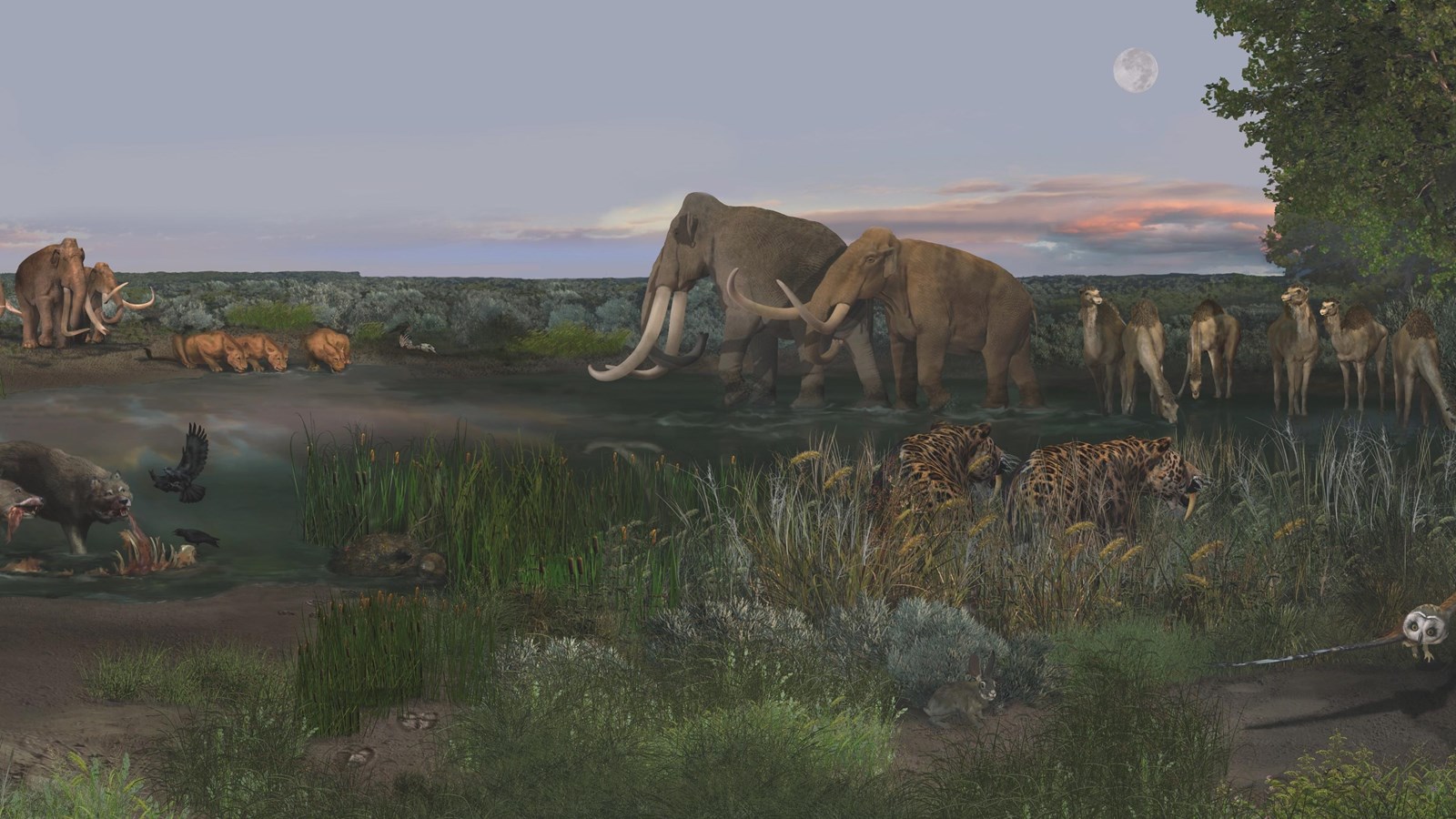
Created by Karen Carr for WACO
The ice sheets moved as far south as Illinois, Indiana, Iowa, and Ohio, but Texas remained ice-free during the Pleistocene Epoch. Some of the smaller bones found here – tortoise shell fragments – tell us the climate in central Texas was temperate with mild winters.
During the mammoths’ time, about 68,000 years ago, the environment would have been like what you are experiencing at the site today. The ice sheets in the far north likely caused temperatures to cool by about 10℉ on average and decreased the humidity.
The landscape was mostly tall grasslands (6 feet/1.8 meters tall) that supported herds of mammoths and other grazing megafauna, animals that are 99 pounds (45 kilograms) or more. Fossils of browsing animals like camels, deer, and dwarf pronghorns tell us this area also had woodlands. Early research of the plant community has found microscopic fossils from native river cane, C4 (full sun) grasses, and conifers such as junipers or pines.
The sediment, or dirt, in the Dig Shelter suggests this area was the edge of a flood plain and possibly had swamp-like areas with slow-flowing water. There is no evidence of a catastrophic flood preserved in the Dig Shelter sediments. Instead, the sediments and fossils suggest long periods of environmental stress.
During the mammoths’ time, about 68,000 years ago, the environment would have been like what you are experiencing at the site today. The ice sheets in the far north likely caused temperatures to cool by about 10℉ on average and decreased the humidity.
The landscape was mostly tall grasslands (6 feet/1.8 meters tall) that supported herds of mammoths and other grazing megafauna, animals that are 99 pounds (45 kilograms) or more. Fossils of browsing animals like camels, deer, and dwarf pronghorns tell us this area also had woodlands. Early research of the plant community has found microscopic fossils from native river cane, C4 (full sun) grasses, and conifers such as junipers or pines.
The sediment, or dirt, in the Dig Shelter suggests this area was the edge of a flood plain and possibly had swamp-like areas with slow-flowing water. There is no evidence of a catastrophic flood preserved in the Dig Shelter sediments. Instead, the sediments and fossils suggest long periods of environmental stress.