



Last updated: April 27, 2026
Place
The Stone Fort Museum
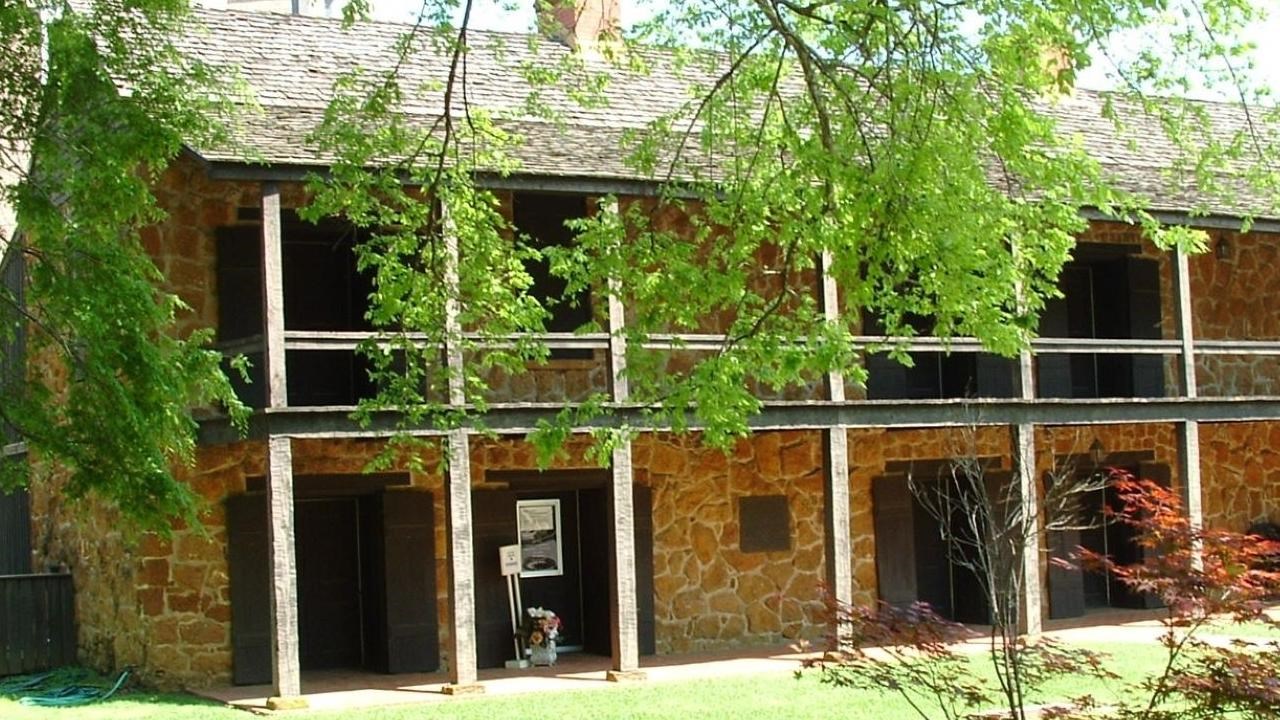
NPS Photo
Quick Facts
Location:
1808 Alumni Drive, Nacogdoches, Texas.
Significance:
The Stone Fort Museum commemorates a structure built in the late 18th century that served as a trading post, private home, church, jail, and saloon.
Designation:
Texas Historic Landmark; Historic Site on El Camino Real de los Tejas NHT.
MANAGED BY:
Amenities
1 listed
Historical/Interpretive Information/Exhibits
Originally known as La Casa Piedra, the Old Stone Fort was the first trading house built in the town of Nacogdoches, Texas.[1] The structure was designed and built by Antonio Gil Ibarvo, a former resident of the settlement of Los Adaes in present-day western Louisiana. After the Spanish government closed that settlement in 1772, Ibarvo led a band of displaced colonists to settle in Nacogdoches.[2]
Placed at the intersection of El Camino Real de los Tejas and La Calle de Norte, the Old Stone Fort was a center of trade and economic activity in Nacogdoches. Ibarvo stored, sold, and traded a variety of goods within the imposing 70-foot-long brick and iron building. After facing allegations of smuggling in 1791, he was forced to leave the town and trade emporium behind in 1796.[3]
Following Ibarvo’s departure, the building served a markedly different function as the seat of Spanish power in eastern Texas. Spanish officials used the building as a distribution office for land titles, and a military headquarters in 1800. While the building served as a symbol of Spanish rule in Texas, it would also become a symbol of revolution. It was at the Old Stone Fort where soldiers of the joint American-Mexican Gutierrez-Magee Expedition declared the liberation of Texas in 1812. The expedition attempted to overthrow Spanish rule but ultimately failed and the would-be revolutionaries abandoned the site.
Years later, the building played a role in yet another revolt, this time against the Mexican government during the Texas Revolution. Anglo-Texan soldiers targeted the building during the Battle of Nacogdoches in 1832 and many famous figures of the Texas Revolution passed through its halls.[4] According to some accounts, David “Davy” Crockett visited before his death at the Alamo.
During the early years of the Republic of Texas, the building was owned by Nacogdoches judge and district attorney John M. Durst, who refashioned the building once again into the town’s courthouse. In 1838, however, the building was sold again to former Texan revolutionary John S. Roberts, who returned the structure to its original use as a commercial hub for his mercantile firm. He also operated it as a saloon, prompting criticism from some locals. After buying the property in 1901, brothers William and Charlie Perkins decided to dismantle it and build a new structure in its place. The brothers donated its parts to the Cum Concilio Club, a prominent local women’s league.[5]
As the Old Stone Fort continually changed hands throughout its history, so too did Texas. In 1936, the State of Texas transferred the materials of the now-disassembled Old Stone Fort to the campus of Stephen F. Austin College in 1936. A replica of the original building – made in part from the same stone as the original – was erected that same year for a centennial celebration.[6]
The building serves as an example of the state’s complicated history. Today, the building houses a museum that offers a variety of programs and exhibits to teach visitors about the structure’s important place in Texas history. The college also uses it as a teaching tool, giving students interested in museum studies hands-on experience as they help to preserve its historic collections.
Site Information
Location (1808 Alumni Drive, Nacogdoches, Texas.)
More site information
El Camino Real de los Tejas National Historic Trail
[1] Archie P. McDonald, “Old Stone Fort,” Handbook of Texas Online, accessed September 29, 2023, https://www.tshaonline.org/handbook/entries/old-stone-fort.
[2] Robert Bruce Blake, “Ibarvo, Antonio Gil,” Handbook of Texas Online, accessed September 29, 2023,https://www.tshaonline.org/handbook/entries/ibarvo-antonio-gil.
[3] McDonald, “Old Stone Fort,” https://www.tshaonline.org/handbook/entries/old-stone-fort.
[4] Ibid.
[5] Ibid.
[6] “The Old Stone Fort: Stone Fort Musuem.” Stephen F. Austin University. Accessed December 4, 2023. https://www.sfasu.edu/story/markers/OldStoneFort.html.