



Last updated: July 1, 2026
Place
Information Panel: Temple of Democracy
NPS / Laurel Brodsky
Quick Facts
Amenities
3 listed
Audio Description, Historical/Interpretive Information/Exhibits, Tactile Exhibit
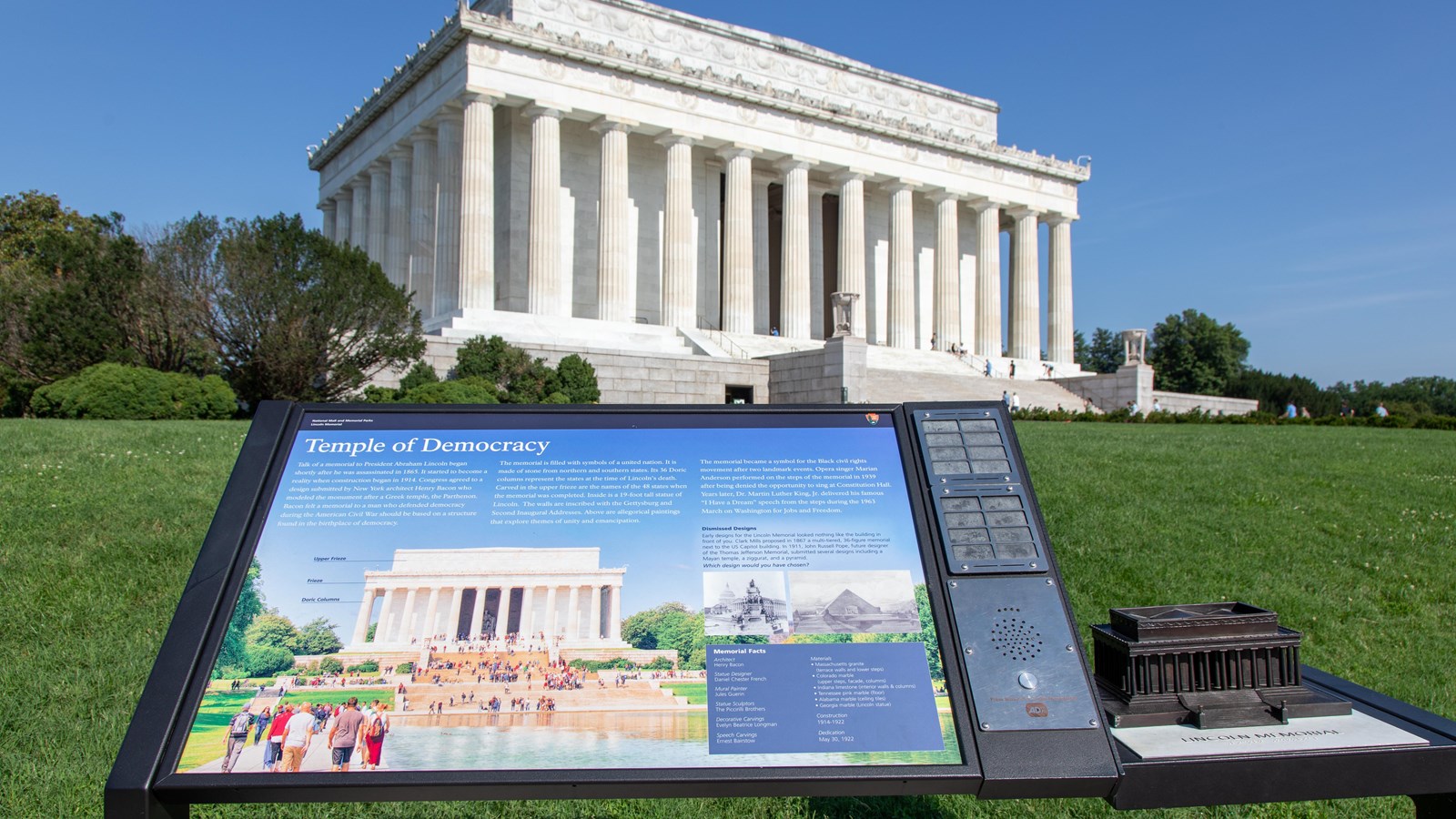
Talk of a memorial to President Abraham Lincoln began shortly after he was assassinated in 1865. It started to become a reality when construction began in 1914. Congress agreed to a design submitted by New York architect Henry Bacon who modeled the monument after a Greek temple, the Parthenon. Bacon felt a memorial to a man who defended democracy during the American Civil War should be based on a structure found in the birthplace of democracy.
The memorial is filled with symbols of a united nation. It is made of stone from northern and southern states. Its 36 Doric columns represent the states at the time of Lincoln's death. Carved in the upper frieze are the names of the 48 states when the memorial was completed. Inside is a 19-foot tall statue of Lincoln. The walls are inscribed with the Gettysburg and Second Inaugural Addresses. Above are allegorical paintings that explore themes of unity and emancipation.
The memorial became a symbol for the Black civil rights movement after two landmark events. Opera singer Marian Anderson performed on the steps of the memorial in 1939 after being denied the opportunity to sing at Constitution Hall. Years later, Dr. Martin Luther King, Jr. delivered his famous "I Have a Dream" speech from the steps during the 1963 March on Washington for Jobs and Freedom.
Statue Designer: Daniel Chester French
Mural Painter: Jules Guerin
Statue Sculptors: The Piccirilli Brothers
Decorative Carvings: Evelyn Beatrice Longman
Speech Carvings: Erniest Bairstow
Construction: 1914-1922
Dedication: May 30, 1922
The memorial is filled with symbols of a united nation. It is made of stone from northern and southern states. Its 36 Doric columns represent the states at the time of Lincoln's death. Carved in the upper frieze are the names of the 48 states when the memorial was completed. Inside is a 19-foot tall statue of Lincoln. The walls are inscribed with the Gettysburg and Second Inaugural Addresses. Above are allegorical paintings that explore themes of unity and emancipation.
The memorial became a symbol for the Black civil rights movement after two landmark events. Opera singer Marian Anderson performed on the steps of the memorial in 1939 after being denied the opportunity to sing at Constitution Hall. Years later, Dr. Martin Luther King, Jr. delivered his famous "I Have a Dream" speech from the steps during the 1963 March on Washington for Jobs and Freedom.
Dismissed Designs
Early designs for the Lincoln Memorial looked nothing like the building in front of you. Clark Mills proposed in 1867 a multi-tiered, 36-figure memorial next to the US Capitol building. In 1911, John Russell Pope, future designer of the Thomas Jefferson Memorial, submitted several designs including a Mayan temple, a ziggurat, and a pyramid. Which design would you have chosen?Memorial Facts
Architect: Henry BaconStatue Designer: Daniel Chester French
Mural Painter: Jules Guerin
Statue Sculptors: The Piccirilli Brothers
Decorative Carvings: Evelyn Beatrice Longman
Speech Carvings: Erniest Bairstow
Materials
- Massachusetts granite (terrace walls and lower steps)
- Colorado marble (upper steps, facade, columns)
- Indiana limestone (interior walls & columns)
- Tennessee pink marble (floor)
- Alabama marble (ceiling tiles)
- Georgia marble (Lincoln statue)
Construction: 1914-1922
Dedication: May 30, 1922