



Last updated: April 9, 2026
Place
Spanish Governor's Palace
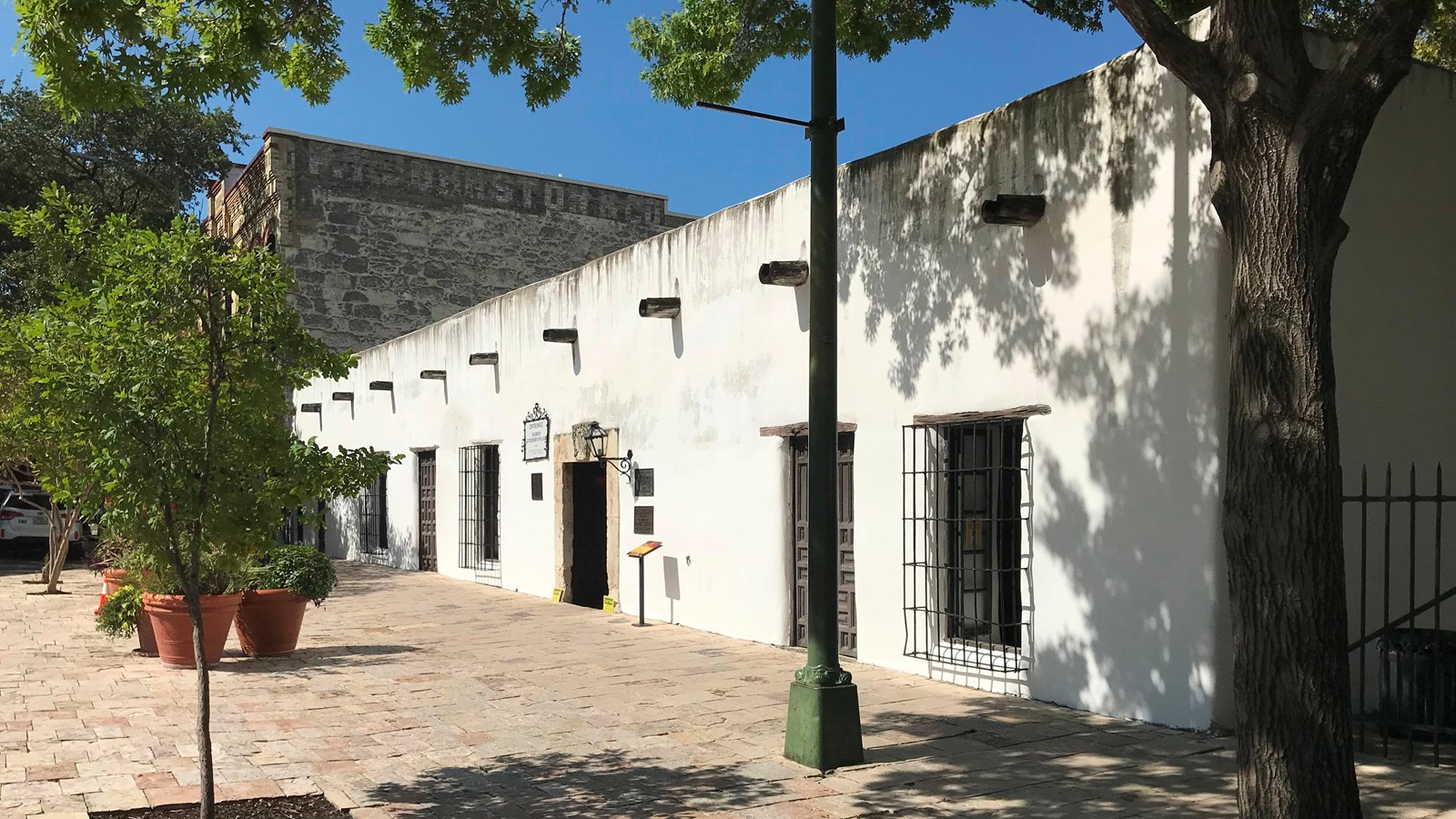
Photo/NPS
Quick Facts
Location:
105 Plaza de Armas (105 Military Plaza), in downtown San Antonio, Texas
Significance:
Visit the Spanish Governor's Palace to experience San Antonio's beginnings.
Designation:
Certified site; National Historic Landmark
MANAGED BY:
Amenities
1 listed
Historical/Interpretive Information/Exhibits
Located in downtown San Antonio, the Spanish Governor’s Palace is a relic of Presidio San Antonio de Béxar, one of the oldest vestiges of Spanish colonial life along El Camino Real de los Tejas.[1] Only one acting governor ever lived there, but that was enough to inspire a preservationist to name the building the “Spanish Governor’s Palace” in the early 20th century.[2] Also known as the Comandancia, or command headquarters, the building was part of the presidio—a fortified colonial settlement—built to protect Spanish missionaries and limit the expansion of the French Empire in North America. Presidio San Antonio de Béxar helped project the power of the Spanish Crown both within San Antonio and along El Camino Real de los Tejas.
Between 1690 and 1722, Spanish colonial officials established several presidios in what is now Texas, including Presidio La Bahía, Presidio San Sabá, and Presidio Los Adaes.[3] These sites housed Spanish soldiers who protected Spanish priests, families, and Indigenous converts to Christianity. In addition to defending the communities, the garrisons at presidios also provided military escorts for supply trains that traveled on El Camino Real de los Tejas.[4] They were small affairs—a 1726 survey reported only 45 soldiers at San Antonio de Béxar.[5]
In the 1730s, presidio captain José de Urrutia built living and office space on the presidio grounds. This structure, known as the “Captain’s House,” housed the garrison’s commanders into the early 1800s. The presidio’s military leaders faced many challenges, and surviving documents suggest that they constantly worried about threats from both the French Empire and Indigenous nations. Captain Luis Antonio Menchaca reported in 1763 that, without fortified walls, the Spanish garrison and its 22 soldiers were vulnerable to attack.[6] To safeguard the ranches of local settlers and defend the presidio, the number of Spanish troops was increased to 80 in 1772.[7]
By 1804 when Juan Ignacio Pérez purchased the house, Urrutia’s successors had expanded the original one-room Captain’s House into six rooms.[8] In July 1816, the Spanish Crown appointed Pérez interim governor of Texas.
In 1823, Pérez’s son Ignacio inherited the Captain’s House and lived there with his family during the Texas Revolution. In his 1852 will, he divided the residence between his widow and daughters, giving each of them a separate room. In the latter half of the 1800s, many of the surrounding buildings on Military Plaza were torn down and replaced with businesses. Several floods and general neglect led to the deterioration of the residence, and what remained of the house was turned into a commercial space.[9] For a time, it looked as though all of the structure might be demolished.
Beginning in 1892, historic preservationist Adina Emilia De Zavala began an effort save what was left of the nearby Alamo compound.[10] As part of her advocacy, she began referring to the former Captain’s House as the Spanish Governor’s Palace.[11] Perez’s descendant Concepcion Linn Walsh took full ownership of the property by 1900.[12] Thanks to the efforts of De Zavala and her allies, the San Antonio municipal government purchased the building in 1929 and began a restoration effort. Her efforts also cemented the name “Spanish Governor’s Palace” in the public consciousness.[13]
The restoration of the building was overseen by local architect Harvey P. Smith, who would later direct the restorations of San José y San Miguel de Aguayo Mission and San Francisco de la Espada Mission.[14] In addition to stabilizing and repairing the structure, the team also embedded interpretive panels into each room of the building. Newer research has revised some of the original project team’s conclusions, and architectural historians today believe that the restored building is bigger than it was during the Spanish colonial era.[15]
Today, the Spanish Governor’s Palace is managed by the City of San Antonio. Tours are offered every day except Sunday, and the space can also be rented. Interpretive panels throughout the building discuss its history as well as its preservation and restoration.
Site Information
Location (105 Plaza de Armas (105 Military Plaza), in downtown San Antonio, Texas)
The complex includes a one-story masonry and stucco structure with ten rooms, a well-manicured courtyard, and a fountain.
More site information
El Camino Real de los Tejas National Historic Trail
[1] “San Antonio de Béxar Presidio,” Texas State Historical Association, https://www.tshaonline.org/handbook/entries/san-antonio-de-bexar-presidio (accessed on 2 May 2024).
[2] Draves, Tim, “Spanish Governor’s Palace [Comandancia].”
[3] Ivey, James E, “The Presidio of San Antonio de Béxar: Historical and Archaeological Research,” Historical Archaeology 38, no. 3 (2004): 106, 116, http://www.jstor.org/stable/25617184; Faulk, Odie B., “Presidios,” Texas State Historical Association, https://www.tshaonline.org/handbook/entries/presidios (accessed on January 6, 2025).
[4] “History and Culture,” Spanish Governor’s Palace, https://www.spanishgovernorspalace.org/History-Culture#242363042-the-colonial-years (accessed on October 15, 2024).
[5] “San Antonio de Béxar Presidio,” Texas State Historical Association, https://www.tshaonline.org/handbook/entries/san-antonio-de-bexar-presidio (accessed on 2 May 2024).
[6] “San Antonio de Béxar Presidio,” Texas State Historical Association.
[7] “San Antonio de Béxar Presidio,” Texas State Historical Association.
[8] Draves, Tim, “Spanish Governor’s Palace [Comandancia],” Texas State Historical Association, https://www.tshaonline.org/handbook/entries/spanish-governors-palace-comandancia (accessed on January 6, 2025).
[9] “History and Culture,” Spanish Governor’s Palace, https://www.spanishgovernorspalace.org/History-Culture#242363042-the-colonial-years (accessed on October 15, 2024).
[10] Ables, Robert L., “Zavala, Adina Emilia De (1861–1955),” Texas State Historical Association, https://www.tshaonline.org/handbook/entries/zavala-adina-emilia-de (accessed on January 6, 2025).
[11] Draves, Tim, “Spanish Governor’s Palace [Comandancia].”
[12] Draves, Tim, “Spanish Governor’s Palace [Comandancia].”
[13] Draves, Tim, “Spanish Governor’s Palace [Comandancia].”
[14] Christopher Long, “Smith, Harvey Patridge,” Texas State Historical Association, https://www.tshaonline.org/handbook/entries/smith-harvey-partridge (accessed on October 15, 2024).
[15] “History and Culture,” Spanish Governor’s Palace.