



Last updated: May 13, 2026
Place
San Pedro Springs
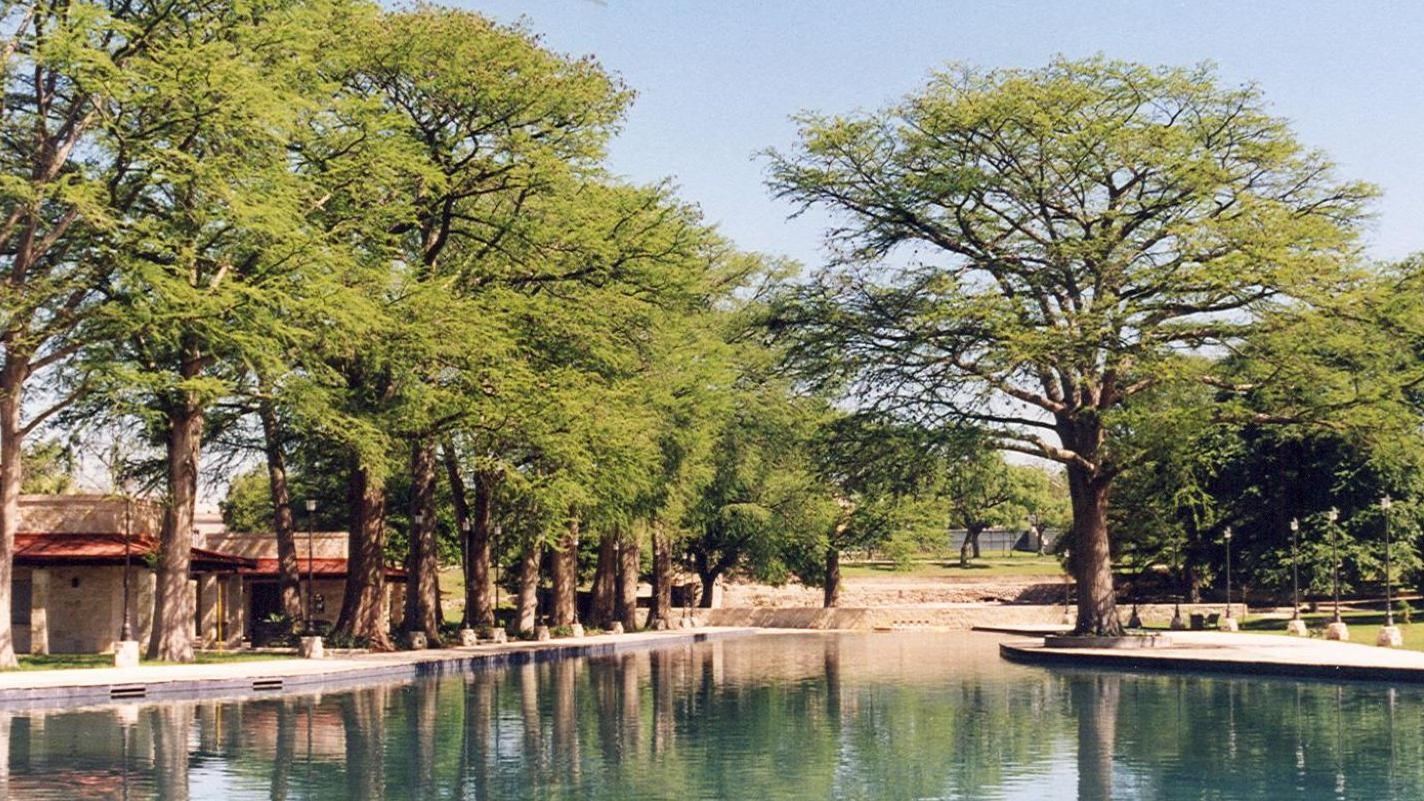
Photo/San Antonio Parks and Recreation
Quick Facts
Location:
in San Pedro Springs Park, 1315 North San Pedro Avenue, San Antonio, Texas
Significance:
The oldest park in Texas, and one of the oldest in the entire nation, San Pedro Springs has deep connections to both American Indian and European settlement in the San Antonio era.
Designation:
Certified Site on El Camino Real de los Tejas NHT.
MANAGED BY:
Amenities
1 listed
Historical/Interpretive Information/Exhibits
San Pedro Springs, a freshwater spring nestled within San Antonio’s San Pedro Park in, is a historic oasis along El Camino Real de los Tejas. For hundreds of years, these waters played a pivotal role in shaping the communities that called and continue to call this place home.
Long before Texas’s colonial period, the Payayas—a Native American nation—settled near the springs at a village known as Yanaguana. Generations lived upon the banks of the spring, taking advantage of the abundance of natural resources like fish and edible plants afforded by these waters.[1]
Spanish settlers would first arrive at San Pedro Springs in 1709. Padre Isidro Félix de Espinosa, leader of an exploratory expedition, described his first sight of the springs: “We crossed a large plain in the same direction, and after going through a mesquite flat and some holm-oak groves we came to an irrigation ditch, bordered by many trees and with water enough to supply a town. It was full of taps and sluices of water, the earth being terraced. We named it Agua de San Pedro….” Like the Payayas before them, the Spaniards recognized the wealth of resources the springs could provide and began planning to create their own permanent settlement on its shores.
After nine years of deliberations with the royal governor, Padre Antonio de San Buenaventuara y Olivares received permission to build a mission among the Payayas of San Pedro Springs.. Soldier Martin de Alarcón was ordered to erect a presidio to protect the nascent mission. Olivares hastily fashioned a makeshift church from vines and underbrush to the west of the springs named San Antonio de Valero; Alarcón and his contingent of thirty-five soldiers built their fort, Presidio San Antonio de Bexar, nearby on the banks of the San Antonio River. These two buildings would become the foundation of the City of San Antonio, with Olivares’ mission eventually moving from the springs to its current location on the San Antonio River, the building known today as “The Alamo.”
The city of San Antonio grew with the arrival of Spanish settlers from the Canary Islands in 1731, necessitating the construction of several acequias, or irrigation canals, to bring water from San Pedro Springs to homes and fields. Two years prior, King Phillip V of Spain had declared the land surrounding the springs an ejido, or piece of public land to be shared by all peoples of San Antonio. When Canary Islanders first arrived in 1731 with no land of their own, they tilled fields on the ejido surrounding San Pedro Springs.[2]
Another chapter in the history of San Pedro Springs began when Texas received statehood in 1845 and large numbers of new American settlers began to arrive in San Antonio and frequent the springs for recreation. The city deemed the springs a public reserve in 1851. Over the next several decades, due in large part to the work of Swiss landscape artist J.J. Duerler, the park developed into the city’s preeminent pleasure ground. Duerler received a lease to operate the park in 1864 and infused the space with Victorian aesthetics popular at the time—stone terraces of lush and exotic greenery, dance pavilions and bathhouses, and even imported swans that lived in ornate, miniature homes. The city of San Antonio took over Duerler’s lease in 1891 and became the permanent operator of the park, continuing to expand recreation activities by adding a zoo in 1910 and a swimming pool in 1922.[3]
Today, many of these leisure centers no longer exist, but visitors to the park can still make use of its tennis center and swimming pool or see a play at the San Pedro Playhouse. The now 40-acre park is the second oldest in the United States, with only the Boston Common being older. It is also a living reminder of city’s history and its relationship with El Camino Real.[4]
Site Information
Location (in San Pedro Springs Park, 1315 North San Pedro Avenue, San Antonio, Texas.)
Available Facilities
Facilities in the park include a swimming pool, tennis courts, a library, and a community theater.
More site information
El Camino Real de los Tejas National Historic Trail
[1] United States Department of the Interior, Heritage Conservation and Recreation Service, “National Register of Historic Places Nomination: San Pedro Springs Park,” November 1, 1979, 2.
[2] Ibid.
[3] Ibid., 3.
[4] Dorothy Steinbomer Kendall Revised by Laurie E. Jasinski, “San Pedro Springs Park,” Handbook of Texas Online, accessed September 29, 2023, https://www.tshaonline.org/handbook/entries/san-pedro-springs-park.