



Last updated: May 12, 2026
Place
Republic of the Rio Grande Museum
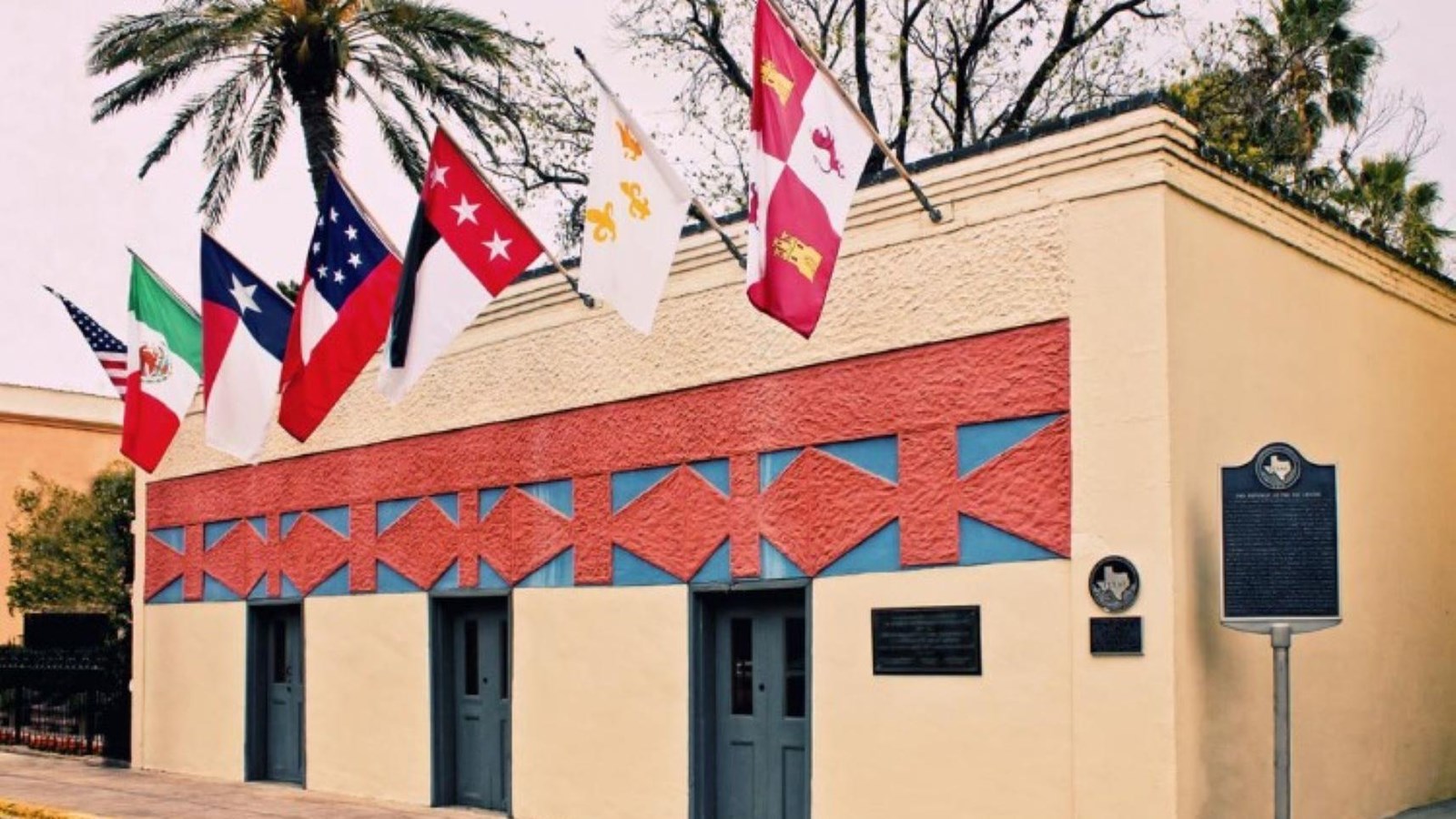
Photo/Webb County Heritage Foundation
Quick Facts
Location:
1005 Zaragoza St., Laredo, Texas 78040, at the southwest corner of San Agustin Plaza.
Significance:
Like the Treviño-Uribe Rancho to its south, this museum tells an important story of the Texas-Mexico borderlands in the decade and a half before Texas' annexation by the United States.
Designation:
NHT Certified Site; State Historic Landmark; contributing structure, San AgustÍn de Laredo Historic District; Historic site on El Camino Real de los Tejas NHT.
MANAGED BY:
Amenities
1 listed
Historical/Interpretive Information/Exhibits
Located in the heart of Laredo, Texas, the Republic of the Rio Grande Museum tells the story of a short-lived republic that emerged along El Camino Real de los Tejas amid the political and military upheaval of the 1830s and 1840s. The story of this short-lived republic, however, began long before. The Spanish settlement of San Agustín de Laredo, founded in 1755, was one of several settlements located along El Camino Real. It grew out of a rancho compound, or ranching headquarters, and served as a town and guard post. Laredo was located at a frequently used Rio Grande crossing, which included ferry service at least as early as 1767 and eventually became the main crossing in the area. With the founding of Villa Dolores and Laredo, traffic on the San Antonio-Laredo Road segment of El Camino Real increased.[1]
El Camino Real facilitated the growth of Laredo’s economy. Ranchers brought cattle along the route and established large ranches south of the settlement. Using the trail to reach their new homes in Texas, Anglo American settlers flooded into the region after Mexico’s independence from Spain in 1821. Seeking more autonomy and resenting Mexico’s abolition of slavery, Anglo American and Tejano settlers formed the Republic of Texas in 1836. As fighting between the nascent Texas Republic and Mexico increased, Laredo found itself contested territory. The continuous instability and lack of protections against raiders along the border led ranchers and other settlers to declare a new nation in 1840, the Republic of the Rio Grande, with Laredo as its capital. The Republic’s founders espoused local control of resources, offering military protection and clearly defined borders to those living in northern Mexico along the Rio Grande.[2]
The Republic of the Rio Grande’s existence was brief. After a Mexican force under General Mariano Arista defeated the Republic’s army at Morales, Coahuila, Republic President Antonio Canales Rosillo traveled to Austin, capitol of newly independent Texas, to raise support. While he was unable to convince Texas President Mirabeau B. Lamar to formally recognize his government, Canales was able to attract numerous new recruits to his army.[3] Despite this, the Republic’s position remained precarious, and its leaders surrendered on November 6, 1840. The Republic had lasted only 283 days.[4]
The end of the Republic of the Rio Grande did not end the contestation of territory along the Rio Grande. Both Mexican and Texan governments claimed Laredo and, in 1842, a Texas military expedition captured and looted the town.[5] During the Mexican-American War, the town was captured by the United States, and the Treaty of Guadalupe Hidalgo formally established the Rio Grande as the international boundary between the United States and Mexico. In the aftermath of the war, many Laredo residents left the town and resettled on the south bank of the Rio Grande, founding Nuevo Laredo, or New Laredo, in order to remain in Mexico.[6]
Today, the Republic of the Rio Grande Museum is located in the former capitol building of the Republic of Rio Grande in Laredo’s downtown San Agustín Historic District. Operated by the Webb County Heritage Foundation, it includes a bilingual exhibit on the Republic and offers a glimpse of day-to-day life in Laredo in the 1840s. The museum’s three restored rooms include an office and sitting area, a bedroom, and a kitchen. The exhibits display pictures, books, and furniture from the Laredo area in the 1800s.[7]
Visitors can also book a guided tour through Laredo’s San Agustín Historic District with the Webb County Heritage Foundation or pick up a self-guided walking tour brochure at the Republic of the Rio Grande Museum.[8]
Site Information
Location (1005 Zaragoza St., Laredo, Texas 78040, at the southwest corner of San Agustin Plaza.)
One of Laredo's oldest structures, the building was constructed in 1830 in the Mexican vernacular style; it features rectangular massing, a flat roof, and few windows.
More site information
El Camino Real de los Tejas National Historic Trail
[1] NPS, El Camino Real de los Tejas National Historic Trail, Comprehensive Management Plan/Environmental Assessment, pp. 27-28, 38, https://npshistory.com/publications/elte/cmp-ea-2011.pdf
[2] Webb County Heritage Foundation, Republic of the Rio Grande, (last accessed September 19, 2024) https://www.republicoftheriogrande.org/
[3] David Vigness, “Republic of the Rio Grande,” Texas State Historical Society, October 1, 1995 (last accessed September 19, 2024), https://www.tshaonline.org/handbook/entries/republic-of-the-rio-grande
[4] Webb County Heritage Foundation, Republic of the Rio Grande, (last accessed September 19, 2024) https://www.republicoftheriogrande.org/; NPS, El Camino Real de los Tejas National Historic Trail, (last accessed September 19, 2024), https://www.nps.gov/places/el-camino-real-de-los-tejas-national-historic-trail.htm
[5] Carlo E. Cueller, “Laredo, TX,” Texas State Historical Association, November 13, 2019, (last accessed on September 19, 2024), https://www.tshaonline.org/handbook/entries/laredo-tx.
[6] Cueller, “Laredo, TX.”
[7] NPS, “Republic of the Rio Grande Museum,” (last accessed September 19, 2024), https://www.nps.gov/places/republic-of-the-rio-grande-museum.htm; Webb County Heritage Foundation, Republic of the Rio Grande Museum, https://webbheritage.org/Republic-of-the-Rio-Grande-Museum; Webb County Heritage Foundation, Unit 3: Preserving the Past (last accessed September 19, 2024), https://www.republicoftheriogrande.org/copy-of-unit-1
[8] Webb County Heritage Foundation, Historic Walking Tour, (last accessed September 19, 2024), https://webbheritage.org/Tours