



Last updated: April 2, 2026
Place
Presidio La Bahía
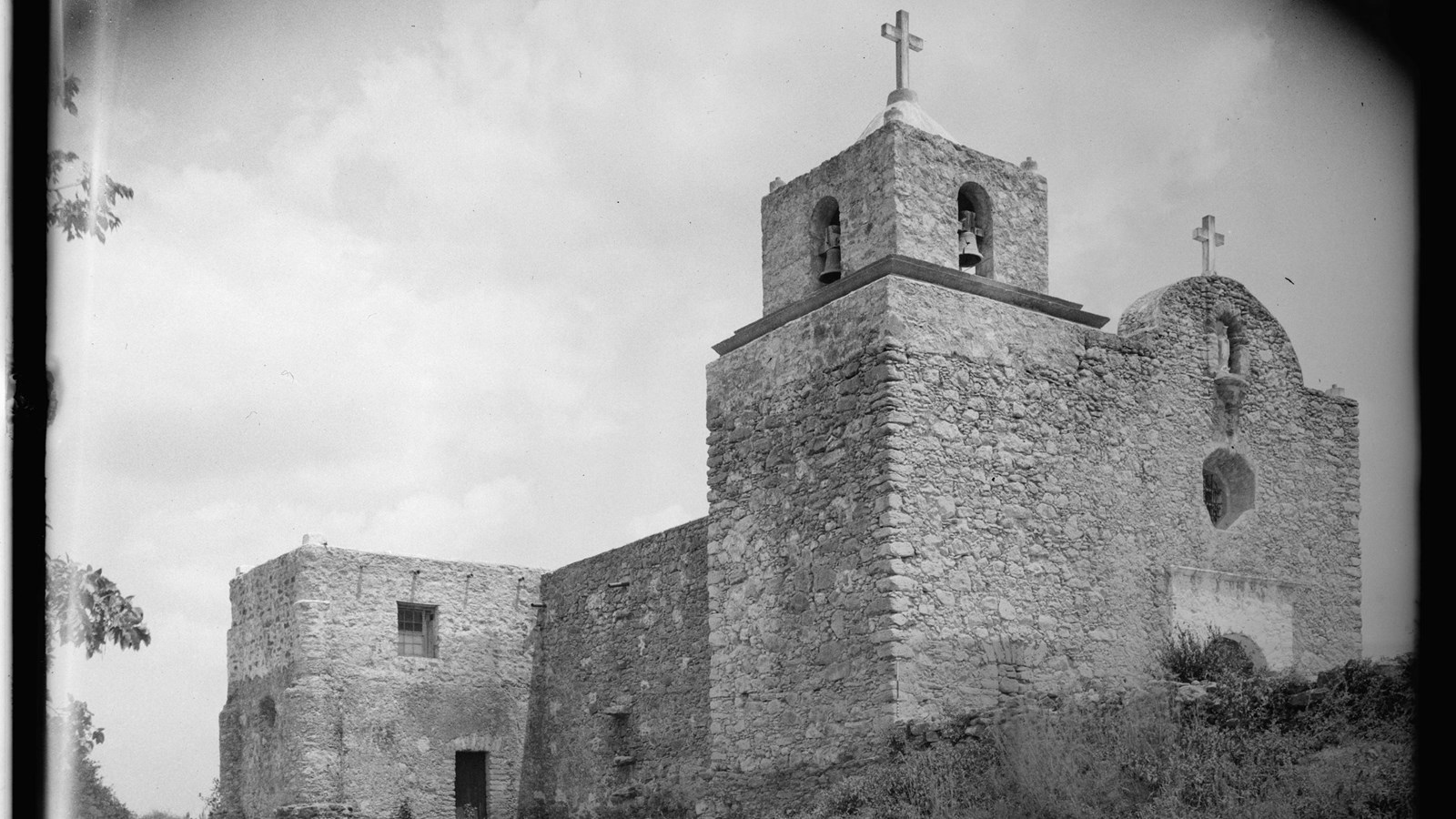
Photo/Library of Congress
Quick Facts
Location:
Presidio La Bahía is across the San Antonio River, 1/4 mile south of the park on U.S. highways 183 and 77A.
Significance:
Presidio La Bahía is one of the world's finest examples of a Spanish frontier fort. It is also the most fought over fort in Texas history, having seen participation in six National Revolutions/Wars for independence. Spanish, Mexican, and Texas soldiers all garrisoned its fortified walls.
Designation:
National Historic Landmark
MANAGED BY:
Amenities
2 listed
Historical/Interpretive Information/Exhibits, Restroom
Presidio La Bahía is a historic fort located in Goliad, Texas, and one of the oldest structures of its kind in North America. The presidio lies in the homeland of the Karankawa people and was a site of protracted conflict, between the Karankawas and Spanish colonizers, between Spanish troops and Mexican revolutionaries, and later, between Mexican soldiers and Texan independence fighters. Under the direction of Spanish colonial governor Marques de San Miguel De Aguayo, Captain Domingo Ramón founded this fort on the banks of the San Antonio River on April 4, 1721. The full name of the settlement is Nuestra Señora de Loreto de La Bahía Presidio – but the site is commonly known now by its shorter name, La Bahía.[1]
The fort sat in the borderlands between French and Spanish imperial aspirations, and the Spanish government hoped that presidios like La Bahía would help stop French incursions into the area. Spanish fortifications were certainly a concern for French settlers and explorers. A report from Juan Antonio de la Peña suggested that St. Denis, French commander in Louisiana and founder of Fort St. Jean de Baptiste in Natchitoches, wanted to attack La Bahía. St. Denis reconsidered upon the arrival of Captain Ramón and the Aguayo Expedition.[2] A translation of Peña’s report details that, “since winter [St. Denis] had gathered to go to take possession of La Bahia del Espiritu Santo, and from there to San Antonio, but that this cloud had disappeared with the coming of the Spaniards.”[3] Presidio La Bahía served in the early 18th century as a critical Spanish outpost, and one that clearly gave French officials such as St. Denis some pause.
The local Indigenous population—the Karankawa people—launched several attacks on the fort in response Spanish attempts at political domination and religious conversion. On December 23, 1723, a Karankawa uprising resulted in the death of Captain Ramón, the founder of Presidio La Bahía.[4] Over the decades that followed, Presidio La Bahía went through multiple changes in leadership and acted primarily as a defensive outpost and home to Spanish soldiers, missionaries, and colonial officials. At one point, Presidio La Bahía served as the Gulf Coast's lone defense against French incursion.[5] Following Mexican independence from Spain in 1821, the presidio’s function became the defense of a new nation.
The Texas Revolution (1835-1836), the conflict that pitted Anglo-Texan and Tejano settlers against the Mexican government and its Tejano loyalists, presented a new chapter in the history of Presidio La Bahía. In 1836, after Texan soldiers had captured the fort and taken up a defensive position, Mexican forces surrounded La Bahía and forced the Texans to surrender. Of the more than 400 Texans who did so, it is estimated that at least 342, including their commander, James W. Fannin, were executed by firing squad on March 27, 1836.[6] The Goliad Massacre, as it became known, devastated the Texan army, but, like the Alamo, motivated Texan soldiers to continue fighting. News brought from survivors and witnesses of the atrocities at Goliad also transformed public opinion within the United States and garnered new support for the Texan cause.[7]
In the 1960s, a reconstruction of the historic presidio became a popular tourist destination. Visitors today will notice the thick stone walls of the chapel at Presidio La Bahía, as well as the arch façade and pyramid-shaped roof.[8] Preserved intact form the colonial period, the presidio’s chapel dates back to the late 18th century.[9] The memory of the 1836 Goliad Massacre also lives on at La Bahía.[10] Several thousand visitors congregate at the presidio each March to commemorate the lives lost. Living history presentations such as reenactments of the Texas Revolution, including historical interpreters speaking the vernacular of the time, are part of these annual events in Goliad. The historic site also includes the Fannin Memorial, which marks the resting place of those killed in the tragedy. Archaeological discoveries at the site include artifacts of Indigenous, French, and Spanish origin, some of which can be viewed at the Presidio La Bahía Historic Site museum in Goliad, Texas.
Site Information
Location (217 Loop 71 Goliad, Texas 77963)
The restored Presidio sits on the footprint of the original fort with original portions of the historic structures. Our Lady of Loreto chapel is the only completely original structure on site and dates to 1779.
Safety Considerations
More Site Information
El Camino Real de los Tejas National Historic Trail
[1] Craig H. Roell, “Nuestra Señora de Loreto de la Bahia Presidio,” Handbook of Texas Online, accessed December 1, 2023, https://www.tshaonline.org/handbook/entries/la-bahia.
[2] Eleanor Claire Buckley, “The Aguayo Expedition into Texas and Louisiana, 1719-1722,” The Quarterly of the Texas State Historical Association, Jul., 1911, Vol. 15, No.1 (Jul., 1911), p. 45.
[3] Ibid.
[4] Donald E. Chipman, “Ramón, Domingo,” Handbook of Texas Online, accessed December 1, 2023, https://www.tshaonline.org/handbook/entries/ramon-domingo
[5] Roell, “Bahia Presidio,” https://www.tshaonline.org/handbook/entries/la-bahia.
[6] Craig H. Roell and Harbert Davenport, “Goliad Massacre,” Handbook of Texas Online, accessed December 1, 2023, https://www.tshaonline.org/handbook/entries/goliad-massacre.
[7] Ibid.
[8] “Presidio Nuestra Senora de Loreto de la Bahia,” National Register of Historic Places Inventory – Nomination Form, (Washington, D.C: U.S. Department of Interior, 1977), p. 2.
[9] Ibid.
[10] Ibid., 136.