



Last updated: April 29, 2026
Place
Paso de Sabinitas
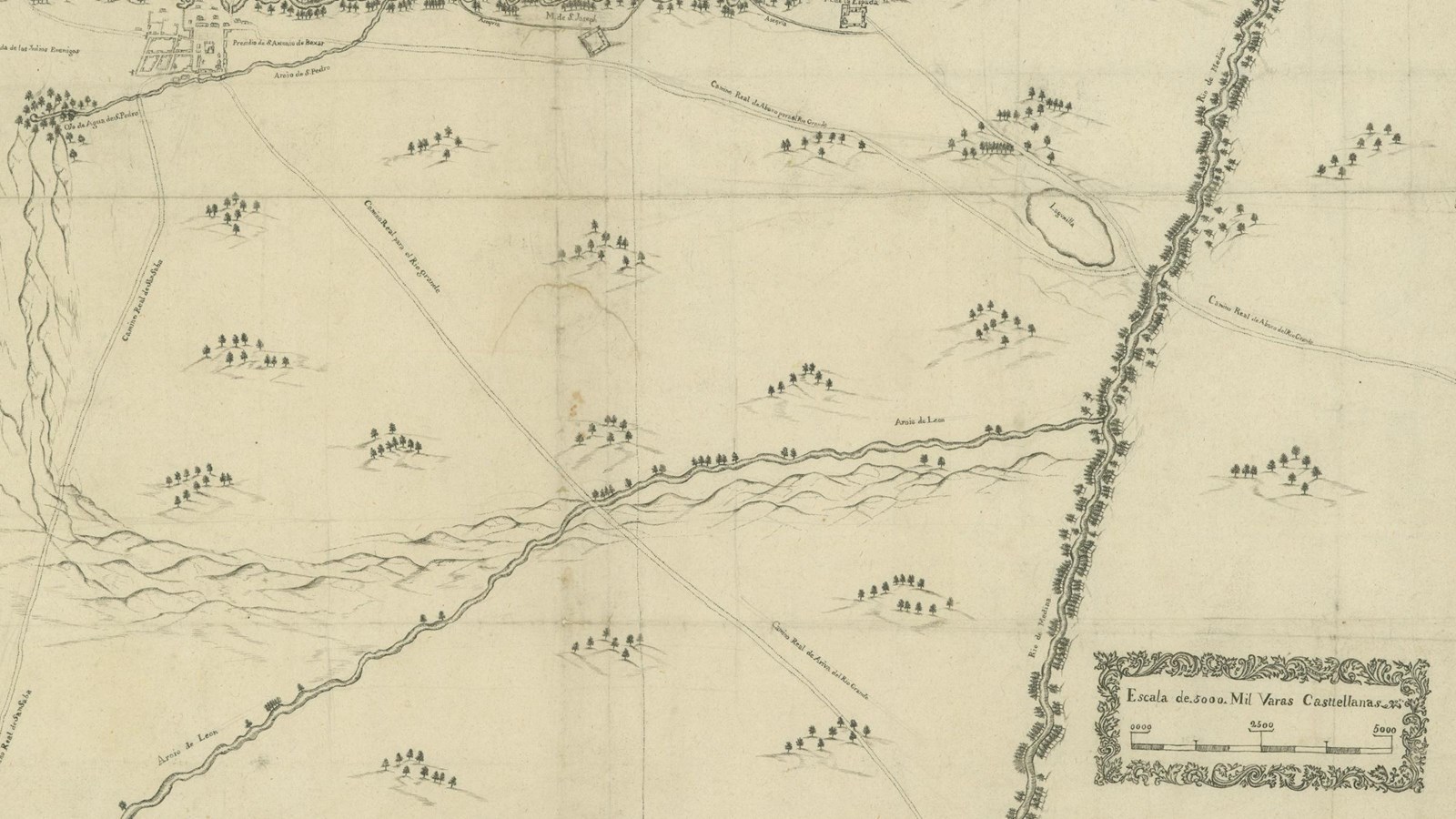
Photo/John Carter Brown Library
Quick Facts
Location:
in the Medina River Natural Area, approximately 500 feet east of Palo Alto Road (State Highway 16), San Antonio, Texas
Significance:
Paso de Sabinitas is another fine example of a river ford along a tributary of the San Antonio River.
Designation:
certified site; state archeological landmark
MANAGED BY:
Amenities
1 listed
Historical/Interpretive Information/Exhibits
The Paso de Sabinitas, also known as the Palo Alto Crossing, is a crossing at the Medina River on El Camino Real de los Tejas south of San Antonio, Texas. While the crossing itself has been in use for thousands of years, San Antonio landowner Melchor de la Garza gave the site its current name during the 18th century, during the Spanish colonial period.[1] The land later became the property of the Anglo-American Jett Family.[2] Paso Sabinitas also lies near the historic Pérez family ranch site.[3]
The Paso de Sabinitas is located within the homeland of the Payaya people, who are part of the Tāp Pīlam Coahuiltecan Nation.[4] The Payaya are one of the many Coahuiltecan groups whose ancestral land spans from today’s Texas across the border into northern Mexico.[5] The Medina River and its crossing at Paso de Sabinitas would have been right at the heart of exchanges between the Payaya people and Spanish colonizers and missionaries, as well as with other Indigenous populations that migrated south into this territory, including the Comanche people.
The area surrounding the Medina River has a long history of contestation, between Native people and Spanish settlers and, later, between the Spanish and Mexican governments and Texan independence fighters. In August 1813, as the Mexican War of Independence raged, an alliance of Mexican revolutionaries, Anglo-Texans, and Native Americans faced off against Spanish royal forces at the bloody Battle of Medina.[6] The deadliest battle in Texas’s history, it was a resounding victory for the royalists, who murdered many of the rebels as they attempted to escape.[7]
Archeological research by Southern Methodist University and Texas A&M University has revealed further details about the history of Paso de Sabinitas.[8] One study identified shards of ceramic, tin, and glass on the southern side of the river crossing, which date back to the Spanish colonial period.[9] The Paso de Sabinitas site also included coiled pottery produced by local Indigenous peoples.[10] The presence of people at the site probably goes back millennia, but soil erosion has led to the disappearance of the prehistoric and protohistoric artifacts that might shed light on this older period in the long history of Paso de Sabinitas.[11]
The Medina River continues to flow through Paso de Sabinitas.[12] Travelers still pass through the area, using Texas State Highway 16/Palo Alto Road to cross the river. Visitors can interact with the site and its history by walking or riding the many scenic hiking and biking trails along the Medina River near the Palo Alto Road bridge. The original ford, or shallow crossing in the river, can be seen about one-tenth of a mile to the east of Highway 16. Nearby, visitors can find other historic sites along the Medina River, such as the Rancho de Pérez historic dwelling and the Dolores-Applewhite Crossing—both along El Camino Real de Los Tejas.[13]
Site Information
Location (in the Medina River Natural Area, approximately 500 feet east of Palo Alto Road (State Highway 16), San Antonio, Texas)
More site information
El Camino Real de los Tejas National Historic Trail
[1] Antonia L. Figueroa and Steve A. Tomka, “Archaeological Survey of the Proposed Medina River Park,” (Report No. 345, Center for Archaeological Research, The University of Texas at San Antonio, 2004), 8; “El Camino Real de los Tejas National Historic Trail, Comprehensive Management Plan/Environmental Assessment: Louisiana & Texas,” (U.S. Dept. of Interior, National Park Service, September 2011), 169.
[2] “El Camino Real de los Tejas National Historic Trail, Comprehensive Management Plan/Environmental Assessment: Louisiana & Texas,” (U.S. Dept. of Interior, National Park Service, September 2011), 169.
[3] Kristi M. Ulrich, Jennifer L. Thompson, et. al., “Testing and Data Recovery at the Pérez Ranch (41BX274), San Antonio, Bexar County, Texas,” (Report, Center for Archaeological Research, The University of Texas at San Antonio, 2010), 6.
[4] “Indigenous Tribes of San Antonio, Texas,” American Library Association, October 12, 2021, (https://www.ala.org/aboutala/indigenous-tribes-san-antonio-texas), accessed December 11, 2023
[5] Ibid.
[6] See Robert H. Thonhoff, “Medina, Battle Of,” Handbook of Texas Online(http://www.tshaonline.org/handbook/online/articles/qfm01), accessed December 11, 2023 (Texas State Historical Association); Lena L. Sweeten McDonald and Tony Scott, “Historic Resources of El Camino Real de los Tejas National Historic Trail,” (United States Department of the Interior, National Park Service, National Register of Historic Places Multiple Property Documentation Form, October 2011), Section E, 22.
[7] Ibid.
[8] Figueroa and Tomka, “Archaeological Survey,” 8
[9] Ibid.
[10] David D. Turner, “Goliad State Historical Park,” Handbook of Texas Online (https://www.tshaonline.org/handbook/entries/goliad-state-historical-park), accessed December 11, 2023 (Texas State Historical Association).
[11] Figueroa and Tomka, “Archaeological Survey,” 36.
[12] Ibid.
[13] Lena L. Sweeten McDonald and Tony Scott, “Historic Resources of El Camino Real de los Tejas National Historic Trail,” (United States Department of the Interior, National Park Service, National Register of Historic Places Multiple Property Documentation Form, October 2011), Section 7, 1.