



Last updated: April 7, 2026
Place
Nacogdoches Convention and Visitors Bureau
NPS Photo
Quick Facts
Location:
200 East Main Street, Nacogdoches, TX 75961
Significance:
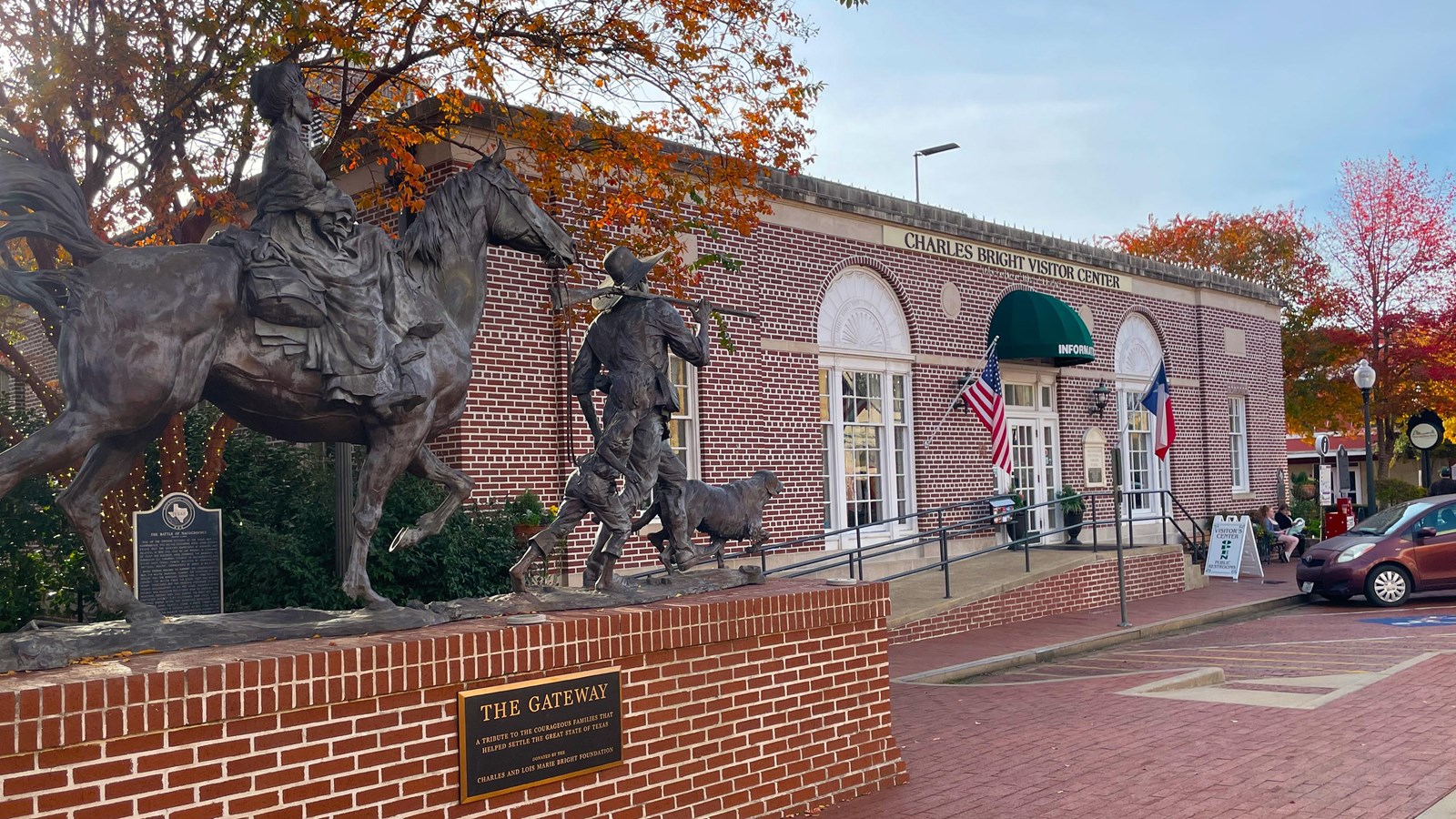
Situated along the historic route of El Camino Real de Los Tejas (today's Main Street), in historic downtown Nacogdoches, the Visitor Information Center offers exhibits on local trail history and provides information on visiting historic sites in the area.
MANAGED BY:
Amenities
6 listed
Historical/Interpretive Information/Exhibits, Information - Maps Available, Parking - Auto, Restroom - Accessible, Water - Drinking/Potable, Wheelchair Accessible
Known as the “Oldest Town in Texas,” the history of Nacogdoches stretches back 12,000 years, encompassing Indigenous, Spanish, French, Mexican, and American stories. For much of its past, El Camino Real de los Tejas linked the town to other communities and facilitated the movement of traders, travelers, soldiers, settlers, and government officials. In the process, the Royal Road transformed the city into a commercial hub. Today, orientation information and exhibits at the Charles Bright Visitor Center at the Nacogdoches Convention and Visitors Bureau describe the history of Nacogdoches and El Camino Real.
Since at least 10,000 B.C.E., people have lived in the area now known as Nacogdoches.[1] The site was associated with Caddoan people as early as 700 BC and, by approximately 1350 AD had become a distinct Caddoan town. As in other Caddoan communities, the Nacogdoche constructed several large earthen mounds that served as both cultural and religious centers. Several of these mounds were located at present-day Washington Square.[2]
The Nacogdoche encountered Spanish explorers in 1528, followed by French explorers around 1685.[3] In the early 1700s Franciscan missionaries established several Spanish missions in the area, including Nuestra Señora de Guadalupe de los Nacogdoches.[4] The missions, however, struggled from a lack of local converts and to contend with the threat of attack from French Louisiana. After France ceded control of Louisiana to Spain following the Seven Years’ War, however, Spain no longer needed a presence along the Louisiana-Texas border. Spanish authorities ordered the missions and settlers to relocate to San Antonio in the early 1770s.[5]
In 1779, a group of Spanish settlers led by Antonio Gil Ibarvo reoccupied the lands surrounding the Caddoan village and abandoned mission structures.[6] Since much of the land had already been cleared, Ibarvo and his fellow settlers decided to stay. By 1800, many of the Nacogdoche had perished from disease or warfare. Others assimilated into the Spanish settlement or joined other Indigenous groups.[7]
Because of its location on the border of Texas and French-controlled Louisiana, Nacogdoches became a hub of trade. A network of routes built by the Nacogdoche and expanded by Spanish traders connected Nacogdoches to El Camino Real, facilitating trade with other parts of Texas and Mexico. The town was the site of several revolts against the Spanish Empire, including in 1812 when American Augusta William Magee and Mexican revolutionary José Bernardo Maximiliano Gutiérrez de Lara declared Texas independent. In response, Spanish General Joaquin de Arredondo marched on Nacogdoches and sacked the town.[8]
After the Mexican War of Independence, large numbers of Anglo-American settlers from the United States travelled westward along El Camino Real from Louisiana into Texas, some choosing to settle in Nacogdoches.[9] Tensions with Mexican authorities in this period led to several uprisings in the growing town. During the Fredonian Revolt against the Mexican government, the rebels made Nacogdoches their command center but fled to the United States when the Mexican Army advanced on the town.[10] In 1832, the Mexican garrison clashed with local militia in the Battle of Nacogdoches, one of the earliest events in the Texas Revolution. Victorious, the Texan militia expelled the Mexican forces from much of East Texas.[11] In 1838, Nacogdoches resident Vicente Cordova launched a pro-Mexican revolt to try and return Texas to Mexico.[12] The revolt failed, and Cordova fled to Mexico.[13]
After Texas independence in 1836 and U.S. statehood in 1845, travelers continued to use El Camino Real to reach Nacogdoches. However, the city’s economy stagnated. After the 1882 construction of a railroad to Nacogdoches, the city rebounded as a center of trade. Nacogdoches grew steadily, although it did not experience the large population growth of cities like Dallas, Houston, and San Antonio.[14]
In 1918, the United States government built a new post office in Nacogdoches.[15] In 1973, the government sold the property, no longer used to store and sort mail, to the City of Nacogdoches, which turned it into a public library. In the late 1990s, the Nacogdoches Convention and Visitors Bureau transformed it into a visitor center.
Today, the Charles Bright Visitor Center tells the story of the town’s rich history and cultures. Exhibits explain Nacogdoches’ complex past, and information is available for planning visits to the area. Outside, a sculpture titled “The Gateway” represents the Anglo-American settlers who traveled to Texas on El Camino Real.[16] The visitor center is open seven days a week, with shorter hours on weekends.
Site Information
Location (200 East Main Street, Nacogdoches, TX 75961; Located in the Charles Bright Visitor Center, along East Main Street/El Camino Real de Los Tejas, in historic downtown Nacogodoches.)
More site information
El Camino Real de los Tejas National Historic Trail
[1] Jere L. Jackson, “A Brief History of Nacogdoches,” Stephen F. Austin State University, https://www.sfasu.edu/story/Nacogdoches/nac-history.html (accessed on November 1, 2024).
[2] Jackson, “A Brief History of Nacogdoches.”
[3] Jackson, “A Brief History of Nacogdoches.”
[4] Archie P. McDonald, “Nacogdoches, TX,” Texas State Historical Association, https://www.tshaonline.org/handbook/entries/nacogdoches-tx (accessed on November 1, 2024).
[5] McDonald, “Nacogdoches, TX;” Harriett Denise Joseph and Donald E. Chipman, “Spanish Texas,” Texas State Historical Association, August 25, 2023, https://www.tshaonline.org/handbook/entries/spanish-texas (accessed on December 6, 2024).
[6] McDonald, “Nacogdoches, TX.”
[7] Thomas N. Campbell, “Nacogdoche Indians,” Texas State Historical Association, https://www.tshaonline.org/handbook/entries/nacogdoche-indians (accessed on December 9, 2024).
[8] McDonald, “Nacogdoches, TX.”
[9] Christopher Long, “Nacogdoches County,” Texas State Historical Association, updated December 17, 2020, https://www.tshaonline.org/handbook/entries/nacogdoches-county (accessed on December 10, 2024).
[10] Archie P. McDonald, “Fredonian Rebellion,” Texas State Historical Association, https://www.tshaonline.org/handbook/entries/fredonian-rebellion (accessed on November 1, 2024).
[11] Archie P. McDonald, “Nacogdoches, Battle of,” Texas State Historical Association, https://www.tshaonline.org/handbook/entries/nacogdoches-battle-of (accessed on November 1, 2024).
[12] Robert Bruce Blake, “Córdova, Vicente,” Texas State Historical Association, https://www.tshaonline.org/handbook/entries/cordova-vicente (accessed on November 2, 2024); Rebecca J. Herring, “Cordova Rebellion,” Texas State Historical Association, updated August 4, 2020, https://www.tshaonline.org/handbook/entries/cordova-rebellion (accessed on December 9, 2024).
[13] Herring, “Cordova Rebellion.”
[14] McDonald, “Nacogdoches, TX”; Christopher Long, “Nacogdoches County”; ”History of Nacogdoches,” City of Nacogdoches, https://www.nactx.us/601/History-of-Nacogdoches (accessed on December 10, 2024).
[15] “Charles Bright Visitor Center History,” Visit Nacogdoches, https://www.visitnacogdoches.org/p/about/history/charles-bright-visitor-center-history (accessed on November 1, 2024).
[16] “Charles Bright Visitor Center History,” Visit Nacogdoches; Emily Smith, “The Gateway,” East Texas History, https://easttexashistory.org/items/show/313 (accessed on December 10, 2024).