



Last updated: June 11, 2026
Place
Mule Spring, Truckee Route
By Jerry Martini
Quick Facts
Location:
Mule Spring Rd, Nevada Co., California. Access can be difficult and visitors are encouraged to travel with a knowledgeable guide.
Significance:
Struggling through deep snow, the 1847 Donner relief parties left horses and food at this campsite before continuing on foot to reach the emigrants stranded east of Donner Summit. After hiking this far in their weakened condition, the rescued emigrants were able to ride from Mule Spring to the safety of Johnson’s Rancho.
Designation:
Nevada County Registered Historical Landmark; Historic site on the California NHT.
MANAGED BY:
Bureau of Land Management
Amenities
2 listed
Historical/Interpretive Information/Exhibits, Scenic View/Photo Spot
Travelers on the Truckee Route of the California Trail often camped at Mule Spring, perched high above Bear River on the west slope of McGuire Mountain in the Sierra Nevada. The site experienced peak emigrant use from 1848 to 1852, when improved roads diverted traffic to other routes. During the gold rush years, some treasure seekers fanned out from Mule Spring to try their luck in the gold fields. Others continued to Johnson’s Rancho, about 45 miles west of the spring, and then to Sacramento to outfit for their mining adventure.
Mule Spring figured importantly in the rescue efforts for the Donner-Reed Party, trapped by deep snow east of Donner Summit over the winter of 1846-1847. The first party of rescuers, known as the First Relief, started into the mountains from Johnson’s Rancho near present Wheatland, CA, on Feb. 4, 1847. On the sixth day of travel, their horses and pack mules floundered in chest-deep snow, forcing a halt at Mule Spring. The men cached most of their provisions there and sent one man back to Johnson’s with the pack mules. Leaving a couple boys in camp to guard the supplies and remaining horses, 7 rescuers continued on wearing homemade snowshoes, lugging 50- to 75-pound packs of dried beef and flour through ever-deepening snow. They reached the starvation camp on Feb. 21, the same day the Second Relief started from Johnson’s Rancho.
The First Relief brought 18 survivors from the starvation camps into the Mule Spring camp on March 2-3.
“We stayed a day or so, getting the horses and mules ready to ride,” wrote 13-year-old Virginia Reed. “No more dragging over the snow, when we were tired, so very tired, but green grass, horses to ride, and plenty to eat.”
They rode the remaining 45 miles to safety at Johnson’s Rancho.
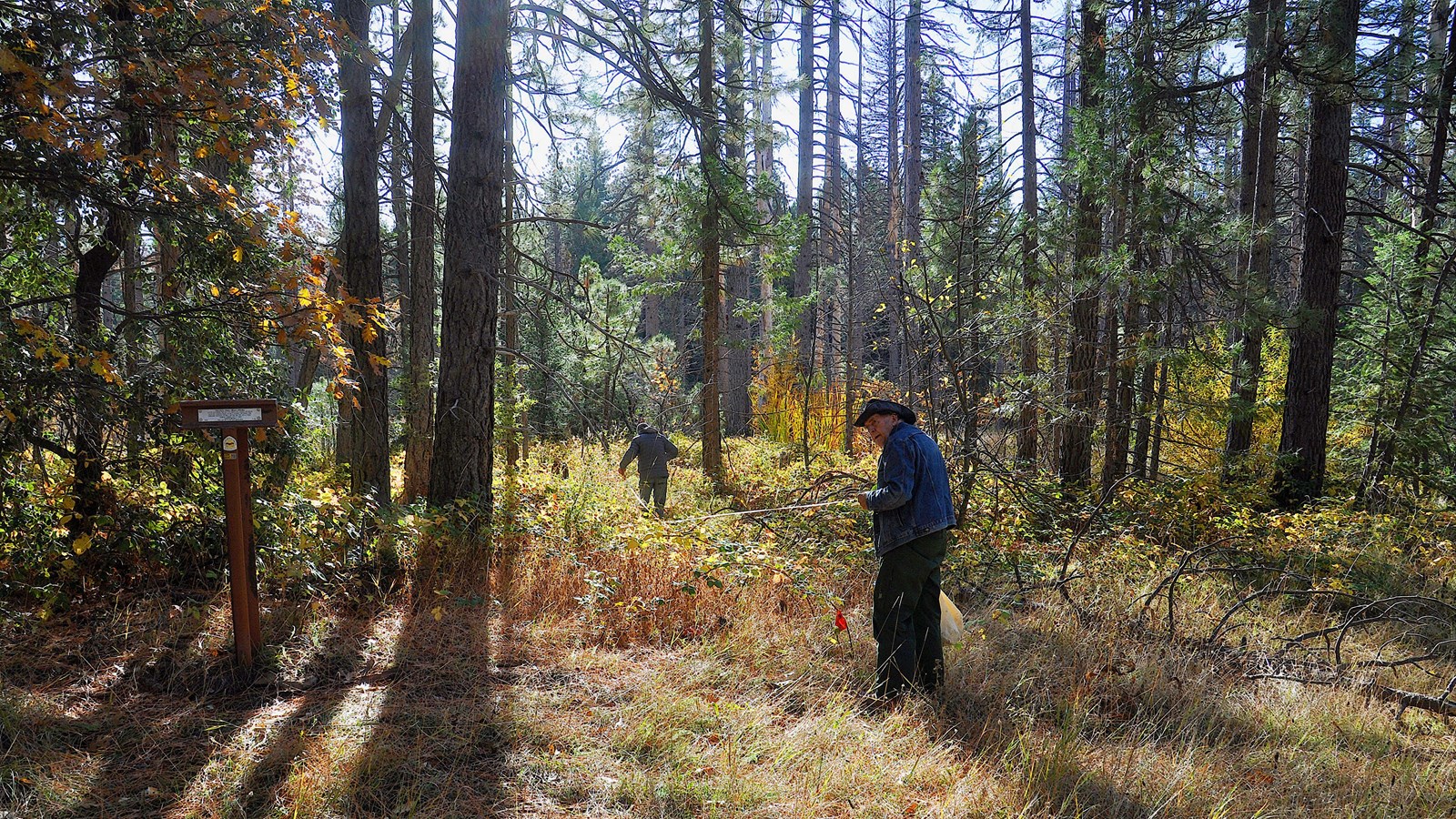
Mule Spring continued to serve as a base camp and staging area for the remainder of the rescue effort, which continued through mid-April, 1847. Today’s visitors to the site will find a t-shaped trail marker and a clear spring that is partially protected by a covering of weathered planks.
Because Mule Spring can be difficult to find, visitors are encouraged to travel with a guide who knows the way. The site lies on public lands about 3 1/2 miles northeast of Dutch Flat and is accessed by a network of unsigned, unpaved, and largely unmaintained roads passable to vehicles with high clearance and 4-wheel drive. From the end of Mule Spring Rd, visitors must park and walk through forest, brush, fallen trees, and marshy ground to find the spring.
Site Information
Location (Mule Spring Rd., Nevada County, California.)