



Last updated: September 30, 2026
Place
Cowpens Audio Tour Stop 2: Morgan's Flying Army
NPS
In December 1778, the British staged a successful invasion of the South. Landing on the Georgia coast, King George’s armies won decisive victories over patriot forces in Georgia. The victorious British carried their military success into South Carolina, where they scored major victories at Charleston, Waxhaws, and Camden. By the fall of 1780, only a shattered remnant of the Continental Army remained in the Southern States. Into the breach of defeat stepped two monumental American commanders, Major General Nathanael Greene and newly promoted Brigadier General Daniel Morgan.
Daniel Morgan’s leadership was instrumental in several battles in the early years of the American Revolution, especially in the October 1777 American victory at Saratoga, New York. Feeling he deserved a promotion to Brigadier General for his role in the battle, he was passed over for promotion. Unfortunately, Morgan resigned from the Continental Army in the spring of 1779 and went home to Winchester, Virginia. After major defeats in the South and pressure from his former comrades, Congress granted Morgan his well-earned promotion. He was sent south and joined General Nathanael Greene’s Southern Army in the fall of 1780.
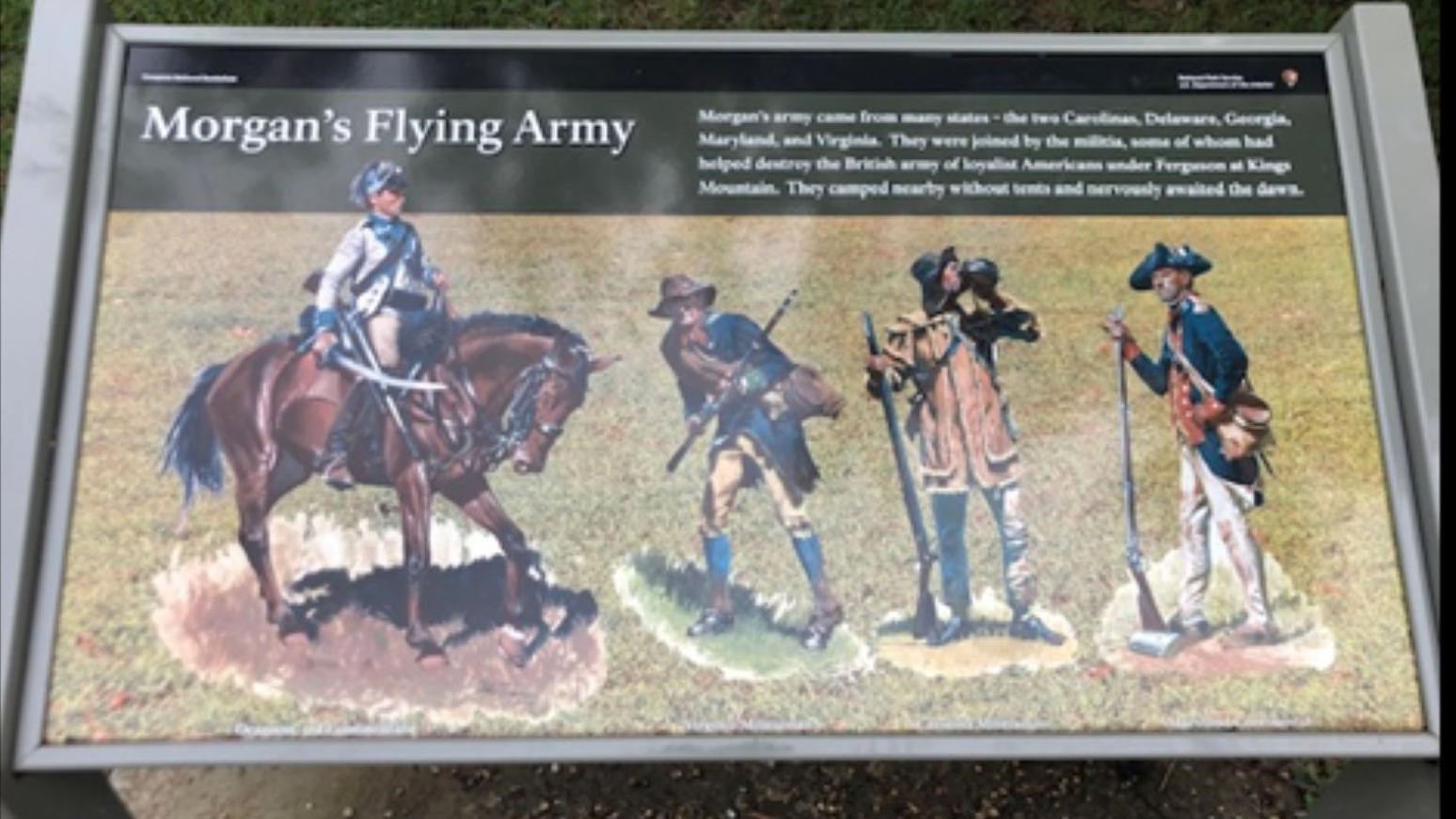
General Greene took command of the Southern Army, which numbered around 2300 men. However, only 1400 of the men were fit for duty. Greene could only muster around 900 Continental troops. The army lacked men, supplies, food, tents, uniforms, and was riddled with diseases, like smallpox. The Americans were outnumbered, out-supplied, and out-gunned by General Lord Charles Cornwallis’s British forces, which totaled around 7000 men. Against all military doctrine, and out of near desperation, Greene split his small force into two parts and gave command of a “flying army” to General Morgan.
The solid core of Morgan’s small Army was 300 officers and men from the Maryland and Delaware Continental Infantry, commanded by Lieutenant Colonel John Eager Howard. Lieutenant Colonel William Washington commanded 82 troopers from the 3rd Continental Light Dragoons. Augmenting the professional Continental soldiers were state troops from North Carolina, South Carolina, and Virginia. Local militia companies from Georgia, the Carolinas, and Virginia joined Morgan’s army as it moved into the South Carolina backcountry. By the morning of the battle, January 17, 1781, Morgan had a force of around 1000- 1500 troops.