



Last updated: April 7, 2026
Place
Montopolis Bridge
Photo/Larry D. Moore
Quick Facts
Location:
Austin, Texas
Significance:
The bridge sits at the best river crossing in the area
Designation:
National Register of Historic Places
MANAGED BY:
Amenities
1 listed
Historical/Interpretive Information/Exhibits
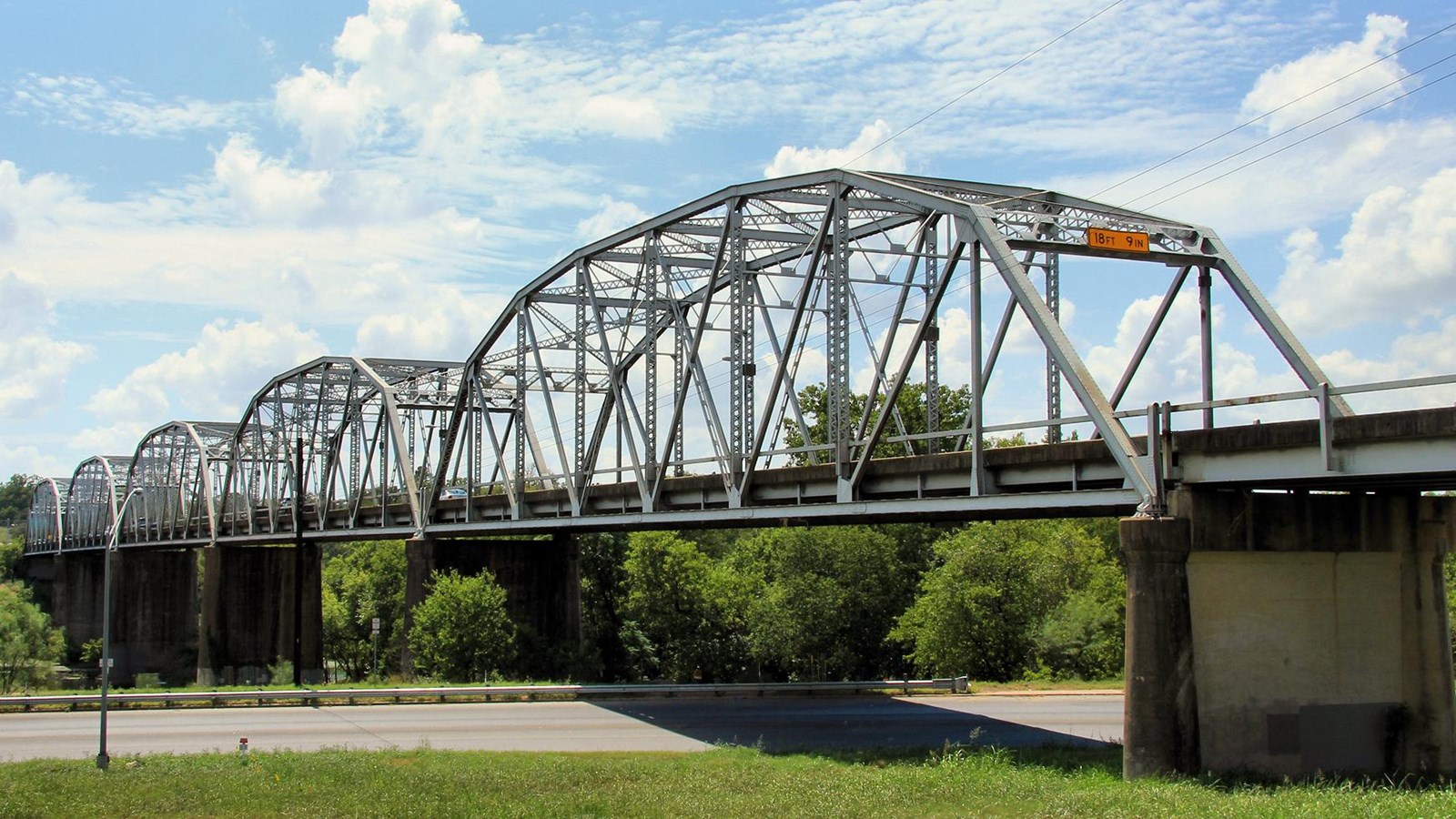
The Montopolis Bridge is a 1,221-foot steel truss structure that crosses the Colorado River just north of the Montopolis neighborhood outside of Austin, Texas. Though the bridge seen today was built in the late 1930s, this site has long been a throughfare for people, animals, and goods traveling through Travis County and along El Camino Real de los Tejas.
Long before any bridge was built on this site, Indigenous tribes and European settlers used the area to cross the Colorado River. In 1832, Jessie Cornelius Tannehill settled along the north bank with the aim of creating a town. He named the area Montopolis, a “city on a hill,” and designed plots for homes, farms, and churches. Across the river on the south bank, Santiago del Valle acquired 35,000 acres and sold parcels to settlers who established small cotton plantations and cattle ranches.[1] Around this time, residents of the two communities often utilized ferries to cross the river.[2] When a wooden bridge near Austin used to transport cattle across the state collapsed, cattle drivers used the future site of the Montopolis Bridge as a relatively shallow alternate crossing for their herds.
By the 1880s, Travis County officials contracted for the construction of a bridge at Montopolis. Designed by John Andrewartha, an Austin architect and civil engineer, the original bridge consisted of a wooden bridge deck and a square steel truss.[3] Despite some controversy concerning the bridge’s height during development, engineers and other bridge experts considered it a “first-class structure” when it opened.[4] It attracted a lot of use, especially among the local farmers. A few weeks after it opened, an observer counted as many as 370 vehicles and horsemen crossing the bridge in a day.[5]
The original Montopolis Bridge remained in use until tragedy struck on June 15, 1935. At approximately 11 am, torrential flood waters tore the bridge off its foundations. Local proprietor Eugene Howard observed: “The water swept the bridge away in about two minutes. You could see the steel structures twist off and sink and the boarding float off down the river.”[6] It was one of five bridges destroyed by the flooding.[7] The collapse cut off an important commercial transportation route into Austin, presenting problems for farmers bringing their crops to market.[8]
To solve this issue, the Texas Highway Department immediately requested federal emergency relief funds to cover construction of a new truss bridge – the Montopolis Bridge seen today.[9] One of only two five-span bridges in Texas and the most decorative of any Texas Highway Department bridge, the new structure featured a concrete foundation, steel Parker truss, and pedestrian walkway with a decorative steel railing. Construction by the Vincennes Steel Company began on February 15, 1937, and cost approximately $232,000. Emergency funds from the federal government covered half of the cost, and the bridge opened to traffic on February 12, 1938, as part of State Highway 71. Soon, with the rerouting of roads, it would become a crucial high-water connection for State Highway 29 and US Route 183. It provided automobile access to Austin, Lockhart, Bastrop, La Grange, and the Bergstrom Air Force Base (later the Austin-Bergstrom International Airport). In the early 1960s, increased traffic along this route prompted the Texas Highway Department to declare the bridge a one-way, southbound road. When routes were further adjusted in 1995 to accommodate traffic, the Montopolis Bridge transitioned from a main highway route to a frontage road. Though tens of thousands of cars still crossed the bridge each day, this move lightened the strain on the bridge.[10]
For eight decades, the new Montopolis Bridge provided a thoroughfare for cars and trucks to cross the Colorado River and move people and goods along the historic El Camino Real de los Tejas. In 1996, it was added to the National Register of Historic Places.[11] It remained operational until 2018, when it was converted to a bicycle and pedestrian-only pathway. Visitors to the bridge today can bike, walk, or run across the historic structure and consider all the people over the years who made this same crossing.
Site Information
Location (Austin, Texas)
Access
The bridge is open only to cyclists and pedestrians as part of the new hike and bike trail. The path will connect users to multiple trails and parks in Austin. Follow the Camino on foot or bike – using only feet and wheels as travelers did for 300 years when it was the royal road. After all, history and exercise can go hand in hand.
More site information
El Camino Real de los Tejas National Historic Trail
[1] Fred L. McGhee, Austin’s Montopolis Neighborhood (Arcadia Publishing, 2014), 7; Denny, Richard and Lanny Ottosen, “Montopolis, TX,” Handbook of Texas Online, accessed September 9, 2024, https://www.tshaonline.org/handbook/entries/montopolis-tx.
[2] McGhee, Austin’s Montopolis, 16.
[3] Long, Christopher, “Andrewartha, John,” Handbook of Texas Online, accessed September 9, 2024, https://www.tshaonline.org/handbook/entries/andrewartha-john
[4] “Montopolis Bridge,” Austin Weekly Statesmen, April 25, 1889, 2-4; “The Montopolis Bridge,” Austin Weekly Statesmen, October 24, 1889, 3; “Montopolis Bridge,” Austin American-Statesmen, November 21, 1890, 3.
[5] “Montopolis Bridge,” Austin American-Statesmen, November 21, 1890, 3.
[6] “Mighty Rush of Water Sweeps Out Montopolis Bridge Like Kindling Wood,” Austin American-Statesmen, June 16, 1935, 4.
[7] United States Department of the Interior, “National Register of Historic Places: Montopolis Bridge,” September 1996, accessed September 9, 2024, https://catalog.archives.gov/id/40970358.
[8] Ibid., p. 10.
[9] Ibid., p. 10
[10] Ibid.
[11] Ibid.