



Last updated: April 9, 2026
Place
Mission San Antonio de Valero 3rd Site The Alamo
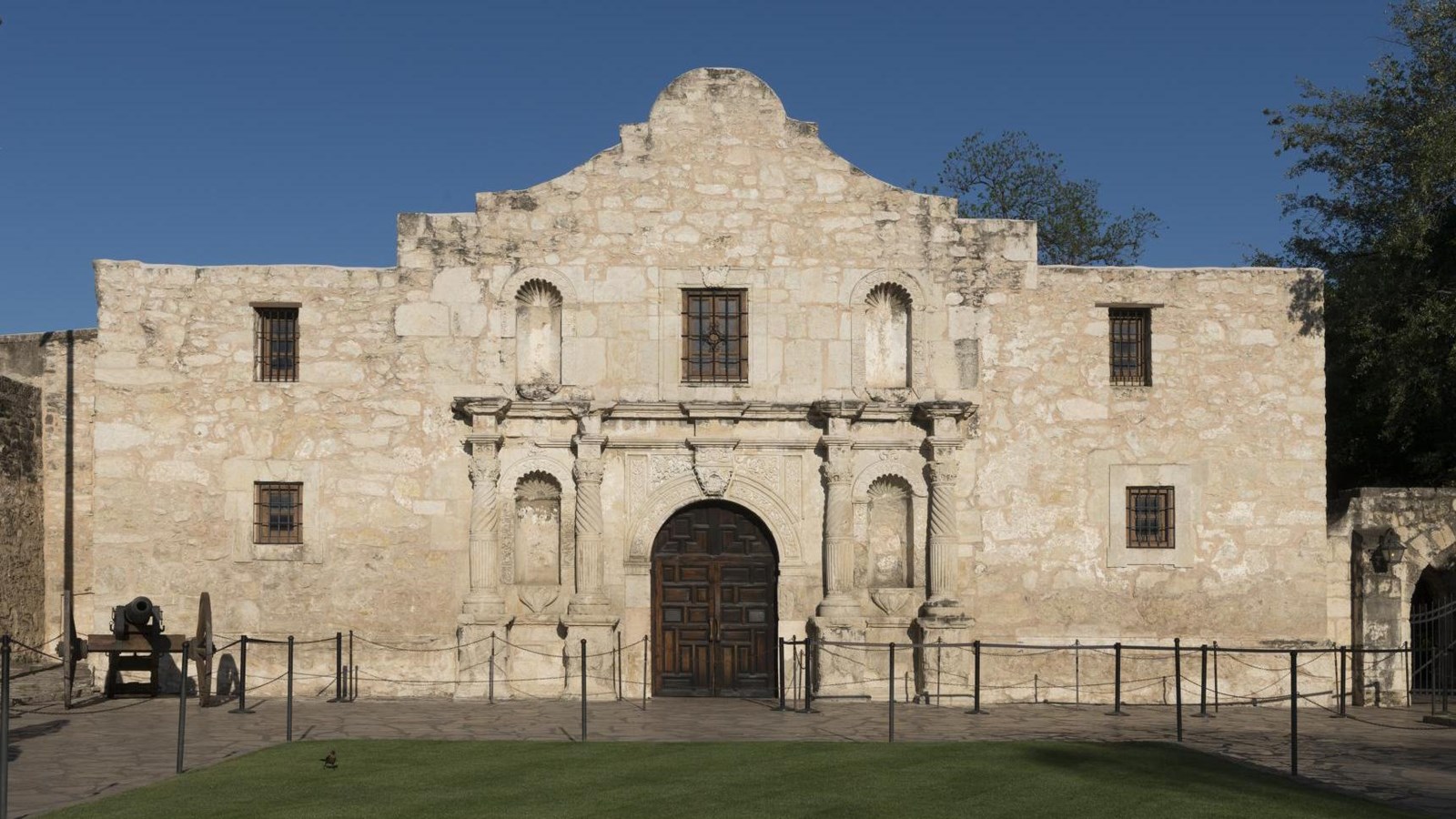
Photo/The Lyda Hill Texas Collection of Photographs
Quick Facts
Location:
300 Alamo Plaza, in downtown San Antonio, Texas
Significance:
The Alamo takes visitors from the early days of Spanish Texas to the fight for independence from Mexico--and beyond.
Designation:
Certified site; National Historic Landmark
MANAGED BY:
Amenities
1 listed
Historical/Interpretive Information/Exhibits
While the Mission San Antonio de Valero is best known as the site of the famed Battle of the Alamo, its history began much earlier. Franciscan missionaries first established the mission along El Camino Real on the banks of the San Antonio River near San Pedro Creek in 1718. In 1724, the mission relocated to its present location. By 1731, five missions, a presidio (fortified garrison), and a residential and agricultural settlement along the San Antonio River together formed the most populous Spanish colony in Texas. El Camino Real connected Mission San Antonio de Valero to the four other San Antonio missions and the presidio. Increasing numbers of people used the Camino to reach San Antonio, drawn by the town’s economic opportunities.[1]
Like missionaries throughout the Spanish Empire, the Franciscans at San Antonio de Valero aimed to convert Indigenous people to Catholicism and turn them into subjects of the Spanish Crown. Missions also helped Spain strengthen its territorial claims in Texas. The cornerstone of the San Antonio Mission chapel was laid in 1744 and construction continued until 1758. The Spanish Crown ordered the mission secularized in 1793. After the 1803 Louisiana Purchase, a Spanish cavalry unit known as the “Alamo Company,” named for their hometown of San Carlos de Alamo de Parras in southern Coahuila, began using the mission as a fort. They protected Spanish Texas from the neighboring United States and local residents and travelers from Indigenous raids. According to one theory, Mission San Antonio de Valero became known as “The Alamo” because of its association with the soldiers of the Alamo Company stationed there. Another theory proposes that, when founding the mission, Spanish missionaries were struck by the beauty of a nearby grove of cottonwood trees. The Spanish word for “cottonwood” is alamo.[2]
After Mexico’s independence from Spain in 1821, the Mexican military maintained a garrison at the Alamo until December of 1835, when General Martin Perfecto de Cos surrendered the Alamo to the Texian Army during the Texas Revolution. In 1836, Mexican President Antonio López de Santa Anna led his forces north along El Camino Real to retake San Antonio and reestablish control over Texas. On February 23, 1836, the army arrived at San Antonio and began a siege of the Alamo. Defending the structure was a Texian garrison composed of Americans, Anglo Texians, Tejanos, and other European immigrants. Also inside the fort were the families of many of the defenders and several enslaved people. After a 13-day siege, the Battle of the Alamo ended on March 6, 1836, when Mexican troops killed all of the fort’s approximately 189 defenders.[3] Santa Anna spared the garrison’s noncombatants. In the coming weeks, the Texian Army retreated. Many Texians fled east along El Camino Real. Sam Houston and the Texian Army also traveled part of the route on their way to the Battle of San Jacinto, where they captured Santa Anna and bargained for Texas independence.[4]
The battle left the Alamo severely damaged. Following the admittance of Texas into the United States in 1845, the U.S. Army used the Alamo as a Quartermaster Depot until 1877, with an interruption from 1861-1865 when Confederate forces occupied the site.[5] By the 1880s, only the church and the Long Barrack, the oldest building at the site dating back to 1724, remained standing. In 1883, the Catholic Church sold the Alamo Church to the State of Texas, and in 1905 the Daughters of the Republic of Texas purchased the Long Barrack. Originally a two-story convent that served as the quarters and offices of Spanish missionaries, it was also the site of the Alamo’s defenders final stand against Santa Anna’s army in 1836. The purchase of these structures ensured their preservation as a memorial to the Alamo’s history.[6]
The Alamo and most of San Antonio Missions National Historical Park were designated a UNESCO World Heritage Site in 2015, the first and only World Heritage Site in Texas. Visitors to the Alamo compound in downtown San Antonio can visit the Alamo Church and the Long Barrack. The Ralston Family Collections Center features artifacts and interactive exhibits. At the Living History Encampment, staff give talks and hands-on demonstrations relating to daily life at the time of the Texas Revolution. Visitors can also visit the Convento Courtyard as well as the Acequia, a part of the colonial era irrigation system that brought water from the San Antonio River to the mission complex. A UNESCO audio tour highlights key locations and events relating to the structure. A new visitor center and museum is slated to open in 2027.[7]
Site Information
Location (300 Alamo Plaza, in downtown San Antonio, Texas)
This beautifully reconstructed mission offers expansive grounds and many Spanish architectural details, carved in limestone from the banks of the San Antonio River.
More site information
El Camino Real de los Tejas National Historic Trail
[1] World Heritage, “Mission San José Audio Tour, Stop 21 – El Camino Real,” accessed September 17, 2024, https://www.worldheritagesa.com/Portals/17/PDF/Audio%20Tour%20Transcripts/Stop-21.pdf; NPS, “Louisiana and Texas: El Camino Real de los Tejas National Historic Trail,” accessed September 17, 2024, https://www.nps.gov/articles/delostejas.htm; World Heritage Office, “The Alamo,” accessed September 17, 2024, https://www.worldheritagesa.com/Missions/The-Alamo.
[2] National Historic Trail Association, El Camino Real de los Tejas, “San Antonio-Goliad Region, Mission San Antonio de Valero,” accessed September 17, 2024, https://www.elcaminorealdelostejas.org/san-antonio-goliad-region/; World Heritage Organization, “Alamo Audio Tour, Stop 1 – Introduction & The Church,” accessed September 17, 2024, https://www.worldheritagesa.com/Portals/17/PDF/Audio%20Tour%20Transcripts/Alamo/Stop-1.pdf; Tarín, Randell G, “Second Flying Company of San Carlos de Parras,” Handbook of Texas Online, accessed September 17, 2024, https://www.tshaonline.org/handbook/entries/second-flying-company-of-san-carlos-de-parras; The Alamo, “Birth of a Fortress,” accessed October 24, 2024, https://www.thealamo.org/remember/birth-of-a-fortress; Menard, Valerie, “Remember the Cottonwood? Two theories about how the Alamo got its name,” Texas Parks and Wildlife, March 2006, accessed October 24, 2024, https://tpwmagazine.com/archive/2006/mar/legend/
[3] Williams, Amelia W., “Alamo,” Handbook of Texas Online, accessed September 17, 2024, https://www.tshaonline.org/handbook/entries/alamo; World Heritage Office, The Alamo.
[4] Covington, Carolyn Callaway, “Runaway Scrape,” Handbook of Texas Online, accessed September 17, 2024, https://www.tshaonline.org/handbook/entries/runaway-scrape; Moskal, Emily, “Texas’ Royal Road,” Texas Parks & Wildlife, August/September 2017, accessed September 17, 2024, https://tpwmagazine.com/archive/2017/aug/ed_2_caminoreal/index.phtml; Kemp, L.W., “San Jacinto, Battle of,” Handbook of Texas Online, accessed September 17, 2024, https://www.tshaonline.org/handbook/entries/san-jacinto-battle-of; McGraw, Al, “Origins of the Camino Real in Texas,” Texas Almanac, accessed September 17, 2024, https://www.texasalmanac.com/articles/origins-of-the-camino-real-in-texas
[5] Bruce Winders, “San Antonio and the Alamo in the Civil War,” The Alamo, (last accessed September 20, 2024), https://www.thealamo.org/remember/military-occupation/alamo-in-the-civil-war
[6] Williams, “Alamo”; World Heritage Office, “The Alamo”; The Alamo, “Long Barrack,” accessed September 17, 2024, https://www.thealamo.org/visit/whats-at-the-alamo/long-barrack
[7] City of San Antonio World Heritage Office, “San Antonio Missions,” San Antonio Mission Trails Historic Sites, accessed September 17, 2024, https://www.sanantonio.gov/Mission-Trails/Mission-Trails-Historic-Sites/Missions; The Alamo, “Long Barrack”; The Alamo, Living History Encampment, accessed September 17, 2024, https://www.thealamo.org/visit/whats-at-the-alamo/encampment; The Alamo, Alamo Exhibit, accessed September 17, 2024, https://www.thealamo.org/support/alamo-plan/alamo-collections-center; World Heritage Office, “The Alamo”; NPS, Mission Espada, accessed September 17, 2017, https://www.nps.gov/places/mission-espada.htm; Moskal, “Texas’ Royal Road”