



Last updated: April 9, 2026
Place
Mission Dolores State Historic Site
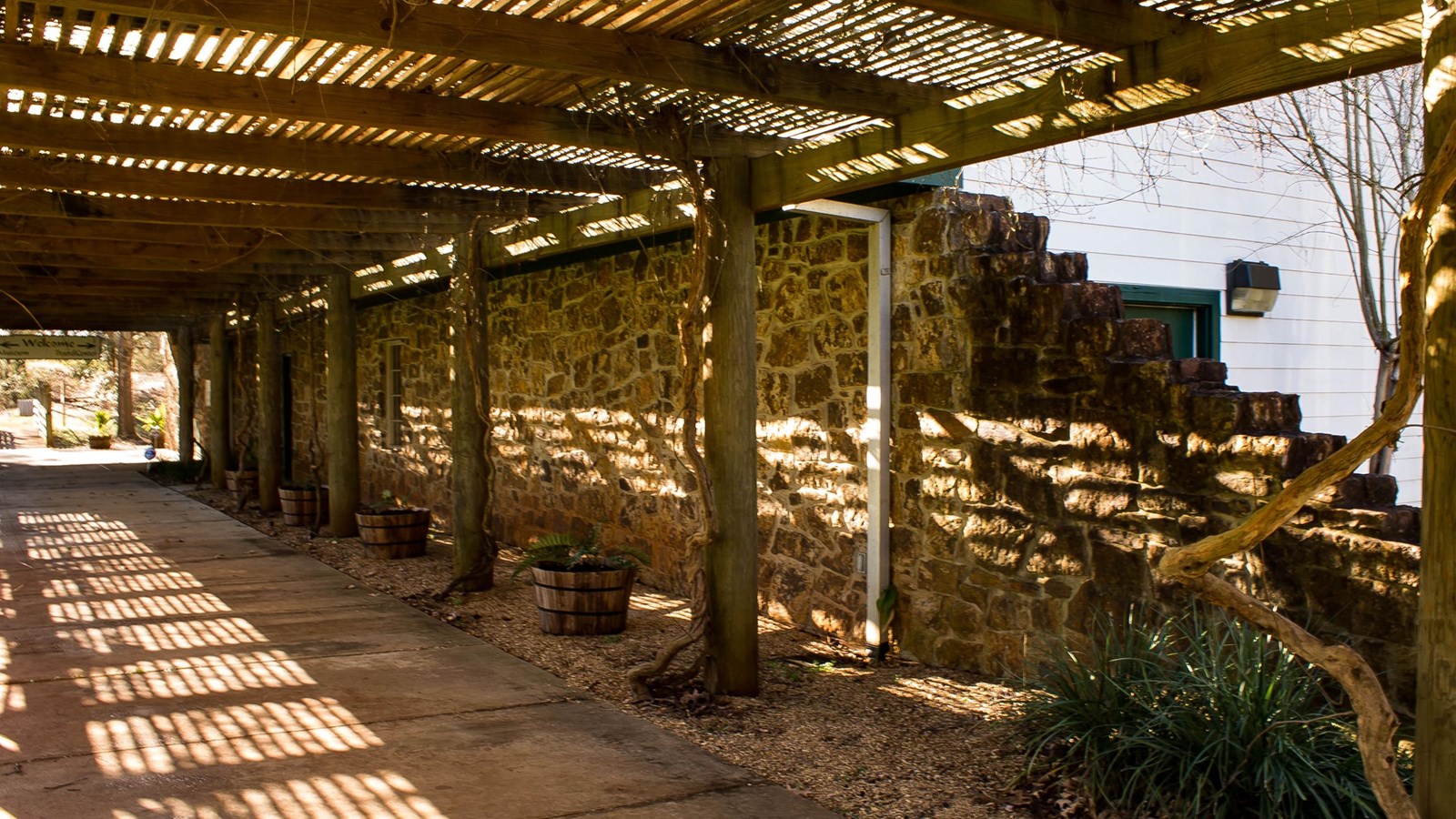
Photo/Rene Library
Quick Facts
Location:
701 South Broadway, San Augustine, Texas
Significance:
Mission Dolores tells a crucial story of American Indian interaction with Spanish settlers in eastern Texas.
Designation:
certified site, state historic site, National Register of Historic Places
MANAGED BY:
Amenities
1 listed
Historical/Interpretive Information/Exhibits
In 1717, a Spanish expedition led by military officer Domingo Ramón established Mission Nuestra Señora de los Dolores de los Ais, also known as Mission Dolores, as one of six Franciscan missions in East Texas.[1] The goal of the mission was to secure Spanish control of the area and convert the local Ais peoples to Catholicism. French expansion into Texas worried the Spanish authorities, who saw the mission as a way to bolster Spain’s presence and deter invasion.
The first iteration of Mission Dolores was short-lived. In 1718, the War of the Triple Alliance broke out, and in 1719 a French lieutenant organized an attack on the Spanish mission at Los Adaes.[2] Word soon spread to nearby Mission Dolores that the French were on their way. Alarmed, the Spanish abandoned all their positions in East Texas.[3] In 1721, Franciscan missionaries re-established Mission Dolores at a new location they believed would be easier to defend from French attack.[4] The official name, Mission Nuestra Señora de los Dolores de los Ais, translates to “Our Lady of Sorrows, for the Ais”— a reference to the Indigenous people the Spanish missionaries hoped to convert there.[5] Mission Dolores was located in the center of eight Ais settlements in the Piney Woods of East Texas, on the eastern branch of El Camino Real de los Tejas.[6] Three small springs flowed nearby, providing drinking water and a potential means of irrigation. Spanish settlers cleared the natural vegetation, including mixed pine and hardwood forests, around the mission to create fields and pastures.
Mission buildings included a church and residences. Evidence suggests that two priests typically lived at the mission, protected by a garrison of soldiers.[7] The soldiers’ families lived at the site and contributed to its upkeep. Over the next 50 years, Spanish missionaries tried, relatively unsuccessfully, to convert the Ais people to Catholicism. Some Ais temporarily resided at the mission but would leave when supplies ran out and the mission was no longer useful to them.[8] Though much remains unknown, the Spanish historical record indicates that the Spanish priests and soldiers generally enjoyed peaceful relations with the Ais people.[9] By 1776, though, European diseases had decimated the Ais. A French trader observed in the 1770s that they were “almost extinct as a nation; four years ago, the small pox destroyed the greater of them.”[10] By the mid-1800s, the remaining Ais lived among several other Indigenous groups, including the Caddo, Inoni, and Anadarko.[11]
After the Seven Years War, Louisiana came under Spanish rule in 1763. No longer needing to defend the Texas-Louisiana border, the Spanish Crown abandoned the East Texas Missions in 1773, pulling back to its forts and churches at San Antonio.[12] In the early 1800s, settlers from the United States and some members of the Shawnee, Cherokee, Delaware, and Kickapoo nations began arriving in East Texas.[13] In 1833, Anglo settlers established the town of San Augustine near the former mission site.[14] Memories and stories of Mission Dolores and its structures persisted among the area’s Spanish and Indigenous residents, even as the physical traces of the mission disappeared.[15]
In the 1970s and 1980s, archaeologists from Stephen F. Austin State University found what remained of the mission.[16] There were no visible traces above ground, and some of the historic remnants had been destroyed by the construction of State Highway 147. Despite the damage, archaeologists excavated and uncovered surviving features including wells and wall remnants. They also uncovered Spanish, French, and Ais items made of ceramic and metal.[17]
In the early 1990s, the City of San Augustine acquired the site. It built a museum, where exhibits display artifacts recovered from the site and tell the story of Mission Dolores. There is also an archaeology lab. The Texas Historical Commission assumed ownership of the site in 2016.[18] Today, Mission Dolores is listed on the National Register of Historical Places and is designated a State Antiquities Landmark. El Camino Real de los Tejas National Historic Trail passes through the Mission Dolores State Historic Site, which sits just a few blocks from the San Augustine town square. In addition to exploring the museum, visitors can also enjoy picnics, frisbee golf, and camping.[19]
Site Information
Location (701 South Broadway, San Augustine, Texas)
Available Facilities
Visitors can explore the site’s history at the museum where interpretive displays tell the story of Mission Dolores. The property also has a campground, picnic area, and group pavilions.
More site information
El Camino Real de los Tejas National Historic Trail
[1] “Beginnings of Mission Dolores,” Texas Beyond History, https://www.texasbeyondhistory.net/dolores/beginnings.html (accessed on September 10, 2024).
[2] “Beginnings of Mission Dolores.”
[3] “Beginnings of Mission Dolores.”
[4] “Beginnings of Mission Dolores.”
[5] “Nuestra Señora de los Dolores de los Ais: Spanish Mission on the Camino Real,” Texas Beyond History, https://www.texasbeyondhistory.net/dolores/ (accessed on September 10, 2024).
[6] “Who were the Ais?” Texas Beyond History, https://www.texasbeyondhistory.net/dolores/ais.html?.html (accessed on September 6, 2024).
[7] “Mission Dolores History,” Texas Historical Commission, https://thc.texas.gov/state-historic-sites/mission-dolores/mission-dolores-history (accessed on September 6, 2024).
[8] “Who were the Ais?”
[9] “Mission Dolores History.”
[10] “Who were the Ais?”
[11] “Who were the Ais?”
[12] “Mission Dolores History.”
[13] Vista K. McCroskey, “San Augustine, TX,” Texas State Historical Association, February 12, 2019, https://www.tshaonline.org/handbook/entries/san-augustine-tx-san-augustine-county (accessed on September 9, 2024).
[14] “San Augustine TX.”
[15] “Nuestra Señora de los Dolores de los Ais: Spanish Mission on the Camino Real.”
[16] “Mission Dolores History.”
[17] “Mission Dolores History.”
[18] “Mission Dolores History.”
[19] “Mission Dolores State Historic Site,” Texas Historical Commission, https://thc.texas.gov/historic-sites/mission-dolores (accessed on September 9, 2024).