



Last updated: April 7, 2026
Place
Main and Military Plazas
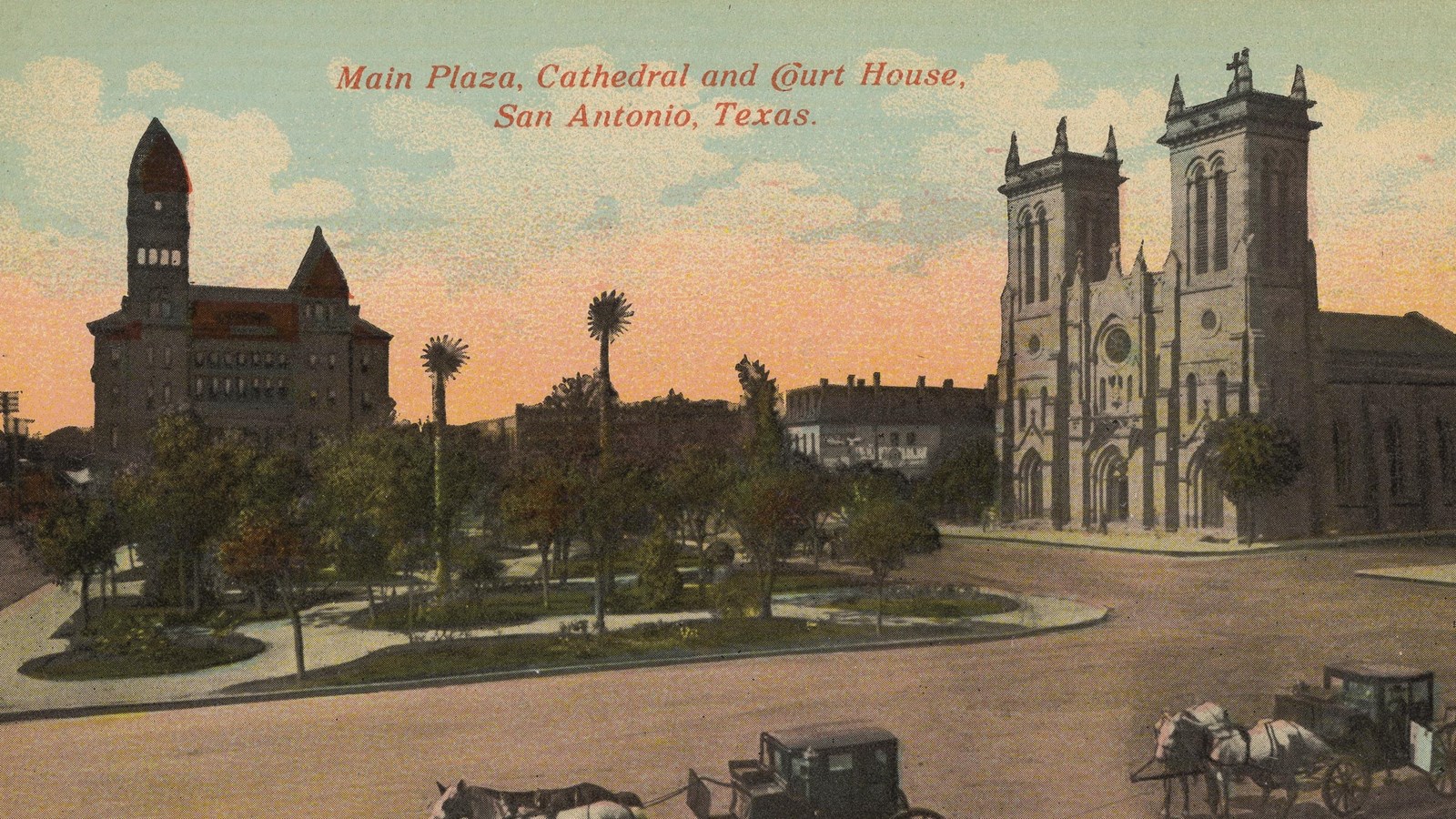
Photo/Houston & Texas History Research Collection
Quick Facts
Location:
includes all city-owned open areas bounded by Commerce Street, Dolorosa Street, Calder Alley, and Soledad Street, San Antonio, Texas
Significance:
The plazas, as well as nearby historic housing, government structures, and even a church, create a complete picture of civilian life in 18th-century San Antonio.
Designation:
Certified site, National Historic District, City Historic District
MANAGED BY:
Amenities
1 listed
Historical/Interpretive Information/Exhibits
Main and Military Plazas have witnessed over 200 years of San Antonio history. Both plazas have changed over the years, as the city has evolved from Spanish garrison to modern commercial hub. Today, they provide opportunities for visitors to socialize, shop, and engage with the area’s history.
In 1718, Presidio San Antonio de Béxar, a fortified garrison established to defend the region, became the first permanent Spanish military presence in the San Antonio River Valley.[1] In 1722, the presidio relocated to its current location, and military authorities ordered the creation of the Plaza de Armas, or Military Plaza, to serve as a parade ground and market square.[2] Soldiers of the presidio provided escorts for officials and supply trains traveling along El Camino Real de los Tejas and protected residents at the five nearby missions. The military plaza served as a training ground and symbol of the Spanish Crown’s power where Spanish civilians and local Indigenous people could observe the strength and discipline of the Spanish military. Near the plaza, the garrison’s captain lived in a building that later housed the interim governor of Texas from 1816-1817; it would become known as the “Spanish Governor’s Palace” in the early 1900s.[3]
The presence of the Spanish garrison helped attract settlers to the area. At Marqués de San Miguel de Aguayo’s suggestion in 1731, the Spanish Crown arranged for a small number of Canary Islanders to come to Texas.[4] Working with the local community, these 56 settlers helped create the first civil government in Texas.[5] They established Plaza de las Islas Canarias, or Main Plaza, as a marketplace where local people and merchants travelling on El Camino Real could exchange their wares. Many early Spanish settlers lived around the square itself in small residences. Today, the Melchor de la Garza house stands as an example of one of these early dwellings.[6] The royal houses, or “Casas Reales,” provided space on the plaza for the local municipal government.[7] Although the exact date is disputed, sometime in the 1730s San Fernando Cathedral was established on Main Plaza as a place of worship for San Antonio residents.[8]
After France ceded control of Louisiana to Spain in 1763, the Spanish Crown no longer needed missions and presidios in East Texas to defend the Louisiana-Texas border. A royal order in 1772 decreed that the Spanish abandon all missions and presidios except those at La Bahía (modern-day Goliad) and San Antonio.[9] Many of the East Texas missionaries and residents followed El Camino Real to San Antonio, which became the new capital of Spanish Tejas. For the residents of the growing city, El Camino Real served as strategic trade and travel route connecting San Antonio to other major settlements like Laredo and Goliad.[10]
San Antonio continued to grow, even as secularization closed the missions and calls for Mexican independence led to violent conflict over the future of Texas. Residents of San Antonio participated in rebellions against the Spanish Empire and some fled along El Camino Real to the United States to avoid reprisals from Spanish authorities.[11] During the Texas Revolution, the Mexican Army and the Texian Army fought fiercely over San Antonio and control of El Camino Real. Control of the town alternated between the Mexican Army and the Texian Army until June 1836, when the Mexican garrison surrendered to Texian Army captain Juan Seguín, a Tejano, or Texan of Mexican descent.[12]
Even as newly-built railroad decreased use of El Camino Real during the late 1800s, residents continued to utilize Main and Military Plazas. Beginning in 1868, the Catholic Church embarked on a renovation of San Fernando Cathedral that added new architectural elements, including twin bell towers and a larger interior space.[13] Merchants and businesspeople purchased many of the original homes, tore them down, and replaced them with businesses. Many of the buildings that survived, like the Spanish Governor’s Palace, were repurposed for commercial use as well. In the 1890s, new buildings were added to the mix, including a Romanesque Revival-style courthouse on Main Plaza and a new city hall in the Italian Renaissance Revival style on Military Plaza.[14] The 12-story “Main Plaza Building” initially opened as a bank in 1922.[15]
Over the years, the plazas have also served a place for protest and activism. In 1939, around 12,000 pecan shellers marched to San Antonio City Hall to demand higher wages and better working conditions.[16] Led by Emma Tenayuca, the protest and strike resulted in higher wages and official recognition of the sheller’s union. The event also prompted many of the pecan companies to invest in mechanization, resulting in many former protestors losing their jobs.[17] In the 1960s, civil rights activists protested segregation outside City Hall.[18]
In 2006, the city of San Antonio began redeveloping Main Plaza to bring back its historic pedestrian character and re-energize civic life. Today, Main and Military Plazas remain spaces for community gathering and commerce, as well as governmental functions. Visitors to the plazas can learn about their history through 34 historical markers and monuments and can tour the historic Spanish Governors Palace and San Fernando Cathedral.[19] Shops, cafes, and restaurants--many located in historic buildings--are available for visitors to eat and shop. Outdoor tables, fountains, and trees in Main and Military Plaza provide visitors with a relaxing space to reflect on San Antonio’s long history.
Site Information
Location (includes all city-owned open areas bounded by Commerce Street, Dolorosa Street, Calder Alley, and Soledad Street, San Antonio, Texas)
Available Facilities/Exhibits
On Military Plaza, the Italian Renaissance Revival-style city hall—built in 1888-91. On Main Plaza, the Romanesque Revival-style county courthouse—built in 1882.
More site information
El Camino Real de los Tejas National Historic Trail
[1] “San Antonio de Bexar Presidio,” Texas State Historical Association, August 4, 2020, https://www.tshaonline.org/handbook/entries/san-antonio-de-bexar-presidio (accessed on October 29, 2024).
[2] “Main and Military Plaza,” City of San Antonio, https://www.sanantonio.gov/historic/scoutsa/HistoricDistricts/MainMilitary (accessed on October 28, 2024).
[3] Tim Draves, “Spanish Governor’s Palace [Comandancia],” Texas State Historical Association, 1976, updated January 11, 2017, https://www.tshaonline.org/handbook/entries/spanish-governors-palace-comandancia (accessed on December 2, 2024).
[4] “Canary Islanders,” Texas State Historical Association, May 16, 2018, https://www.tshaonline.org/handbook/entries/canary-islanders (accessed on October 29, 2024).
[5] “Canary Islanders.”
[6] “Main and Military Plazas Historic District,” City of San Antonio; National Register of Historic Place Inventory Nomination: Main and Military Plazas National Historic District, San Antonio, TX: PDF pp. 9, 15.
[7] “Main and Military Plazas Historic District,” City of San Antonio; National Register of Historic Place Inventory Nomination: Main and Military Plazas National Historic District, pdf p. 16.
[8] Ann Graham Gaines, “San Fernando Cathedral,” Texas State Historical Association, October 6, 2022, https://www.tshaonline.org/handbook/entries/san-fernando-cathedral (accessed on October 29, 2024).
[9] Harriett Denise Joseph and Donald E. Chipman, “Spanish Texas,” Texas State Historical Association, August 25, 2023, https://www.tshaonline.org/handbook/entries/spanish-texas (accessed on December 6, 2024).
[10] Emily Moskal, “Texas’ Royal Road,” Texas Parks & Wildlife, August/September 2017, https://tpwmagazine.com/archive/2017/aug/ed_2_caminoreal/index.phtml (accessed on October 29, 2024).
[11] Dr. Bruce Winders, “San Antonio and the Alamo in the Mexican War of Independence,” The Alamo, https://www.thealamo.org/remember/birth-of-a-fortress/anahuac-june-1832-1-2-1 (accessed on October 30, 2024).
[12] “Military and Main Plazas,” Texas Historical Commission: Texas Time Travel, https://texastimetravel.com/directory/military-plaza-historic-district-tour/ (accessed on October 29, 2024); Jesús "Frank" de la Teja, “Seguin, Juan Nepomuceno (1806–1890),” Texas State Historical Association, 1976, October 11, 2023, https://www.tshaonline.org/handbook/entries/seguin-juan-nepomuceno (accessed on December 2, 2024); “Battle and Revolution,” The Alamo, https://www.thealamo.org/remember/battle-and-revolution (accessed on December 6, 2024).
[13] Gaines, “San Fernando Cathedral.”
[14] “Military and Main Plazas Historic District,” National Register of Historic Places Inventory Nomination: Main and Military Plazas National Historic District, pdf pp.16-17.
[15] “Military and Main Plazas Historic District,” National Register of Historic Place Inventory Nomination: Main and Military Plazas National Historic District, pdf pp. 10-11.
[16] “1938: Pecan Shellers Strike,” Library of Congress, https://guides.loc.gov/latinx-civil-rights/pecan-shellers-strike (accessed on October 28, 2024); “Main and Military Plazas,” Texas Historical Commission.
[17] “1938: Pecan Shellers Strike.”
[18] “These Photos Show San Antonio’s Long and Powerful History of Street Protests,” San Antonio Current, June 19, 2020, https://www.sacurrent.com/sanantonio/these-photos-show-san-antonios-long-and-powerful-history-of-street-protests/Slideshow/23556278 (accessed on December 2, 2024).
[19] “History,” Main Plaza Conservancy, https://www.mainplaza.org/history/ (accessed on November 4, 2024); “Military and Main Plazas Historic District,” National Register of Historic Place Inventory Nomination: Main and Military Plazas National Historic District, pdf p. 19.