



Last updated: February 19, 2026
Place
George Rogers Clark Home Site at the Falls of the Ohio River
Quick Facts
Amenities
13 listed
Benches/Seating, Cellular Signal, Entrance Passes for Sale, Gifts/Souvenirs/Books, Historical/Interpretive Information/Exhibits, Information, Information - Maps Available, Information - Ranger/Staff Member Present, Information Kiosk/Bulletin Board, Junior Ranger Activity, Parking - Auto, Parking - Bus/RV, Restroom
Lewis and Clark came together on October 14, 1803, after about six weeks and over 600 miles traveled by the expedition from Pittsburgh. The Louisville Farmer’s Library reported the following day, “Captain Lewis arrived at this port on Friday last. We are informed, that he has brought barges & c. on a new construction, that can be taken in pieces, for the purpose of passing carrying places, and that he and captain Clark will start in a few days on their expedition to the Westward.” Lewis and Clark continued preparations to head west while staying at the cabin of George Rogers Clark.
Many of the recruits for the expedition joined them here, including Nathaniel Pryor, William Bratton, and brothers Reubin and Joseph Field. The expedition departed from the mouth of Mill Creek the afternoon of October 26.
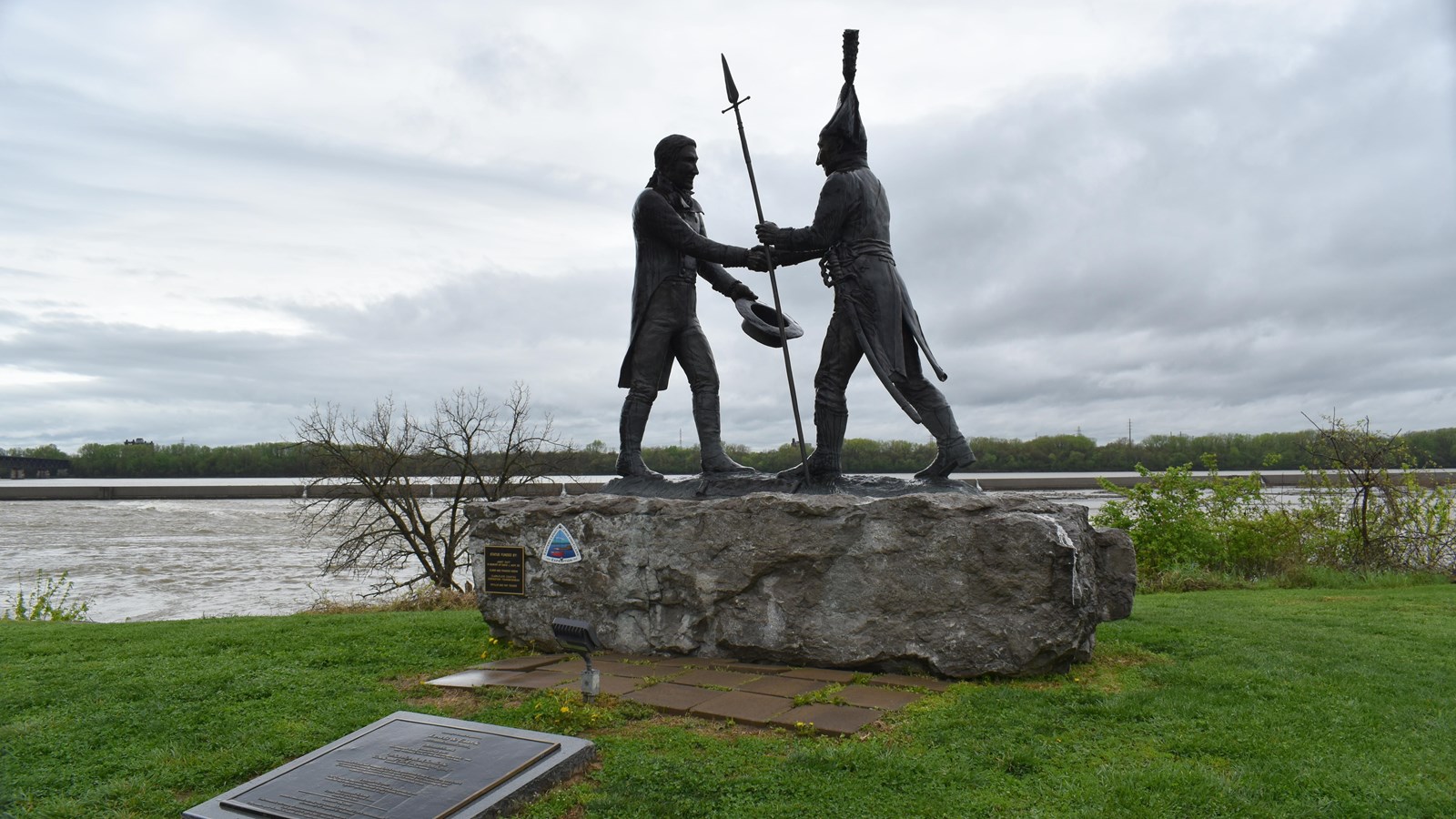
At the time of the expedition, the Falls of the Ohio River were the only major navigational barrier on the Ohio River. Improvements began in 1830 with the construction of the first locks. A hydroelectric dam was added in 1927, and the McAlpine Dam and Locks were expanded and improved in the 1960s. The Falls were named a National Natural Landmark in 1966. Falls of the Ohio State Park was established in 1981 on the Indiana side of the river. At the entrance to the park near the interpretive center is a prominent statue commemorating the meeting of Lewis and Clark. The Old Clarksville Site, which featured a replica of George Rogers Clark’s log cabin until a fire destroyed the structure in May 2021, is included in the park.
George Rogers Clark Home Site is a High Potential Historic Site of the Lewis and Clark National Historic Trail.
Lewis and Clark NHT Visitor Centers and Museums
This map shows a range of features associated with the Lewis and Clark National Historic Trail, which commemorates the 1803-1806 Lewis and Clark Expedition. The trail spans a large portion of the North American continent, from the Ohio River in Pittsburgh, Pennsylvania, to the mouth of the Columbia River in Oregon and Washington. The trail is comprised of the historic route of the Lewis and Clark Expedition, an auto tour route, high potential historic sites (shown in black), visitor centers (shown in orange), and pivotal places (shown in green). These features can be selected on the map to reveal additional information. Also shown is a base map displaying state boundaries, cities, rivers, and highways. The map conveys how a significant area of the North American continent was traversed by the Lewis and Clark Expedition and indicates the many places where visitors can learn about their journey and experience the landscape through which they traveled.