



Last updated: January 31, 2026
Place
Fort William and Fort John
NPS
Before the military, Robert Campbell and William Sublette established Fort William as a fur trader post near this spot by confluence of the North Platte and Laramie Rivers in 1834. It was small wooden fort only 100 by 80 feet. The hope for the two fur traders was to setup a fort to trade buffalo robes with the local American Indian population. It was this fort that saw the first white women traveling West in 1836, Narcissa Whitman and Eliza Spalding. These two women traveled with their husbands and were the first non-white men to traverse what would be known as the Oregon Trail.
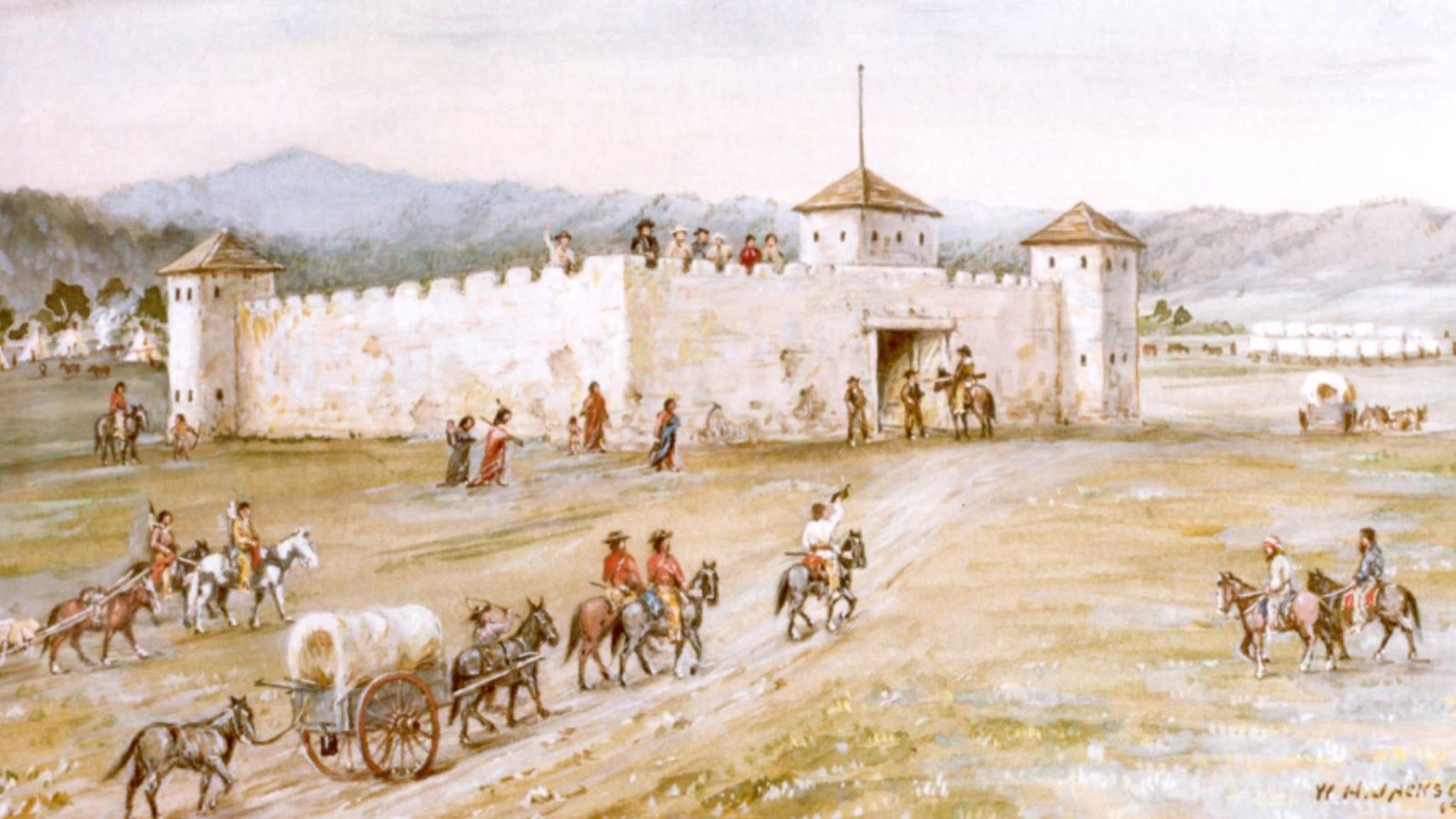
In 1841, Fort John replace Fort Willaim, John was adobe brick style fort and stood right where you are standing today. The American Fur Company contracted Hispanic workers from New Mexico to travel to Wyoming to build the fort. Many of these workers would stay in the area and build their own farms. The same year the project was completed, and Fort John was open for trade for the incoming Oregon/California Trail emigrants. Its entrance would be right where the entrance to Captain’s Quarters is today. After 1841, Fort John was owned by the Pierre Chouteau & Company, a successor to the American Fur Company. The fort not only kept up the fur trade, but in 1841 the first wagon train came through on its way to Oregon. The fort now became a place where emigrants could buy food, oxen, and other items. By 1846 hundreds of people traveled across the Laramie River resupplied at Fort John and continued to Oregon and California. Among these travelers were the Donner Party, who were not lost yet but would become infamous in present day California. For the Mormon’s starting their journey to Utah, they would have stayed on the north side of the Platte River while, while others heading to Oregon or California stayed on the south side. One of the most dangerous crossings was the North Platte River where Mormons, such as Brigham Young, had to cross to get to Fort John to buy supplies. In 1849 Fort John was sold for 4,000 dollars to the United States government. The fort’s owners were happy to sell as turning a profit was very difficult. The adobe walls would stand until 1864, while the rest of Fort Laramie slowly built around it. It was these walls that help protect soldiers and civilians from possible attacks after the Grattan Fight in 1854.
In 1841, Fort John replace Fort Willaim, John was adobe brick style fort and stood right where you are standing today. The American Fur Company contracted Hispanic workers from New Mexico to travel to Wyoming to build the fort. Many of these workers would stay in the area and build their own farms. The same year the project was completed, and Fort John was open for trade for the incoming Oregon/California Trail emigrants. Its entrance would be right where the entrance to Captain’s Quarters is today. After 1841, Fort John was owned by the Pierre Chouteau & Company, a successor to the American Fur Company. The fort not only kept up the fur trade, but in 1841 the first wagon train came through on its way to Oregon. The fort now became a place where emigrants could buy food, oxen, and other items. By 1846 hundreds of people traveled across the Laramie River resupplied at Fort John and continued to Oregon and California. Among these travelers were the Donner Party, who were not lost yet but would become infamous in present day California. For the Mormon’s starting their journey to Utah, they would have stayed on the north side of the Platte River while, while others heading to Oregon or California stayed on the south side. One of the most dangerous crossings was the North Platte River where Mormons, such as Brigham Young, had to cross to get to Fort John to buy supplies. In 1849 Fort John was sold for 4,000 dollars to the United States government. The fort’s owners were happy to sell as turning a profit was very difficult. The adobe walls would stand until 1864, while the rest of Fort Laramie slowly built around it. It was these walls that help protect soldiers and civilians from possible attacks after the Grattan Fight in 1854.