



Last updated: April 2, 2026
Place
Fort St. Jean Baptiste State Historic Site
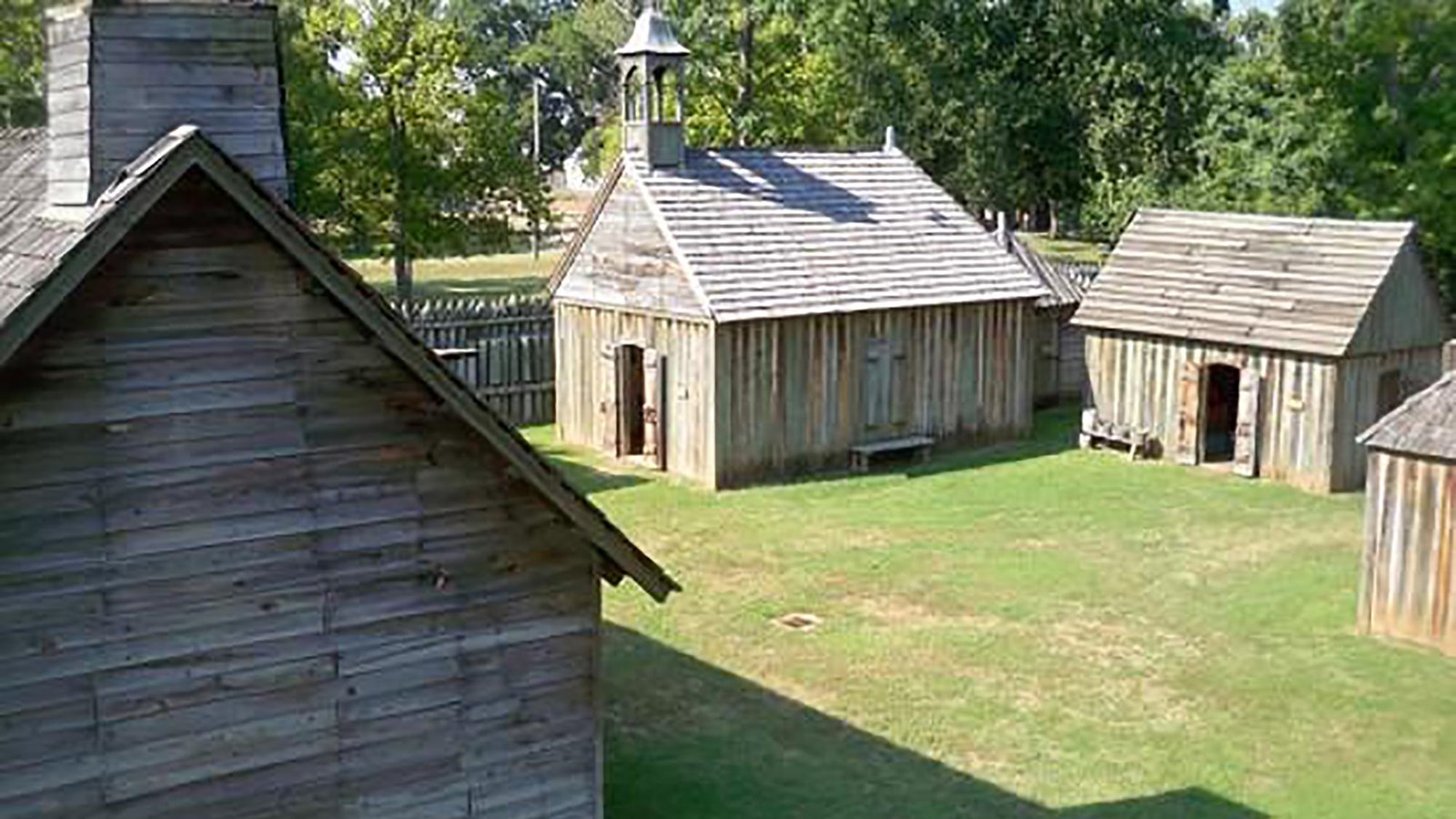
Photo/Louisiana State Parks
Quick Facts
Location:
155 Jefferson Street in Natchitoches, between Keyser Street and University Parkway
Significance:
Fort St. Jean Baptiste was one of the most important trading centers in the Lower Mississippi Valley
Designation:
certified site, State Historic Site
MANAGED BY:
Amenities
1 listed
Historical/Interpretive Information/Exhibits
Along a bend in the Red River, near present-day Natchitoches, Louisiana, is Fort St. Jean Baptiste de Natchitoches. Built in 1714 on the orders of Louis Juchereau St. Denis, the fort helped advance the interests of the French government by facilitating trade with the local Natchitoches Caddo people and deterring expansion by the Spanish Empire.
Caddo communities thrived in an agricultural society in what is now northwest Louisiana, eastern Texas, and southern Arkansas.[1] Their pottery and crafts made them an important trading partner, and French authorities were determined to foster trade. While overseeing this fort, St. Denis learned the Caddo language and engaged in a yearly exchange of animal hides, arms, and other goods.[2]
Fort St. Jean Baptiste was a prime example of the back-and-forth between the French and Spanish governments attempting to control the trade routes of the Red River. Letters between the French governor of Louisiana, Antoine de la Mothe Cadillac, and his deputy, St. Denis, highlight typical fears of the French government in the early eighteenth century. The men worried that, if the Spanish Empire established itself in the Natchitoches area, it would gain access to the Red River and its trade routes.[3] French traders defended Fort St. Jean Baptiste from Spanish attacks with two rows of palisades, vertical logs placed in the bottom of a trench to deter attacks.[4] The fort, however, did not deter Spanish colonization for long—less than 20 miles to the west, Spanish settlers built the settlement of Nuestra Señora del Pilar de Los Adaes in 1721.[5]
As France and Spain competed for influence along the Red River, the Caddo fostered their traditional military alliances with the Wichita people. Over time, they did develop close trading ties with both the Spanish and the French settlements.[6] The relationships between the French arrivals and Caddo people in Natchitoches during the operating years of Fort St. Jean Baptiste included the merging of cultures through mixed families: colonial Louisiana marriage records show relationships between Indigenous Caddo women and French men.[7] Caddos traditionally gave gifts to celebrate the union of two people, and French traders may have seen this, along with kinship ties and connections, as an avenue to access further trading possibilities.[8] Indigenous slavery is also part of the fort’s history. Records of the site include an account of the marriage of a Chitimacha woman, Jeanne de la Grande Terre, to her former enslaver, a French warehouse manager in Natchitoches.[9]
The fort’s founder, St. Denis, became its commandant in 1722 and served in that role until he died in 1744.[10] In 1763, in the aftermath of the Seven Years’ War, France ceded its Louisiana colony to Spain, ending Natchitoches' time as a border outpost between Spanish and French forces. The fort eventually fell into disrepair and was abandoned around the time of the Louisiana Purchase, which brought the area under the control of the United States. Fort St. Jean Baptiste de Natchitoches served as a critical trading post that shaped the interaction between the Caddo people and their Spanish and French counterparts. Today, the site of the fort is a park and visitors can come to learn more about the complicated history of the region. Visitors can tour a replica of the structure, and self-guided tours and special programs allow them to better understand its story.
Site Information
Location (155 Jefferson Street in Natchitoches, between Keyser Street and University Parkway)
Available Facilities/Exhibits
The fort replica, a picnic area, and restrooms. In 1979, work began on the fort reconstruction at a location a few hundred yards from the original fort site. Local building materials were used and many 18th-century techniques were employed in the replication, with handmade hinges and latches brought from a nearby foundry.
More site information
El Camino Real de los Tejas National Historic Trail
[1] David La Vere, “Between Kinship and Capitalism: French and Spanish Rivalry in the Colonial Louisiana-Texas Indian Trade,” The Journal of Southern History 64, no. 2 (1998), 206.
[2] Ibid.
[3] Eleanor Claire Buckley, “The Aguayo Expedition into Texas and Louisiana, 1719-1722,” Quarterly of the Texas State Historical Association, July 1911, Vol. 15, No. 1 (Jul., 1911), p. 6.
[4] “Fort St. Jean Baptiste State Historic Site,” Louisiana State Parks, https://www.lastateparks.com/historic-sites/fort-st-jean-baptiste-state-historic-site, accessed 28 November 2023.
[5] H. F. Gregory, George Avery, Aubra L. Lee, and Jay C. Blaine, “Presidio Los Adaes: Spanish, French, and Caddoan Interaction on the Northern Frontier,” Historical Archaeology 38, no. 3 (2004), 65. http://www.jstor.org/stable/25617181.
[6] Gregory et. al., “Presidio Los Adaes,” 66.
[7] La Vere, “Between Kinship and Capitalism,” 211-212.
[8] Ibid.
[9] Ibid.
[10] “Fort St. Jean Baptiste,” Louisiana State Parks, https://www.lastateparks.com/historic-sites/fort-st-jean-baptiste-state-historic-site.