



Last updated: April 2, 2026
Place
Fort Boggy State Park
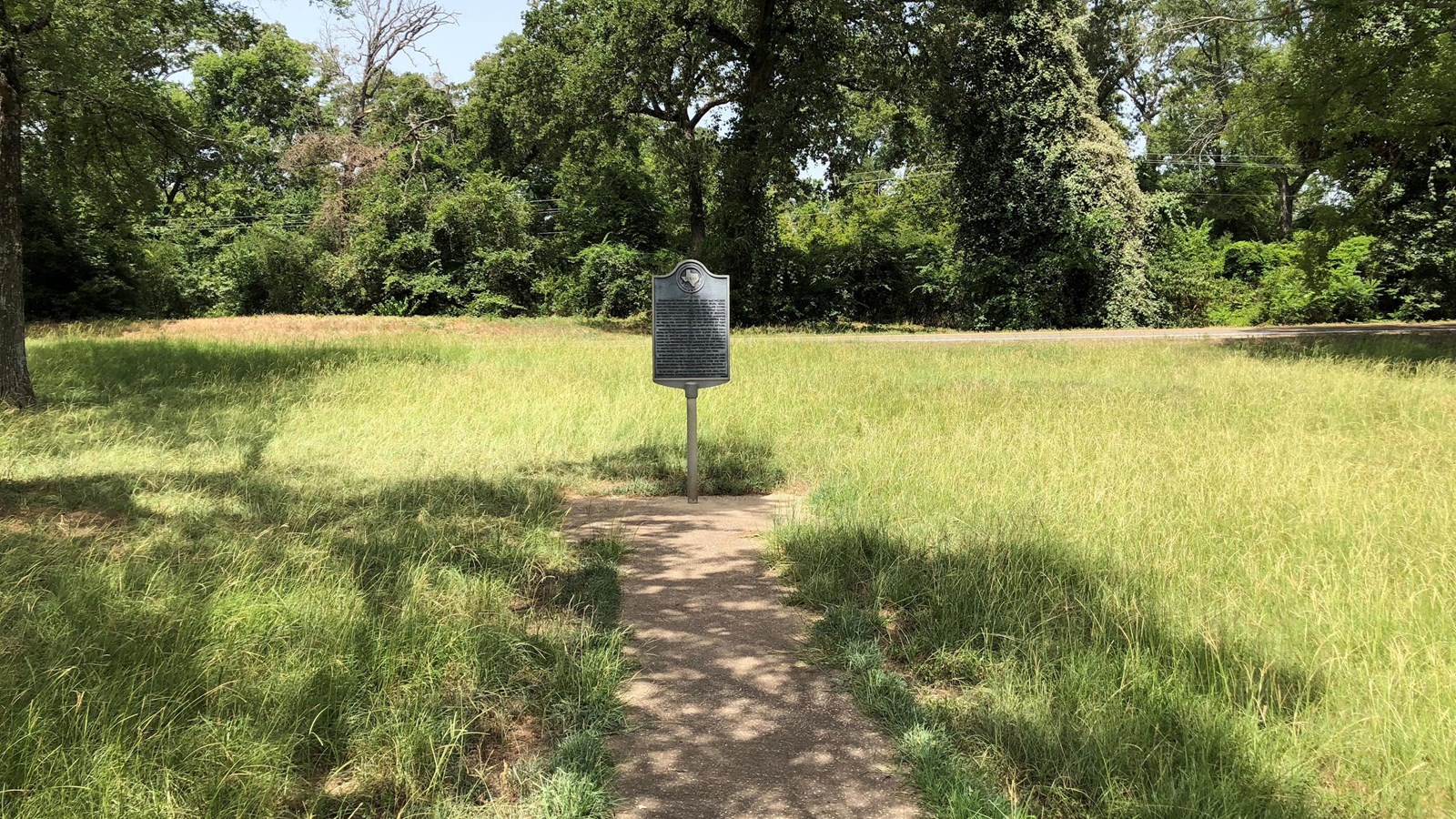
Photo/Historical Marker Database
Quick Facts
Location:
4994 Highway 75 South , Centerville, TX 75835
Significance:
Fort Boggy gives visitors a taste of frontier life during the Mexican period.
MANAGED BY:
Amenities
1 listed
Historical/Interpretive Information/Exhibits
Fort Boggy State Park preserves the site of an 1839 fortification in Leon County near El Camino Real de los Tejas. While no visible trace of the fort remains today, its history highlights Anglo American efforts to expel Indigenous Texans in order to secure land for commercial development and agriculture.
After Texas declared independence in 1836, Republic of Texas President Sam Houston negotiated treaties and made concessions to Indigenous nations. Over Houston’s veto, however, the Texas congress opened all Native American lands in Texas to white settlers, leading to violence between would-be settlers backed by Texas militia units and Indigenous people fighting for their homelands. In late 1838, Mirabeau Lamar won the Texas presidential election. Lamar reversed Houston’s conciliatory policy toward Native Americans and ordered “the prosecution of an exterminating war on their warriors, which will admit no compromise and have no termination except in their total extinction or total expulsion.”[1] Chief among his goals was securing land in Texas for cotton cultivation, which he believed would boost the republic’s economy.[2] Companies of Texas Rangers, a mounted militia force authorized by Texas lawmakers in 1835 to protect settlers, hunted down and killed Indigenous men, women, and children. Many survivors fled Texas entirely and resettled in the United States.[3] Native Americans, including the Comanches and Kickapoos, retaliated by destroying farms and killing settlers.[4]
Constructed within Kichi and Kickapoo territory, Fort Boggy lay on contested ground. Republic of Texas officials had tried to expel the Kickapoo and Kichi peoples to clear the area for Anglo American settlers, but while the Kichi had fled the area by 1835, the Kickapoos resisted.[5] After enduring a series of removals orchestrated by the United States government, Kickapoos were determined to remain in Texas and defend their territory.[6] Texan officials were frustrated by the Kickapoos ability to raid settlements and, if needed, flee across the border into present-day Oklahoma, where they were protected by allies in the Choctaw, Chickasaw, and Creek Nations.[7]
In 1839, amidst the Republic of Texas’s campaign of extermination and expulsion, a company of Texas Rangers began construction of Fort Boggy.[8] Despite proximity to El Camino Real, the area had been abandoned by Anglo American settlers after Caddo and Comanche forces attacked Fort Parker in neighboring Limestone County in 1836.[9] Would-be settlers hoped that the fort, along with the company of Texas Rangers, would protect them from raids and establish Anglo American control of what would become Leon County. The two-story fort soon attracted a group of families from the United States, including the Byrns, Staleys, and Erwins.[10]
At its height, Fort Boggy featured two blockhouses, a palisade wall, and living quarters for militia and families.[11] Around 75 people once lived within or around its walls. The safety offered by the fort’s defenses and garrison and the fort’s location along El Camino Real encouraged the creation of businesses in the area, including a county store, a sawmill, a grist mill, and a steamboat landing.[12] The community around the fort became known as Leona.[13]
As disease and Texas Ranger attacks decimated the Kickapoo, their ability to conduct raids in Leon County weakened. Anglo Americans relied less on the fort for protection and began to settle in outlying areas. The fort itself began to deteriorate, although according to one account, remnants of the structure could still be seen in the late 1800s.[14]
The Fort Boggy area served as farmland until the 1930s.[15] Although the fort was gone, its history was not forgotten. The Texas Centennial Commission placed a historic marker at the site in the 1930s. By this time, the Sullivan family owned much of the land where the fort once stood, and in 1985 Eileen Crain Sullivan donated her land, including the former site of Fort Boggy, to the State of Texas.[16]
Today, Fort Boggy State Park protects more than 1,847 acres of land. Visitors to the park can hike, bike, fish, swim, boat, and take in the natural landscape. There are a variety of campsites and cabins available for visitors who want to spend the night. The marshy nature of the area, which frustrated early settlers, today supports a variety of wildlife. A historical marker placed in 1985 is located outside of the park’s boundaries at a rest area on I-45 and tells the story of the fort. [17]
Site Information
Location (4994 Highway 75 South , Centerville, TX 75835)
The fort consisted of two small blockhouses (fortified buildings that usually include ports for firing outwards) and eleven dwellings inside an area just less than one square mile.
More site information
El Camino Real de los Tejas National Historic Trail
[1] Andrew J. Torget, Seeds of Empire: Cotton, Slavery, and Transformation of the Texas Borderlands, 1800-1850 (Chapel Hill: University of North Carolina Press, 2015), pg. 208.
[2] Torget, Seeds of Empire, pg. 208.
[3] Torget, Seeds of Empire, pg. 208.
[4] Ben H. Procter, “Texas Rangers,” Handbook of Texas Online, accessed October 23, 2024, https://www.tshaonline.org/handbook/entries/texas-rangers; Pekka Hamalainen, The Comanche Empire, (Yale University Press: 2008), pp. 215-17.
[5] Wood, “History of Leon County,” pg. 205.
[6] Joseph Herring, “Cultural and Economic Resilience Among the Kickapoo Indians of the Southwest,” Great Plains Quarterly (Fall 1986): 263.
[7] Herring, “Cultural and Economic Resilience,” pg. 269.
[8] W.D. Wood, “History of Leon County,” Quarterly of the Texas State Historical Association, Vol. IV, no. 3. January 1901, pg. 205-206. Other sources state that settlers first raised the palisade and then requested a company of Texas Rangers.
[9] Art Leatherwood, “Fort Parker,” Handbook of Texas Online, accessed October 23, 2024, https://www.tshaonline.org/handbook/entries/fort-parker; Hailey, James L. and Christopher Lang, “Leon County” Handbook of Texas Online, accessed October 23, 2024, https://www.tshaonline.org/handbook/entries/leon-county
[10] “Fort Boggy State Park: History,” Texas Department of Parks and Wildlife, https://tpwd.texas.gov/state-parks/fort-boggy/history, (accessed on 9 July 2024); W.D. Wood, “History of Leon County.”
[11] “Fort Boggy State Park: History.”
[12] W.D. Wood, “History of Leon County,” pg. 206.
[13] W.D. Wood, “History of Leon County,” pg. 206.
[14] W.D. Wood, “History of Leon County,” pg. 206.
[15] “Fort Boggy State Park: History.”
[16] “Fort Boggy State Park: History.”
[17] Brian Anderson and Richard Denney, “Fort Boggy,” Historical Marker Database, last revised on July 4, 2018, https://www.hmdb.org/m.asp?m=119705