



Last updated: April 7, 2026
Place
El Camino Real de los Tejas Visitor Center
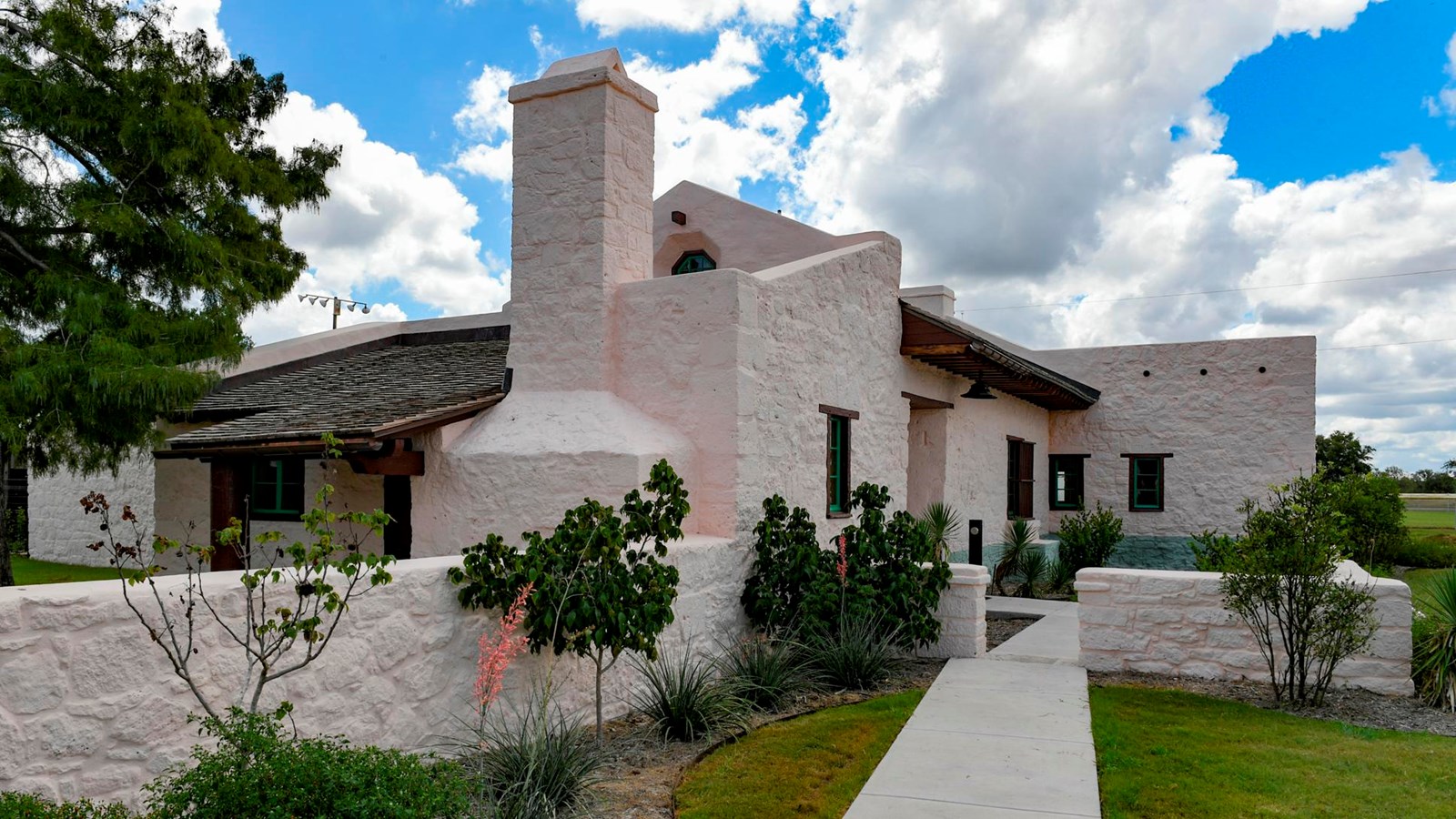
Photo/Texas Parks and Wildlife Department
Quick Facts
Location:
El Camino Real de los Tejas Visitor Center is part of Goliad State Park & Historic Site; 108 Park Road 6, just west of US highways 77 and 183 and State Highway 239, ¾ mile south of Goliad
Significance:
As park visitors move through the three main rooms, they will encounter interpretive exhibits, as well as interactive elements that will help tell the story of El Camino Real de los Tejas.
Designation:
Certified Site
MANAGED BY:
Amenities
2 listed
Historical/Interpretive Information/Exhibits, Restroom
El Camino Real de los Tejas Visitor Center is located in Goliad and housed in a cottage built for the caretaker of Mission Nuestra Señora del Espíritu Santo de Zúñiga in the 1930s. The visitor center tells the histories both of El Camino Real and of efforts to preserve and document the route and the resources along it.[1]
In the early 1900s, interest in the history of El Camino Real led the Texas legislature to sponsor research of the route. Members of the Civilian Conservation Corps (CCC), a federal program created during the Great Depression to conserve America’s resources, worked to preserve this history.[2] From 1935-1941, architects Samuel Vosper and Raiford Stripling worked with World War I veterans enrolled in the CCC to reconstruct Mission Espíritu Santo in Goliad.
As part of widespread efforts to convert Indigenous Texans to Catholicism, Franciscan priests established Mission Espíritu Santo at its present-day location in Goliad in 1749. Nearby, Presidio Nuestra Señora de Loreto de Bahía protected travelers along El Camino Real de los Tejas.[3] While the mission had a successful ranching operation, the Franciscans struggled to retain Indigenous converts, many of whom died from disease or fled. Raids by the Apache and Comanche also threatened the mission’s existence.[4]
Mission Espíritu Santo was partially secularized in 1794 and fully secularized in 1830. Over the next century, the largely abandoned mission site deteriorated. The Goliad city council permitted residents to remove the stone from the mission’s structures for use in other buildings. By the 1900s, only the foundation of the walls remained.[5] The CCC planned to rebuild the mission using the foundation as a blueprint. As part of this effort, Vosper and Stripling designed a cottage that could serve as both an experimental architectural site and the future home of the restored mission’s caretaker.[6] This cottage, constructed in 1936-1937, would eventually become El Camino Real de los Tejas Visitor Center.
Vosper and Stripling designed the caretaker’s cottage as a one-story limestone building with a wooden roof. The two had traveled across Texas, Mexico, and California to study colonial Spanish architecture, and the cottage was a chance for them to apply what they had learned. The five-room, one-bath structure was more than a residence. It served as an experimental studio for the architects and builders. Developing prototypes on a smaller scale, they tested a variety of techniques for later use in the mission reconstruction, including a latilla ceiling (made from peeled branches or pieces of wood laid between the ceiling beams), clamshell window frames, hand-carved doors and cabinets, forged iron hinges, and a one-of-a-kind wooden staircase leading to the attic workspace. The cottage quickly attracted public attention. First Lady Eleanor Roosevelt visited the completed structure in 1940.[7]
The cottage served as the park superintendent’s residence until 2007. A grant from the Texas Department of Transportation and the Federal Highway Administration funded the rehabilitation of the caretaker’s cottage as park offices and a visitor center. The building reopened in 2018.[8]
The visitor center in the refurbished CCC cottage features interactive exhibits that help tell the story of El Camino Real and its influence in South Texas. The interpretive exhibits also highlight the role CCC architects and builders played in preserving the history of the nearby Mission Nuestra Señora del Espíritu Santo de Zúñiga. The cottage features original wooden furniture and a scrapbook of photographs and other materials from the architects’ tour prior to constructing the building. Exhibits highlight the CCC workers’ craftsmanship, teach visitors about the CCC’s architectural legacy and its role in historic preservation, and explain how the work carried out by the CCC at the caretaker’s cottage ensured the success of the mission restoration project and, ultimately, Goliad State Park.[9]
Site Information
Location (108 Park Road 6, just west of US highways 77 and 183 and State Highway 239, ¾ mile south of Goliad)
The historic building was a caretakers cottage built by the Civilian Conservation Corps. While moving through the cottage, visitors find interactive exhibits and activities primarily relating to the trail while highlighting aspects of the structure.
More site information
El Camino Real de los Tejas National Historic Trail
[1] NPS, Louisiana and Texas: El Camino Real de los Tejas National Historic Trail, accessed October 23, 2024,https://www.nps.gov/articles/delostejas.htm
[2] Louisiana and Texas: El Camino Real de los Tejas National Historic Trail; Joseph M. Speakman, “Into the Woods: The First Year of the Civilian Conservation Corps,” Prologue Magazine, Fall 2006, Vol. 38, No.3, accessed October 23, 2024, https://www.archives.gov/publications/prologue/2006/fall/ccc.html.
[3] NPS, Goliad State Park and Mission Espiritu Santo State Historic Site, accessed October 23, 2024, https://www.nps.gov/places/goliad-state-park-and-mission-espiritu-santo-state-historic-site.htm; NPS, Mission Nuestra Señora de la Bahía del Espíritu Santo de Zúñiga -- Spanish Colonial Missions of the Southwest Travel Itinerary, accessed October 23, 2024, https://www.nps.gov/subjects/travelspanishmissions/mission-nuestra-senora-de-la-bahia-del-espiritu-santo-de-zuniga.htm.
[4] Goliad State Park and Mission Espiritu Santo State Historic Site; Mission Nuestra Señora de la Bahía del Espíritu Santo de Zúñiga -- Spanish Colonial Missions of the Southwest Travel Itinerary.
[5] Mission Nuestra Señora de la Bahía del Espíritu Santo de Zúñiga -- Spanish Colonial Missions of the Southwest Travel Itinerary.
[6] Emily Moskal, “Texas’ Royal Road,” Texas Parks & Wildlife, September 2017, (last accessed September 20, 2024), https://tpwmagazine.com/archive/2017/aug/ed_2_caminoreal/index.phtml ; NPS “El Camino Real de los Tejas Visitor Center,” El Camino Real de Los Tejas National Historic Trail, (last accessed September 18, 2024) https://www.nps.gov/places/el-camino-real-de-los-tejas-visitor-center.htm
[7] “Goliad’s Custodian’s Cottage: A Living Library,” Living New Deal, September 27, 2016, (last accessed September 18, 2024), https://livingnewdeal.org/goliads-custodians-cottage-living-laboratory/; Amber Aldaco, “State Funding of $1.5M to restore Goliad History,” Victoria Advocate, August 11, 2017 (last accessed September 19, 2024), https://www.victoriaadvocate.com/news/local/state-funding-of-1-5m-to-restore-goliad-history/article_979e0079-88aa-5bd7-bb0a-8904f0256a50.html ; Gene Fowler, “Spanish Colonial Architecture Finds New Life in the Restored Custodian’s Cottage at Goliad State Park,” Texas Highways, (last accessed September 20, 2024, https://texashighways.com/travel-news/spanish-colonial-architecture-finds-new-life-in-the-restored-custodians-cottage-at-goliad-state-park/
[8] “Goliad’s Custodian’s Cottage: A Living Library”; “Goliad State Park Unveils New El Camino Real Visitors Center,” Texas Parks and Wildlife, August 31, 2018, https://tpwd.texas.gov/newsmedia/releases/?req=20180831a
[9] “Goliad State Park Unveils New El Camino Real Visitors Center”; Aldaco, “State Funding of $1.5M to restore Goliad History”; “Goliad’s Custodian’s Cottage: A Living Library”; Gene Fowler, “Spanish Colonial Architecture Finds New Life in the Restored Custodian’s Cottage at Goliad State Park,” Texas Highways, last accessed September 20, 2024, https://texashighways.com/travel-news/spanish-colonial-architecture-finds-new-life-in-the-restored-custodians-cottage-at-goliad-state-park/