



Last updated: March 4, 2026
Place
DuBois High School
Mark Bollinger
Quick Facts
Location:
Mount Hope, WV
Significance:
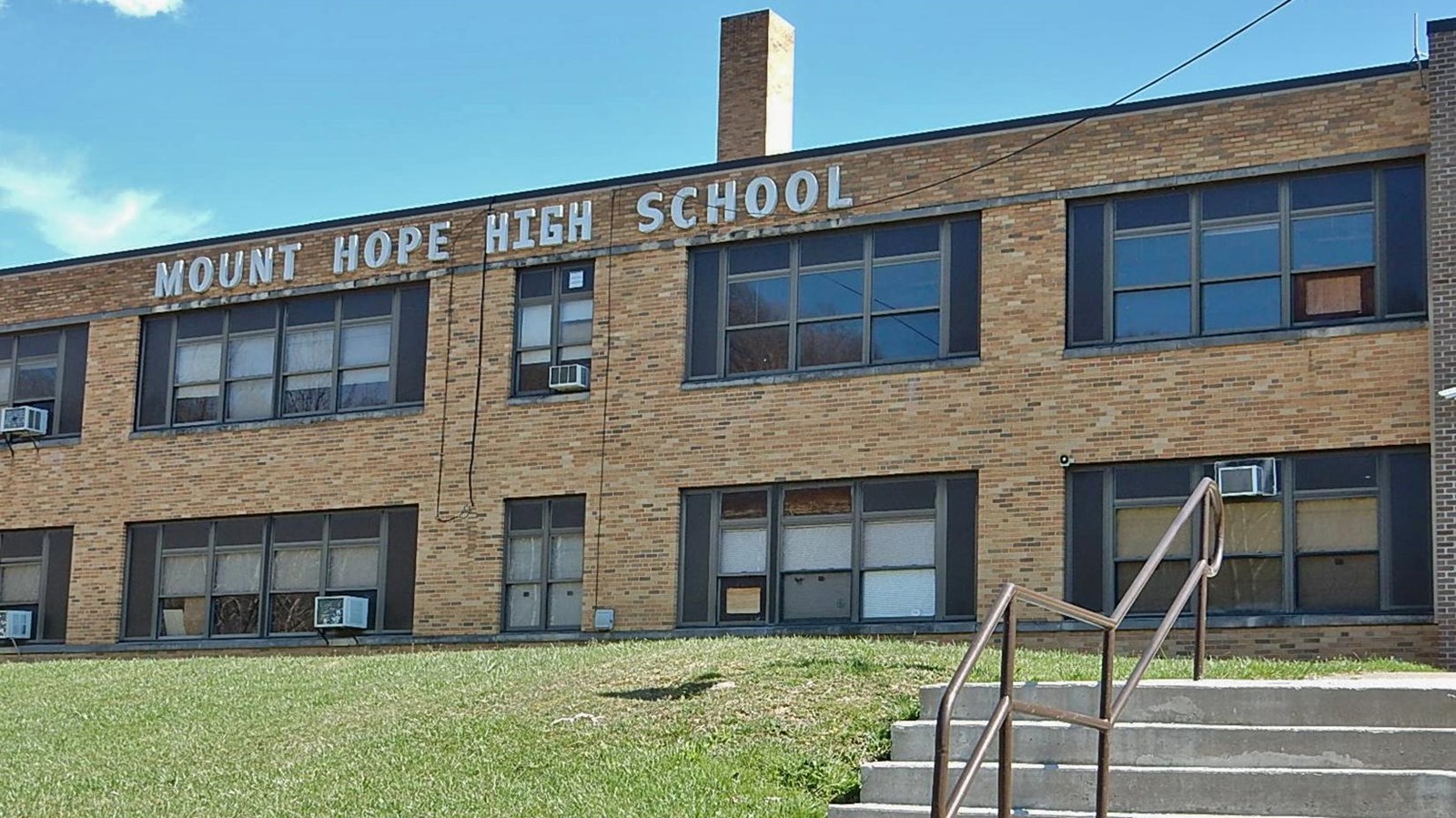
DuBois School, named after Dr. W. E. B. DuBois, an educator and civil rights leader on the staff of Howard University in Washington, DC., was the first high school for African Americans in Fayette County.
OPEN TO PUBLIC:
No
Amenities
1 listed
Historical/Interpretive Information/Exhibits
African American Heritage Driving Tour Stop 11: Integration of West Virginia Schools
If using the NPS app, to listen to the audio narrative, press the green button below or read the audio narrative text below.
This tour stop is not advised for trailers, RVs, or motorhomes due to limited parking and difficulty turning around.
Audio Narrative
Written by: Mark Bollinger
Narrated by: Joshua Flynn
On May 17, 1954, “Separate but Equal” became “Unequal.” That day, the United States Supreme Court ruled that segregated schools were unconstitutional. In West Virginia, school segregation was mandated by the State Constitution. West Virginia was one of seventeen states that had a dual school system; schools for whites and schools for blacks. At the time of the decision, there were 420,000 white and 26,000 black students attending school in West Virginia.1 Black students were not receiving an equal education. They were using outdated, second-hand books as well as band and school equipment passed down from white high schools.
The ruling did not come with specific recommendations; desegregation was left up to the individual states and often to the individual county school systems. By June of 1954, the institutes of higher learning in West Virginia had begun the process of desegregation. By September, twenty-nine of the forty-six West Virginia counties with African American students had also begun the process of integrating their K-12th grade schools.
Some counties were reluctant and slow to integrate their schools. A few remained segregated until the mid-1960s. Other school systems maintained their dual school system allowing lack students to attend an integrated school or continue to attend an all-black school. In most counties, desegregation went fairly smoothly; however, there were students and parents who protested against integration or boycotted efforts to integrate. None of these activities led to major violence.
In Fayette County, school officials announced that all schools would be integrated at the beginning of the 1956-57 school year. Here in Mount Hope, the older White high school was converted to a middle school. The White students were moved to the all-Black DuBois High School which was the newer and nicer of the two high school buildings. DuBois was renamed Mount Hope High School.
The results of integration affected each person differently. African American principals before desegregation were demoted to teachers after integration. Black teachers were the first to lose their jobs if there were not enough teaching positions at the combined schools. Male black students were allowed to play on the football and basketball teams, but they could not play other team sports. African American girls were not allowed to be on the cheerleading squad. Black students could not participate in band or chorus, or join White-only school clubs and organizations.
Artifacts, trophies, yearbooks, and records from many of the black high schools were burned or placed away in boxes and forgotten. Kathleen Scott attended the segregated DuBois High School. For her, the most significant effect of integration was losing many of her friends who lived in more distant communities. “Our friends from other parts of the county began going to high schools closer to where they lived,” she said. “And we didn’t get to see them anymore.” It took West Virginia school districts almost a decade to become fully desegregated, and the closing of the African American schools resulted in a loss of community identity for black residents.
Sources:
Stack, Sam. Integration E-WV: The West Virginia Encyclopedia. 29 October 2013.
Trotter, Joe William Jr. and Bickley, Ancella Radford, Honoring Our Past, Proceedings of the First Two Conferences on W.V’s Black History, Alliance for the Collection, Preservation and Dissemination of W.V.’s Black History, 1991
Bickley, Ancella R., … to be black in Fayette, The Centennial Committee of the Second Baptist Church of Fayetteville, West Viginia.
Woodson, Carter G. Early Negro Education in West Virginia The Journal of Negro History, Vol. 7, No. 1, Association for the Study of African American Life and History, 1922.
Jordan, Lawrence V. Racial Desegregation in Education in West Virginia, The Journal of Negro Education, Vol. 25, No. 3, Journal of Negro Education, 1956.
Additional Information
In 1906 a levy was passed in Fayette County to establish the county’s first high schools, one for white children and one for black children. Eleven years later, this became a reality for African American students when an eight room brick building was erected in 1917 on the hill above Dunloop Creek, across from the present day Mount Hope High School. The school was named after Dr. W. E. B. DuBois, an educator and civil rights leader on the staff of Howard University in Washington, DC.
DuBois High School offered many classes such as home economics, French, chemistry, world history, math, and English. Students could participate in the band that performed at football games and competitions. Boy’s football and basketball were the school’s main team sports. Girls could join the cheerleading squad, but there were no other sports for girls.
Tragedy struck in 1950, when the original schoolhouse was destroyed by fire. On January 30, 1954, the new DuBois High School opened its doors, again as an all-black high school. Two years later, in the fall of 1956, DuBois High School and the all-white high school in Mount Hope integrated and the school was renamed Mount Hope High School.
For the full story go to: Integration of Schools: DuBois High School; Mount Hope, WV
Other nearby places of interest:
DuBois on Main Museum
Mount Hope
Driving Directions:
Physical Address: 110 High School Drive, Mount Hope, WV 25880
GPS Coordinates: N37.898051 -W81.157067
From Beckley, WV: Take Highway 19 north to the exit for Glen Jean. Turn right at the stop light then right onto Highway 16/61 (there is an Exxon Station at this exit). Travel 2 miles to Mount Hope and turn right onto Virginia Street. Travel .1 of a mile and turn right onto High School Drive. Park at the gate and walk up to Tour Stop #11 at the old Mount Hope High School.
From Fayetteville, WV: Take Highway 19 south to the exit for Glen Jean. Turn left at the stop light then right onto Highway 16/61 (there is an Exxon Station at this exit). Travel 2 miles to Mount Hope and turn right onto Virginia Street. Travel .1 of a mile and turn right onto High School Drive. Park at the gate and walk up to Tour Stop #11 at the old Mount Hope High School.
Directions to the next Tour Stop:
Slab Fork
Physical Address: 374 Slab Fork Road, Slab Fork, WV 25920
GPS Coordinates: N37.686920 -W81.330368
From Tour Stop #11, return to Virginia Street and turn left. Travel .1 tenths of a mile to Highway 16 and turn right. Travel on Highway 16 south to the four-lane freeway at Highway 19. Turn right onto the entrance ramp to the freeway toward I-77/I-64. Take I-77 south to exit 42 and follow the exit ramp onto Highway 16 south/97 west toward MacArthur and Sophia, WV. Travel 3 miles on Highway 16 south/97 west. Move to the left lane and continue straight at the split onto Highway 121 (Coalfield Expressway). Travel 4 miles to Slab Fork Road. Turn right onto Stab Fork Road (Route 34) and travel to Slab Fork, WV. Tour Stop #12 and parking is at the old post office on the left coming into Slab Fork.
The requested video is no longer available.