



Last updated: June 16, 2026
Place
Donner Springs
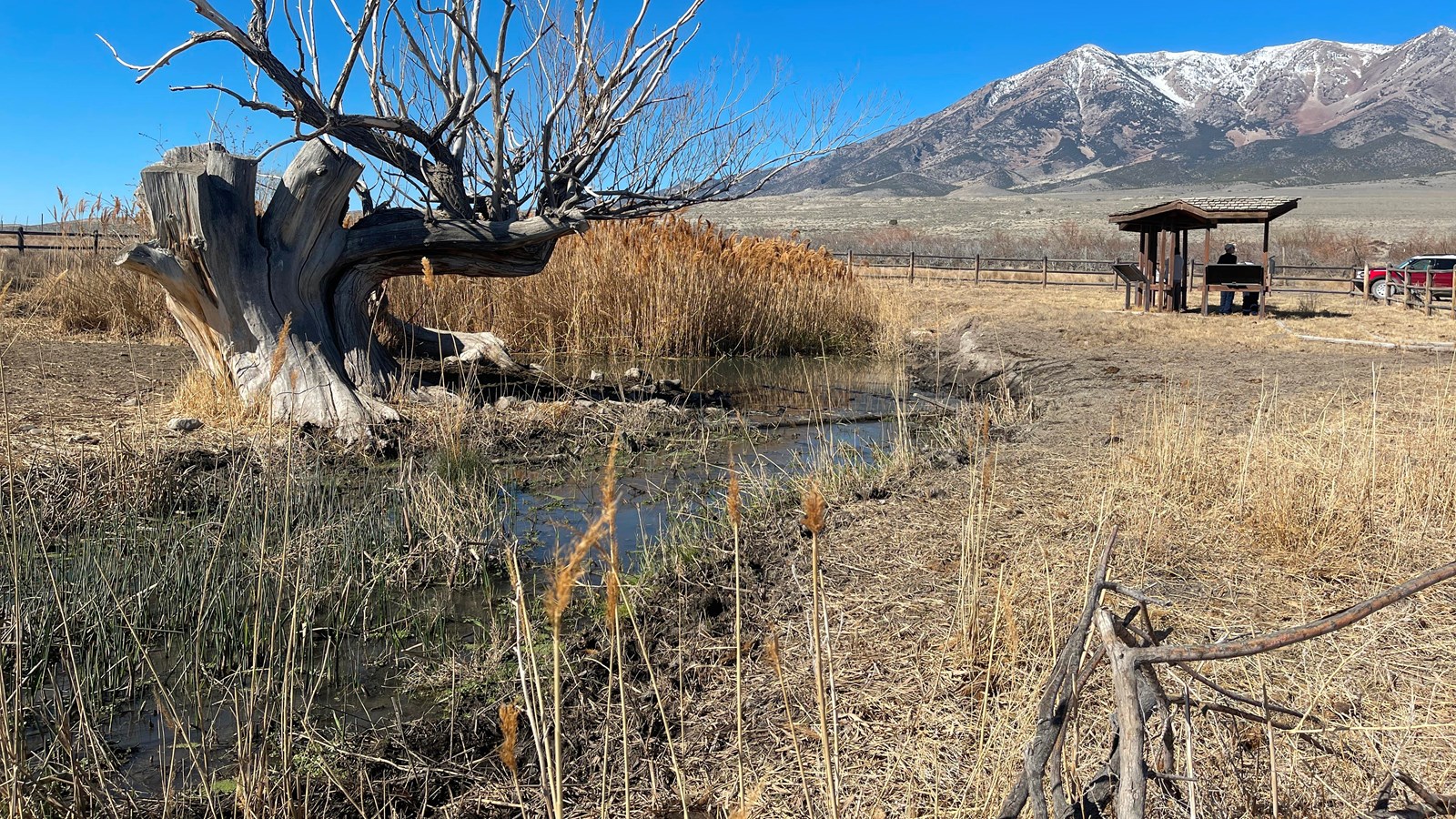
Photo/L. Kreutzer
Quick Facts
Location:
Private ranch on Pilot Mountain Road, approximately 20 miles north of Wendover, UT, near eastern foot of Pilot Mountain. GPS 41.021013 -113.968585
Significance:
At Donner Spring, near the eastern foot of Pilot Peak, emigrants and livestock finally quenched their thirst after crossing the barren Great Salt Lake Desert. The last good water source was Hope Wells, some 90 miles and 2 to 3 days’ travel behind them.
Designation:
Historic site on the California National Historic Trail.
OPEN TO PUBLIC:
No
MANAGED BY:
Private ownership - not open to the public.
Amenities
2 listed
Historical/Interpretive Information/Exhibits, Scenic View/Photo Spot
The transition between the salty mudflats and the meadow surrounding Donner Spring is abrupt, literally a line in the sand. In just one or two steps, the emigrant emerged from an unearthly, white plain of suffering, littered with abandoned wagons and dying livestock, into a green oasis of water and life. The first overlanders to cross the Hastings Cutoff in 1846 arrived on Aug. 3, bushwhacking through a thicket of willows, reeds, and grass to reach the cold, pure “fountain spring.”
Among that pack-mule party was Edwin Bryant, who claimed to have sounded the basin to a depth of 35 feet, and “no bottom found.” (A later emigrant estimated its depth at a more believable 5 feet.) Heinrich Lienhard rode up 16 days later after a 49-hour desert crossing on muleback, to find that advance members of his party had created a “wagon village” surrounding the waterhole. “In spite of long-sustained fatigue everyone was animated and happy,” the Swiss immigrant recorded in his native German. “The young girls gathered together and sang, while the young Americans danced to the squeaky sounds which a man…coaxed from his old fiddle, so that the dust eddied up in clouds; in short, one might have supposed the whole journey completed.”
The Donner-Reed Party, last to cross the Hastings Cutoff that season, straggled to the oasis in small groups Sept. 2-8. Delayed and exhausted by previously grubbing a trail through the Wasatch Mountains, their desert crossing had been horrific. James Reed, traveling with his wife and 4 young children, lost 9 yoke of oxen (18 animals) that stampeded into the desert, crazed by thirst. Despite days of searching, Reed recovered only an ox and a cow. With the help of borrowed oxen, he retrieved one of his 3 wagons, abandoning the others and many belongings to the salt desert. Others of the party left behind oxen and wagons, as well, when continuing along the trail toward the Humboldt River.
Life-saving Pilot Spring eventually came to be called Donner Spring for these ill-starred emigrants, who would face more dire troubles on the road ahead. The early gold rush years, 1849-1850, were busy ones at Donner Spring. Howard Stansbury’s eastbound team of topographical engineers arrived on Nov. 2, 1849. “Clothes, books, cases of medicine, wagon wheels, tools, &c., lay strewn about, abandoned by their owners, who had laboriously brought them two thousand miles only to throw them away,” Stansbury reported. Costmor Harris Clark, rescued by a “water wagon,” reached the oasis on Aug. 29, 1850. “This place has quite the appearance of a town,” he observed. “Tents are pitched on every side and men and women are moving about in every direction. And the beautiful plain which is watered by the streams flowing from a range of snow crowned mountains [the Pilot Range], are covered by animals luxuriating in ‘plenty.’” Clark was among the last overlanders to visit Donner Spring.
There is no further recorded use of the cutoff by emigrants in following years.
Site Information
Location (Private ranch on Pilot Mountain Road, approximately 20 miles north of Wendover, UT, near eastern foot of Pilot Mountain. GPS 41.021013 -113.968585)