



Last updated: June 11, 2026
Place
Devils Ladder, Carson Route
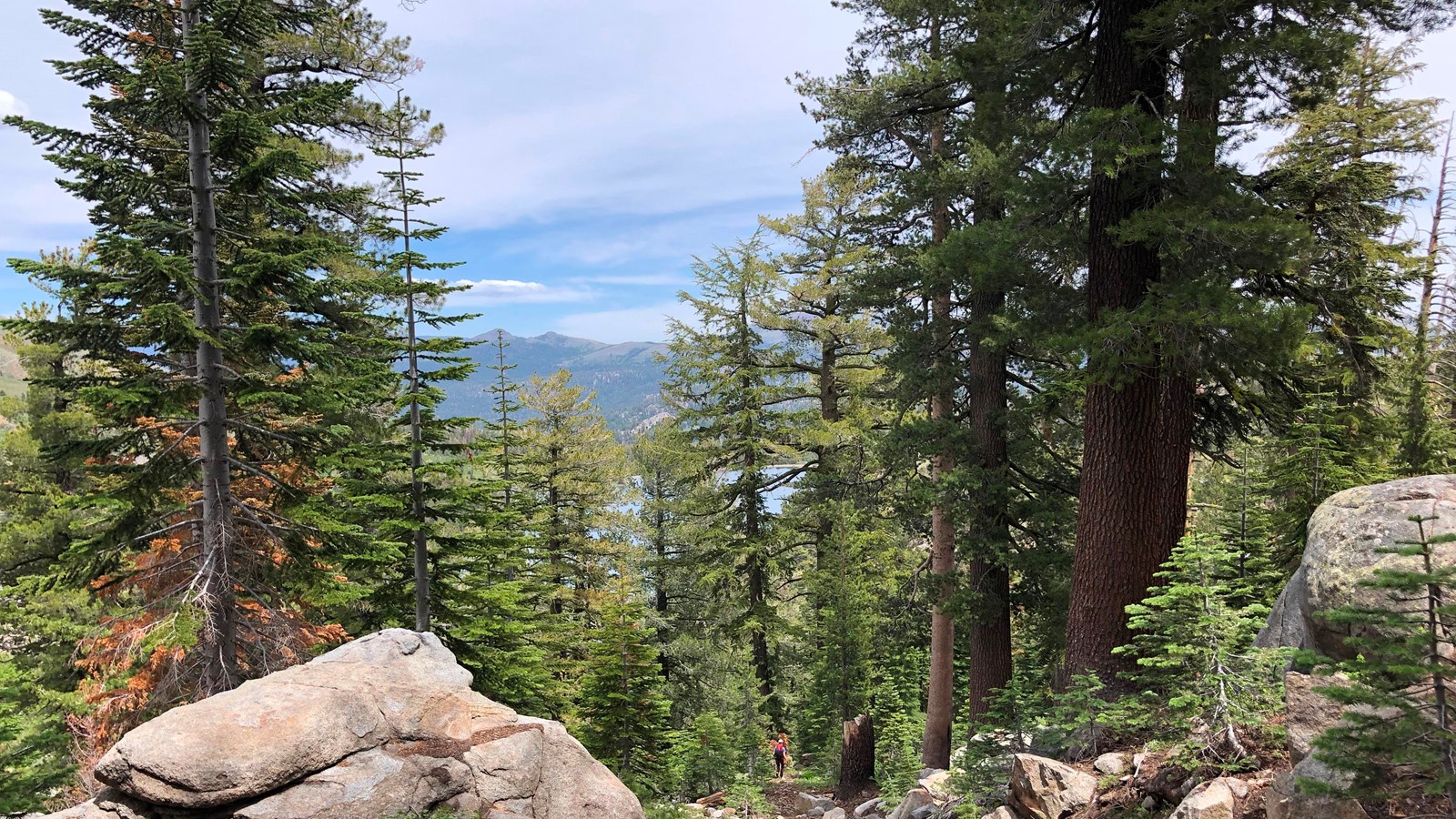
NPS Photo
Quick Facts
Location:
South side of CA-88, 8.8 miles southwest of Picketts Junction, intersection CA-88 and CA-89, California. Brown auto tour signs along the highway help direct visitors to the Devil’s Ladder entrance road.
Significance:
Devils Ladder was the treacherous, steep, 1-mile wagon climb to Carson Pass, the first summit of the Sierra Nevada on the Carson River Route. It is described in many emigrant journals.
Designation:
The Odd Fellows signature rock at Carson Pass is California Historic Landmark No. 378.; Pacific Crest National Scenic Trail passes through the Information Center complex; Historic site on the California NHT.
MANAGED BY:
Eldorado National Forest
Amenities
3 listed
Historical/Interpretive Information/Exhibits, Parking - Auto, Trailhead
After heaving their wagons up rough and rocky West Carson Canyon to reach Hope Valley, overlanders thought they had conquered the worst stretch of trail on the way west.
They had yet to meet Devil’s Ladder.
A half-day’s travel beyond heavenly Hope Valley, emigrants on the Carson River Route reached Red Lake, about a mile below Carson Pass. There, wrote Craig S. Plummer in 1850,
“the road came square against an almost perpendicular wall of rocks high as the clouds and covered with eternal snows.” One wit observed, “It was not only right up and down, but leant a little over,” and James Abbey in 1851 claimed “it was enough to kill an ox to look at.”
This obstacle was the headwall of a cirque—a steep-sided bowl cut into the granite mountainside by glacial ice. The wall rises 720 feet in 1/3 mile. A narrow track with footing of loose, rolling gravel zigzags up the forested, boulder-strewn scarp. Near the top lies a slick bedrock exposure, “Slippery Rock,” where iron-shod draft animals skidded and fell. The trail twists in impossibly tight turns that required men to lift the rear of their wagon and pivot it on its front wheels to face in the right direction. In many places, wrote forty-niner James Pritchard, the trail runs by cliff edges where, if a wagon and team were to slip off, “they would fall from 50 to 100 feet without touching anything.”
It happened. Devil’s Ladder surely deserved its name.
One evening in 1849, William Kelly rode his horse from camp at Red Lake to the foot of the escarpment to test the climb, but the horse “had as little idea of facing it as he would have of climbing a good wall."
The next morning, his party’s men started driving the pack animals up the trail. Occasionally, Kelly wrote, animals would fall and “come sliding down, knocking others off their legs. . . and others coming to their knees, remained like fixtures, fearing, if they stirred, they should come rolling down the whole way.” To get their vehicles up, the men attached long ropes to empty wagons and snugged the ends around trees ahead to prevent the vehicles from rolling backward. Despite the precautions, on the steepest pitch a wagon dragged its screaming team back “with awful violence,” Kelly recorded, seriously injuring two mules. In 1851, J. Wesley Jones witnessed a runaway wagon pull its team backward over a cliff “and they fell a mass of fragments at its base.”
Today’s visitors can access and hike the original wagon trail from near the summit of Carson Pass on CA-88. Huge, old pines are still girdled with scars from the ropes used to secure the wagons. Where the wagon trail continues beyond the parking area toward the pass, a boulder face with the names of an 1849 company of Odd Fellows (a fraternal service club) and the grave of an unknown emigrant are found. A few yards west on CA-88 is a US Forest Service Information Center with publications, exhibits, and restrooms. Purchase a parking pass for your visit there.
Site Information
Location (South side of CA-88, 8.8 miles southwest of Picketts Junction, intersection CA-88 and CA-89, California.)