



Last updated: April 2, 2026
Place
Comanche Lookout
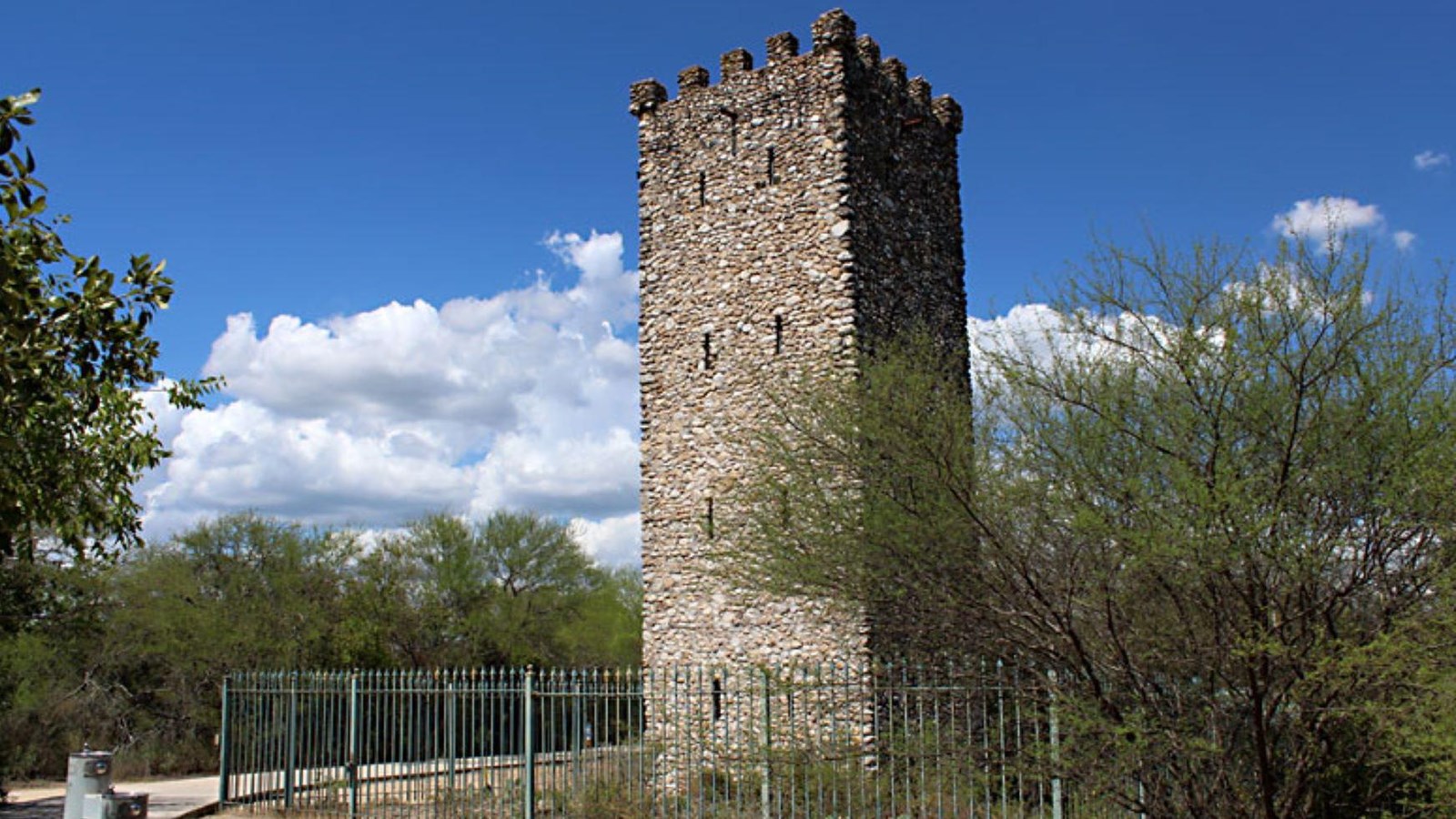
Photo/Gerald McLeod
Quick Facts
Location:
in Comanche Lookout Park, 15551 Nacogdoches Road, San Antonio
Significance:
The old Spanish road (one of several routes of El Camino Real or the Royal Road) from San Antonio to Bastrop and Nacogdoches in East Texas extended past the base of the hill. The road followed earlier American Indian travel routes, and today its remnants are known as Nacogdoches Road.
MANAGED BY:
Amenities
2 listed
Historical/Interpretive Information/Exhibits, Trailhead/Hiker Register
Located in northeastern San Antonio, Comanche Lookout, also known as Comanche Hill, is the fourth-highest point in Bexar County, and has served as a waypoint and lookout for thousands of years. Standing at an elevation of 1340 feet, it is an ideal spot for observing the surrounding landscape, including El Camino Real de los Tejas, which runs along its base.[1]
Comanche Lookout and the surrounding areas were once home to a variety of Coahuiltecan-speaking peoples. Archeological surveys of Comanche Hill have uncovered a dart point, stone tool, and several blade cores. While local folklore suggests that the hill holds buried treasure, archaeological investigations have not turned up any evidence to support this legend.[2] It is probable that these early inhabitants used the hill as a lookout for game, to scan for approaching allies and enemies, and as a reference point when traversing the landscape. These groups also blazed several paths near the hill that were later incorporated into El Camino Real de los Tejas.[3]
The arrival of Spaniards and the establishment of San Antonio marked the beginning of the displacement of the Coahuiltecans. As disease and warfare decimated their populations, some fled to nearby Spanish missions. Others went south to other parts of New Spain, pushed off their lands or taken captive and forced to labor in Spanish silver mines. Having acquired horses from the Spaniards, the Lipan Apache expanded their territory to the south. The Apache held complete control of the area around Comanche Lookout in the mid-1600s. Arriving in the mid-1700s, invading Comanche had pushed the Apache even further south by the early 1800s.[4] It is possible that both groups used Comanche Hill as a camp site and observation post during expeditions to trade with or make war against the Spanish settlers.
As San Antonio grew and Spanish settlements spread throughout Texas, the trails near Comanche Hill were incorporated into El Camino Real, linking San Antonio with other settlements in Texas and connecting it to French Louisiana. During the Texas Revolution, it is possible that soldiers from both the Mexican and the Texan armies used Comanche Hill as a vantage point.
The Comanche Lookout property has had several documented owners throughout its history. At one point, the land was owned by Mirabeau Lamar, the second president of the Republic of Texas (1838-41).[5] Later, the property was owned by Gustav and Adolph Reed, two brothers who had immigrated from Germany. Gustav Reed eventually sold the land to Colonel Edward Coppock.[6]
Coppock’s 44 years of service with the U.S. Army included campaigns against the Apache and Sioux, the Spanish-American War, and the Philippine-American War.[7] After battling the Central Powers during World War I, he retired from the military and purchased land in Texas.[8] Coppock had ambitious plans for Comanche Lookout and erected multiple homes, a lodge, a water tower, a corral, tennis courts, several large sculptures, and a barbequing area. Inspired by the fortifications of medieval England, he ordered the construction of a large stone tower, which he planned to expand into a complete castle.[9]
Coppock’s death in 1948 put an end to his development of Comanche Hill. In the ensuing years, fire destroyed some of the structures and a developer who purchased the land in 1968 razed most of what remained, leaving the tower as the lone remnant of Coppock’s ownership.[10] The City of San Antonio eventually purchased Comanche Lookout in the 1990s and turned it into a public park.[11] Today, the park offers trails, a playground, fitness equipment, public art, and a picnic area for public use. While Coppock’s tower is not open to the public, visitors can still stand atop the hill and take in the landscape just as people have done for thousands of years.
Site Information
Location (in Comanche Lookout Park, 15551 Nacogdoches Road, San Antonio)
Available Facilities
This scenic park features a vantage point, playground, picnicking areas, and trails for hiking.
More site information
El Camino Real de los Tejas National Historic Trail
[1] “Comanche Lookout,” Historical Marker Database, https://www.hmdb.org/m.asp?m=157297 (accessed on October 20, 2024); “Comanche Lookout Park,” San Antonio Department of Parks and Recreation, https://www.sanantonio.gov/ParksAndRec/Parks-Facilities/All-Parks-Facilities/Parks-Facilities-Details/ArtMID/14820/ArticleID/2680/Comanche-Lookout-Park-/Park/45 (accessed on May 31, 2024).
[2] David L. Nickels, “An Archaeological Investigation of Comanche Lookout Park, Northeast Bexar County, Texas,” Index of Texas Archaeology, Volume 1998, no. 11, (1998), pg. 9, 12, 14-15; Athena Hessong, “Comanche Lookout Park History: The Past of a San Antonio Landmark,” Texas Hill Country, https://texashillcountry.com/comanche-lookout-park-history/ (accessed on December 9, 2024).
[3] “Comanche Lookout,” National Park Service, https://www.nps.gov/places/comanche-lookout.htm (accessed on December 9, 2024).
[4] Nickels, “An Archaeological Investigation,” pg. 9, 11; “Native Peoples of the South Texas Plains During Early Historic Times,” Texas Beyond History, https://www.texasbeyondhistory.net/st-plains/peoples/index.html (accessed on December 9, 2024).
[5] “Comanche Lookout Park,” San Antonio Department of Parks and Recreation.
[6] Gerald E. McLeod, “Day Trips: Comanche Lookout Park, San Antonio,” Austin Chronicle, https://www.austinchronicle.com/columns/2020-09-11/day-trips-comanche-lookout-park-san-antonio/ (accessed on May 31, 2024).
[7] Nickels, “An Archaeological Investigation,” pg. 10.
[8] Nickels, “An Archaeological Investigation,” pg. 10.
[9] Nickels, “An Archaeological Investigation,” pg. 10.
[10] “Comanche Lookout Park,” San Antonio Department of Parks and Recreation.
[11] “Comanche Lookout Park,” San Antonio Department of Parks and Recreation.