



Last updated: April 2, 2026
Place
Casa Navarro State Historic Site
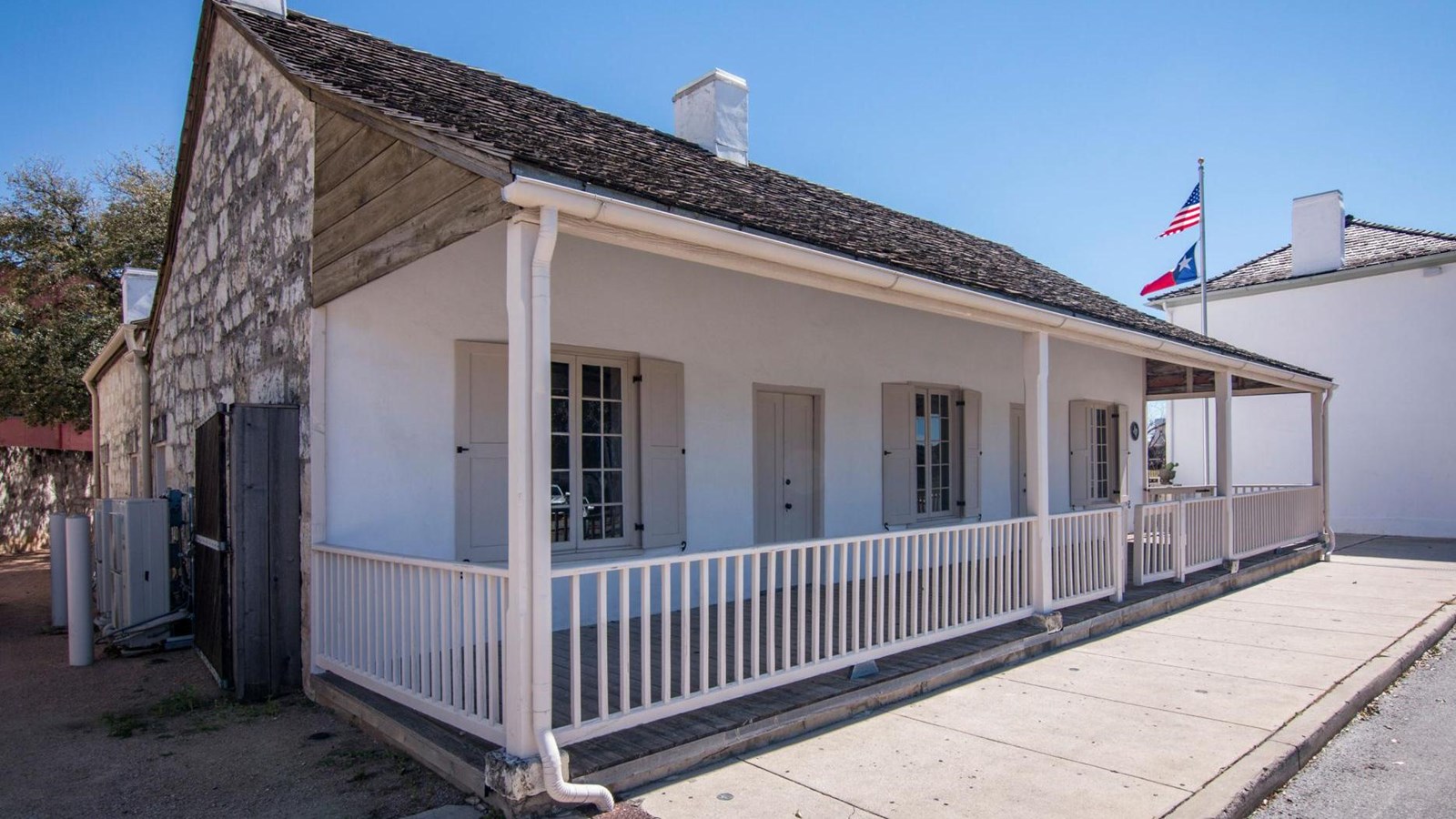
Photo/Texas Historical Commission
Quick Facts
Location:
228 S. Laredo St., San Antonio, Texas
Significance:
Casa Navarro celebrates the life of a tireless advocate of Texas independence.
Designation:
Texas State Historic Site, National Historic Landmark, National Register of Historic Places
MANAGED BY:
Amenities
1 listed
Historical/Interpretive Information/Exhibits
In downtown San Antonio, along El Camino Real de los Tejas, lies the historic home of José Antonio Navarro, a Tejano leader in the Texas independence movement. Navarro’s actions helped transform Texas from a Spanish colony to a part of the United States and, in so doing, impacted the history of El Camino Real.
Born to a politically and commercially prominent family, Navarro grew up in San Antonio de Béxar in what was then northern New Spain. In 1813, he backed the Gutiérrez–Magee Expedition, a revolt against Spanish rule in Texas. After the expedition’s failure, Navarro fled to the United States. Returning home in 1816, he followed in his father’s footsteps by becoming a merchant, making deals and facilitating transactions along El Camino Real and working with partners in New Orleans to import goods from Europe.[1] Navarro was also involved in ranching and land speculation, which became very profitable as Anglo Americans continued to arrive in Texas along El Camino Real.
As Navarro grew his businesses, he became more interested in politics. As a landowner, he saw the value in opening Texas to more immigration, which would increase the value of his land.[2] His travels to New Orleans allowed him to build alliances with prominent Americans. After Mexico secured its independence from Spain, he served in the Coahuila y Tejas state legislature and the federal legislature in Mexico City. [3]
During his travels, Navarro became an ally of Virginia-born empresario Stephen Austin, an advocate for Anglo-American immigration who hoped to settle 300 families in Texas.[4] Navarro supported Austin’s plans. In the legislature, he advocated for increased immigration to Texas, arguing that it would help grow the economy and lessen the threat of Comanche raids.[5] He also worked to defeat anti-slavery legislation that would have forbidden American settlers from bringing enslaved people into Texas along El Camino Real, and bitterly complained when Mexico abolished slavery nationally.[6]
As relations between Mexico and Anglo Texans deteriorated, Navarro supported Texan independence. He was one of two Texas-born Tejanos to sign the Texas Declaration of Independence. Years later, Navarro voted for annexation to the United States during the Convention of 1845 and helped write the 1845 state constitution.[7] The state named Navarro County after him in recognition of his contributions to Texas independence and statehood.
Navarro acquired property in 1832 at the corner of San Antonio’s Laredo and Nueva streets, and he ordered the construction of a house there in the 1850s.[8] Laredo Street was then part of El Camino Real, although usage of the route had begun to decline by the time of the house’s construction.
During Navarro’s time at his Laredo Street home, Anglo Texans were increasingly working to restrict the rights of Tejanos. Navarro fought against this tide of discrimination. In the 1850s, he wrote a series of essays on the role of Tejanos in Texas history, intended to counter the unfavorable portrayals present in Anglo-American histories.[9] It is possible that some of these articles were drafted in the house.
Navarro was a long-time foe of Sam Houston, president of the Republic of Texas and later state governor. He saw Houston’s support of the anti-immigrant and anti-Catholic Know Nothing Party as a betrayal of the state’s Catholic Tejano citizens. He also disapproved of Houston’s pro-Union views during the 1860–1861 secession crisis. When the Civil War broke out, Navarro sided with the Confederacy and his four sons fought in Confederate units.[10]
Navarro died in 1871. After years of neglect, Casa Navarro was restored in the 1960s by the San Antonio Conservation Society. Today, it is one of the oldest structures in San Antonio. Casa Navarro State Historic Site is currently managed by the Texas Historical Commission and offers guided tours and field trips for students. Visitors can get a sense of Tejano life in the 1850s, when Navarro occupied this historic home.
Site Information
Location (228 S. Laredo St., San Antonio, Texas)
The Navarro complex contains three structures: the house, which dates to the 1850s; a kitchen, constructed in the 1830s; and a two-story office building/commercial space, also from the 1850s.
More site information
El Camino Real de los Tejas National Historic Trail
[1] “Casa Navarro History,” Texas Historical Commission, accessed on August 26, 2024, https://thc.texas.gov/state-historic-sites/casa-navarro/casa-navarro-history
[2] “Casa Navarro History,” Texas Historical Commission.
[3] Texas State Library and Archives Commission, “José Antonio Navarro,” accessed on September 19, 2024, https://www.tsl.texas.gov/treasures/giants/navarro/navarro-01
[4] Ibid.
[5] Cody Copeland, “The First Tejano Historian,” Lapham’s Quarterly, accessed September 19, 2024, https://www.laphamsquarterly.org/roundtable/first-tejano-historian
[6] Copeland, “The First Tejano Historian.”
[7] Stanley Siegel, “Navarro, Jose Antonio,” Texas State Historical Association, accessed September 19, 2024, https://www.tshaonline.org/handbook/entries/navarro-jose-antonio
[8] Ibid.
[9] Copeland, “The First Tejano Historian.”
[10] Texas State Library and Archives Commission, “José Antonio Navarro”; Siegel, “Navarro, Jose Antonio.”