



Last updated: June 2, 2026
Place
Caesar Rodney Statue
DOI / Joe Milmoe
Quick Facts
Location:
Freedom Plaza, Washington, DC
Amenities
1 listed
Scenic View/Photo Spot
Caesar Rodney: A Legacy of Resolve and Independence
As the United States approaches its 250th anniversary, Americans are taking time to reflect on the individuals whose courage and determination shaped the nation’s earliest moments. Among them is Caesar Rodney, a Delaware statesman whose legendary ride on July 1–2, 1776, became a decisive turning point in our nation’s quest for independence.
Rodney’s journey has long stood as a symbol of personal sacrifice in service to the ideals of liberty. Gravely ill with a long-standing cancerous condition affecting his face and jaw that caused him chronic pain, Rodney received urgent word that Delaware’s vote for independence was deadlocked. Knowing the gravity of the moment, he mounted his horse and rode nearly 80 miles through darkness, rain, and a violent storm to reach Philadelphia. His arrival broke the tie, allowing Delaware to cast its vote in favor of independence on July 2, helping to secure the adoption of the Declaration of Independence.
The statue of Caesar Rodney commemorates not only this dramatic ride but also his broader contributions as a colonial leader, military officer, and public servant. Throughout his career, Rodney worked to balance the challenges of a divided colony, the demands of wartime leadership, and the emerging ideals that would define a new nation.
As Americans visit historic and cultural sites across the country, Rodney’s story invites reflection on the many individuals, well-known and lesser-known, whose efforts helped build the United States. By exploring these narratives in full, including their triumphs and complexities, visitors gain a deeper understanding of the nation’s ongoing journey toward a more perfect union.
Rodney’s legacy endures as a reminder that the path to independence relied on acts of extraordinary resolve from ordinary people. His ride is one chapter in a much larger story, but it continues to inspire all who seek to understand the origins of American freedom.
Biography
Caesar Rodney (1728–1784) was a farmer, legislator, and Revolutionary-era leader from Kent County, Delaware. Born into a prominent family, Rodney spent much of his early adulthood managing agricultural land and serving in a variety of civic roles, including sheriff, assemblyman, and militia officer. Over time he emerged as one of Delaware’s most experienced political figures, known for his ability to navigate the challenges of a divided colony and the growing tensions with Great Britain.
Rodney served as a member of the Continental Congress, a brigadier general of Delaware’s militia, and later as president (governor) of Delaware during the war. His public life was marked by ongoing health difficulties stemming from a chronic cancerous condition affecting his face and jaw. Despite this illness, Rodney remained a persistent advocate for unity within Delaware and for the broader cause of American independence.
Rodney’s Ride & the Importance of Unanimous Consent
Rodney’s most well-known contribution to the Revolution occurred on the night of July 1, 1776.
In late June 1776, delegates to the Continental Congress conducted an informal test vote on independence. The results revealed deep divisions: Pennsylvania and South Carolina opposed the motion, Delaware’s delegates were split, and New York abstained. Although the majority favored independence, many leaders believed that declaring a new nation required the united support of all colonies. A divided vote, they argued, would undermine both the legitimacy and the long‑term success of the cause.
While away from Philadelphia attending to militia matters in Delaware, Rodney received urgent word that Delaware’s delegates to the Continental Congress were split on the question of independence. With the pivotal vote approaching, Rodney set out on a journey of nearly 80 miles through heavy rain and stormy night conditions to reach Philadelphia in time to cast Delaware’s deciding vote.
With Rodney present on July 2, Delaware cast its vote in favor of independence. South Carolina shifted its position as well, and Pennsylvania’s delegation realigned after further debate. Although New York continued to abstain pending instructions from its provincial congress, no colony voted against independence. The result was unanimous support among all voting colonies, a crucial show of unity at a turning point in American history.
Rodney’s determination helped secure the consensus that many delegates believed essential for the new nation’s credibility. His ride has since become a lasting symbol of the lengths to which individuals went to achieve colonial unity and advance the principles of liberty and representative government.
The Equestrian Statue
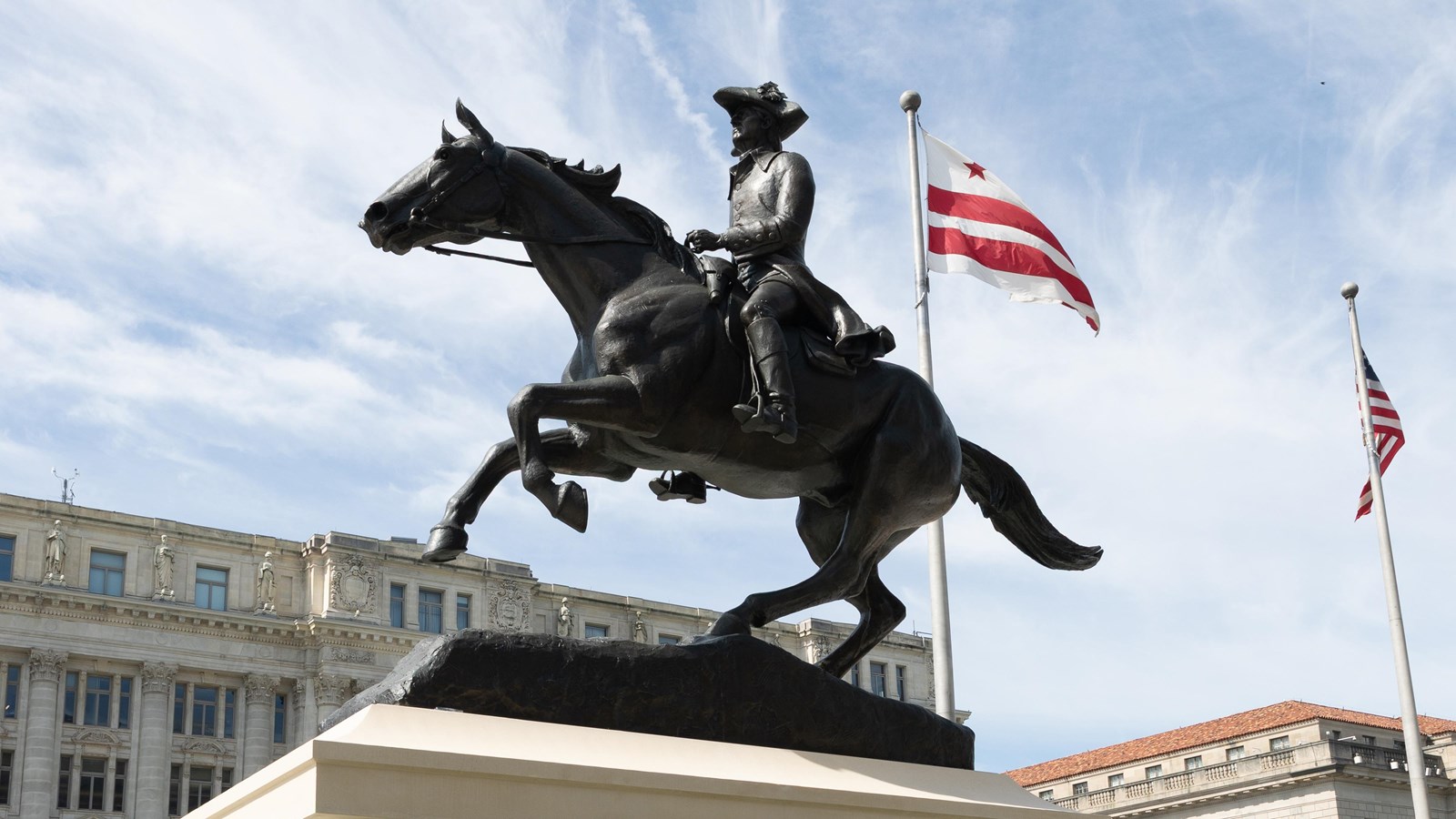
This statue of Caesar Rodney commemorates the dramatic overnight ride and the broader legacy of his service to the nation. Depicted on horseback, Rodney is shown pressing forward through rough weather, an image intended to capture determination, urgency, and sacrifice. Installed as part of efforts to interpret the early years of the American Revolution, the statue has long served as a reminder of the individuals whose actions shaped the outcome of the Continental Congress.
-
Sculptor & Commission: James Edward Kelly (1855–1933), a New York-based artist renowned for his late 19th-century Civil War sculptures and illustrations, was selected by the Caesar Rodney Equestrian Statue Executive Committee, a civic group formed to fund the memorial. They sought to frame Rodney as a heroic figure of patriotic sacrifice.
-
Material & Design: Cast in bronze by the Gorham Company of Rhode Island and mounted on a granite pedestal, the statue portrays Rodney mid-ride on a rearing horse, capturing movement and dramatic tension. Like many equestrian monuments, the statue required careful engineering to support the dynamic pose of a rearing horse. Kelly designed the composition so that the horse’s tail and stance helped distribute the sculpture’s weight and ensure its stability.
-
Dedication & Public Reception: The statue was officially dedicated on July 4, 1923, aligning with the city’s commitment to a City Beautiful initiative that sought to enrich urban spaces and civic pride. The unveiling coincided with celebratory Independence Day ceremonies, reinforcing Rodney’s image as Delaware’s founding hero. Local newspapers of the era praised the statue as a “masterful tribute” to Rodney’s courage and Delaware’s Revolutionary heritage.
Rodney’s Role in Delaware
Throughout the Revolution, Rodney played a central role in managing Delaware’s internal divisions. The colony, geographically and politically situated between strongly differing viewpoints, often struggled to maintain consensus. As president of Delaware from 1778 to 1781, Rodney directed military preparedness, oversaw administrative reforms, and worked to ensure the state’s continued participation in the war effort.
His leadership reflected the challenges facing many early American states: balancing local interests, responding to wartime demands, and helping lay the foundations for a new national government. Rodney’s efforts contributed to Delaware’s stability during a turbulent period and helped secure its position within the emerging United States.
Faith and Conviction
A devout Episcopalian, Rodney grew up in a family with strong Anglican ties, his maternal grandfather was a rector. His religious background shaped his sense of duty and moral purpose. Although not known for overt religious leadership, Rodney’s sense of right and communal responsibility was informed by his faith. This spiritual grounding reinforced his resolve during crises, most notably, the cold night of his ride. His faith provided a private but firm underpinning to his public commitments and the personal costs he bore.
Slavery and Early Abolition Efforts
Much like George Washington, Caesar Rodney was a slave owner: his family’s large plantation, “Byfield,” was worked by slave labor. Despite inheriting the institution and holding financials ties to it, Rodney did take public action to abolish slave trading within the Delaware colony. Upon his death, his will freed several elderly enslaved people immediately and arranged freedom for others he held at the time.
As a legislator in 1766, Rodney participated in efforts with the Delaware General Assembly to restrict the importation of enslaved people into the colony. Though it did not abolish slavery outright, the bill marked a significant early effort to restrict the growth of slavery in Delaware. His actions reflect the tension between Rodney’s economic reliance on slave labor and his evolving concern over the institution's expansion.
Rodney’s complex legacy, as both slaveholder and emergent reformer, offers insight into the contradictory currents of early American history. Understanding Rodney’s connection to slavery alongside his pioneering legislative action provides a fuller account of the challenges faced by the nation’s founders.
Independence and the Changing Landscape of Slavery
Caesar Rodney’s vote for independence contributed to a turning point in American history that would, over time, reshape the institution of slavery. The Declaration of Independence established a new political framework rooted in the principles of natural rights and human equality. Although these ideals were not fully realized at the time, and slavery remained deeply entrenched, the act of breaking from Great Britain placed the colonies in charge of determining their own laws, economies, and social institutions.
In the years that followed, these newly articulated principles inspired early antislavery movements and legislative efforts across several states. Northern states, beginning shortly after independence, passed gradual emancipation laws, citing the same ideals expressed in 1776. The Revolution’s emphasis on liberty and self-government created space for growing public debate, religious activism, and legal challenges that questioned the compatibility of slavery with the founding principles.
While Rodney himself did not witness the end of slavery, his vote helped bring about the political independence that allowed Americans to confront and ultimately abolish the practice. The struggle was long and uneven, but the commitment to the ideals declared in 1776 set in motion a national conversation, one that would continue for generations, about how the United States could more fully live up to the promise of freedom.
Capitol Tribute to Caesar Rodney
In 1934, Delaware donated a marble statue of Caesar Rodney to the National Statuary Hall Collection in the U.S. Capitol. Crafted by sculptor Bryant Baker, the statue is located in the Capitol’s Crypt and honors Rodney’s roles as a Continental Congressman, Revolutionary leader, and first president of Delaware.
Bicentennial Celebrations of 1976
During America’s Bicentennial in 1976, Delaware embraced Caesar Rodney’s legacy as central to its identity. Public ceremonies re-enacted his historic ride and highlighted his enduring significance:
-
Historic re-enactments: On June 30–July 1, 1976, a two-day pageant traced Rodney’s legendary night ride from Dover to Philadelphia. State troopers and civic groups guided a “Rodney” rider along the original route, culminating in a procession at Independence Hall and a formal ceremony in Wilmington’s Rodney Square featuring bands, choruses, and civic leaders.
-
Commemorative publication: The Delaware American Revolution Bicentennial Commission released a booklet titled Caesar Rodney—Patriot: Delaware’s hero for all times and all seasons. It lauded Rodney as “Delaware’s principal hero of the American Revolutionary War,” an emblematic figure whose story “rides through American history as the patron saint of his native state.”
These celebrations reaffirmed Rodney’s place in Delaware’s founding narrative and reflected the broader national effort in 1976 to revisit the ideals and sacrifices of the American Revolution through public commemoration.
Legacy
As the United States approaches its 250th anniversary, Rodney’s story serves as a lens through which to understand the experiences of the people who shaped the nation’s early history. His ride, long celebrated in American memory, highlights themes of duty, perseverance, and the difficult decisions that accompanied the pursuit of independence.
By exploring stories like Rodney’s, alongside the many others who contributed to the founding of the nation, visitors gain a deeper appreciation for the diverse experiences that have influenced the American journey. Each perspective, each challenge, and each moment of determination forms part of the larger narrative of a nation continually striving toward its ideals.