



Last updated: May 5, 2026
Place
Baumann Family Village Sites - Ranchería Grande
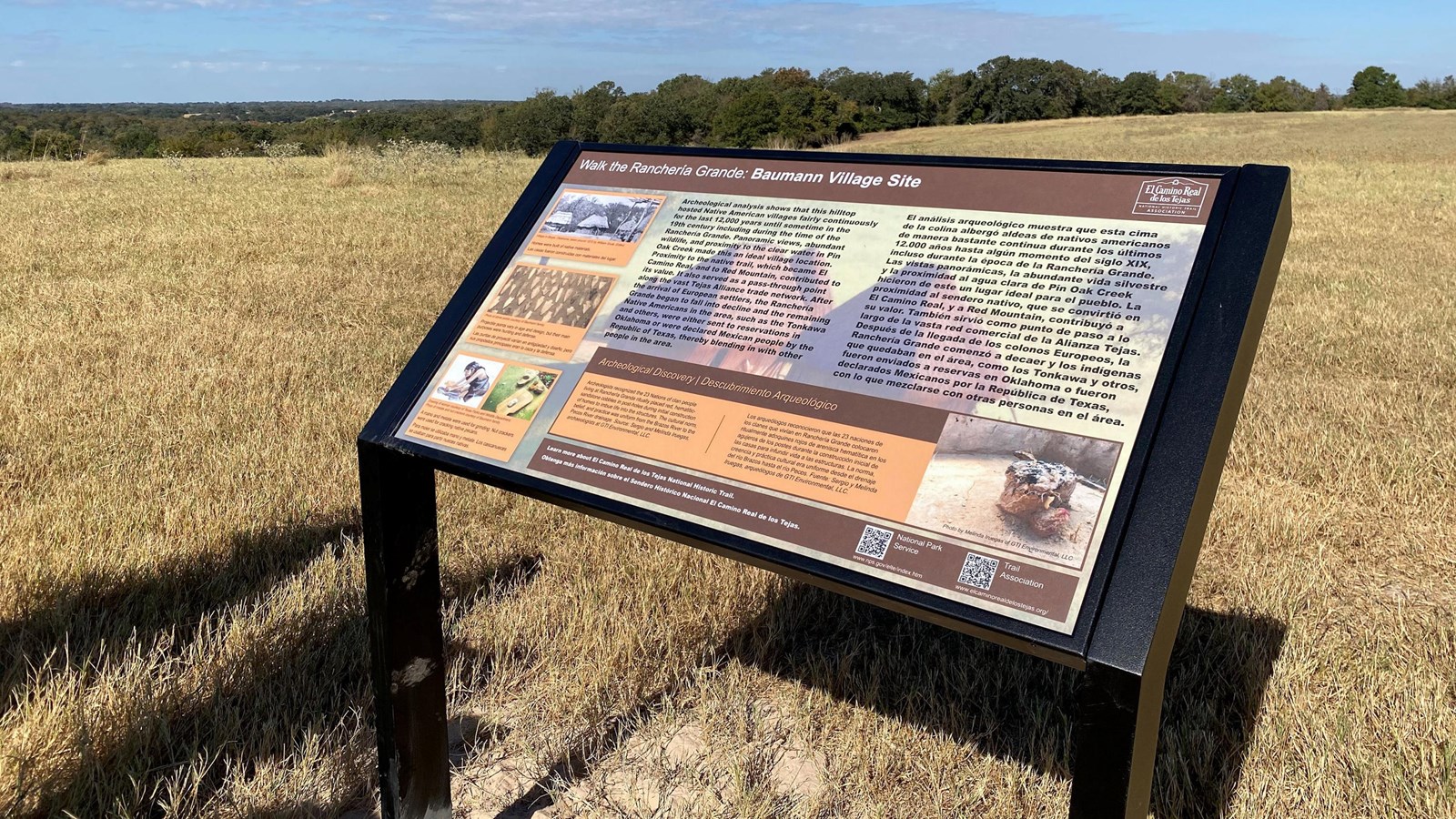
Photo/El Camino Real de los Tejas National Historic Trail Association
Quick Facts
Location:
n/a
Significance:
A rich archaeological zone in an area of intercultural contact.
Designation:
Certified Site; Historic site on El Camino Real de los Tejas NHT.
OPEN TO PUBLIC:
No
MANAGED BY:
Private
Amenities
1 listed
Historical/Interpretive Information/Exhibits
In 1716, Spanish military officer Domingo Ramón led an expedition of Spanish explorers, officials, missionaries, and soldiers from Mexico City to East Texas. Arriving in today’s Milam County, Texas, the expedition encountered a collection of Indigenous villages that stretched for miles. The Spaniards called it Ranchería Grande, or ‘big village.’[1] Cooperating in trade and defense, people belonging to more than 20 Indigenous nations lived there in the bottomlands around the Brazos River. A network of trails, many of which would eventually be incorporated into El Camino Real de los Tejas, connected the villages of Ranchería Grande with each other.[2] While little aboveground evidence for Ranchería Grande exists today, archeological resources like the Baumann Family Village Sites offer archeologists, historians, and the public the chance to better understand the history of this area and the Indigenous history of El Camino Real.
The first European record of the site, written by Spanish officer Domingo Ramón, estimated 2,000 people living in Ranchería Grande.[3] Some Indigenous groups had been living there for hundreds or perhaps thousands of years. Archeological evidence suggests, in fact, that people have lived in the vicinity of Ranchería Grande for at least 10,000 years, taking advantage of the area’s abundant water and fertile land. Others were more recent arrivals, seeking refuge from Apache raiding or from abuse and coercion at Spanish missions in San Antonio or along the Rio Grande.[4]
Indigenous peoples also had cosmological connections to the Ranchería Grande area, which they retain to this day. Naton Samox, meaning “Red Mountain” in the Tonkawa language—and also known today as Sugarloaf Mountain—is a sandstone hill overlooking the Brazos and Little rivers, as well as the floodplains where Ranchería Grande was located. Because of its prominence, it was an important landmark along El Camino Real. Red Mountain was held to be sacred by many of the Indigenous nations that called the area home, particularly the Tonkawa, who consider the mountain part of their tribe’s creation story.[5]
The nations of the Ranchería Grande found themselves displaced by targeted Apache raids as well as French and Spanish expansion in present-day East Texas and Louisiana.[6] Over the next century, as threats increased and their numbers decreased due to warfare and disease, the peoples of Ranchería Grande joined with other local Native American groups, particularly the Tonkawa, eventually losing their tribal identities. The United States government forcibly removed the Tonkawa from their ancestral lands in the mid-1800s. Despite decades of displacement, however, Tonkawa leaders rediscovered the connection to their homeland and Red Mountain in the 1980s, through stories passed down over generations and documents in Spanish-language archives. In December of 2023, after years of effort, the Tonkawa reclaimed the sacred site after tribal leaders purchased Red Mountain and the surrounding land.[7]
Today, the National Park Service and the El Camino de los Tejas National Historic Trail Association work with landowners to interpret the camino’s history. The Baumann Family has cooperated with efforts to study the trail, allowing access to their land for archeological and oral history research. Excavations done on the Baumann property have revealed that the site was occupied by Indigenous people for 12,000 years prior to the 1800s. Evidence of thatched huts—likely associated with Ranchería Grande—dates from the Spanish Colonial Period.[8] Excavations have also revealed the presence of hearths and arrowheads from the Late Prehistoric and Historic Periods (1400-1700 CE).[9] Archaeologists have also identified traces of El Camino Real de los Tejas in the area, including one swale on Baumann land and another six at the nearby Cedar Hill Nature Preserve.[10]
Site Information
Location/Access (this site is not open to the public.)
More site information
Exhibit with Audio Description Available
Conner Swale Site - Ranchería Grande
El Camino Real de los Tejas National Historic Trail
[1] Robert Weddle, “Rancheria Grande,” Texas State Historical Association, April 30, 2019, https://www.tshaonline.org/handbook/entries/rancheria-grande (accessed on December 5, 2024); Donald E. Chipman, “Ramón, Domingo (unknown–1723),” Texas State Historical Association, August 4, 2020, https://www.tshaonline.org/handbook/entries/ramon-domingo (accessed on December 5, 2024); Andy Rhodes, “La Rancheria Grande, Donde Vivia,” The Medallion 56, no. 1 (Winter 2018): pdf p. 5, https://www.thc.texas.gov/public/upload/publications/THC_medallion_winter_2018.pdf (accessed on December 5, 2024).
[2] Michael Barnes, “Rancheria Grande was the big city back in the 1700s,” Austin-American Statesman, September 15, 2016, https://www.statesman.com/story/news/2016/09/15/rancheria-grande-was-the-big-city-back-in-the-1700s/10043104007/.
[3] Herbert E. Bolton, "The Founding of the Missions on the San Gabriel River, 1745-1749," The Southwestern Historical Quarterly, April 1914, Vol. 17, No. 4 (Apr. 1914): 329-330; Weddle, “Rancheria Grande.”
[4] Bolton, "The Founding of the Missions on the San Gabriel River, 1745-1749," p. 330.
[5] Michael Barnes, “Sugarloaf Mountain sold back to Tonkawa tribe after 140 years,” Austin American Statesman, December 28, 2023, https://www.statesman.com/story/news/history/2023/12/28/tonkawa-tribe-central-texas-sacred-sugarloaf-mountain-native-americans-herzog-milam-county/71903887007/ (accessed on December 5, 2024); Andy Rhodes, “La Rancheria Grande, Donde Vivia.”
[6] Iruegas and Iruegas, Rancheria Grande at Los Brazos De Dios, pg. 30.
[7] Barnes, “Sugarloaf Mountain sold back to Tonkawa tribe after 140 years;” Thomas N. Campbell, “Ervipiame Indians,” Texas State Historical Association, July 1, 1995, https://www.tshaonline.org/handbook/entries/ervipiame-indians (accessed on December 5, 2024).
[8] Iruegas and Iruegas, Rancheria Grande at Los Brazos De Dios, pg. 112; “Baumann Village Site,” Cedar Hill Nature Preserve, https://cedarhillnaturepreserve.com/baumann-village-site (accessed on December 5, 2024).
[9] Iruegas and Iruegas, Rancheria Grande at Los Brazos De Dios, pg. 149.
[10] “Conner Swales,” Cedar Hill Nature Preserve, https://cedarhillnaturepreserve.com/conner-swales (accessed on December 5, 2024).