



Last updated: April 2, 2026
Place
Bastrop State Park
Photo/Texas Parks and Wildlife Department
Quick Facts
Location:
100 Park Road 1A, Bastrop, Texas
Significance:
Bastrop State Park offers solitude, family fun, and a glimpse of the history of El Camino Real de los Tejas.
Designation:
Certified site
MANAGED BY:
Amenities
2 listed
Historical/Interpretive Information/Exhibits, Trailhead
Located to the southeast of Austin, Texas, in Bastrop County, the forested acres of Bastrop State Park have long been a historic landmark along El Camino Real de los Tejas. Famous for the “Lost Pines,” a 13-mile grove of loblolly pines strikingly isolated from their traditional growing range, the forest has served as a waypoint for generations of travelers on the Texas frontier. The first known mention of the forest and the Lost Pines comes from the diary entry of Spanish explorer Don Domingo Terán de los Rios penned in 1691. He wrote, “On the 25th, our royal standard and camp moved forward out, the march en route toward the northeast. At midday, we reached the banks of a river which I named Encarnación. We crossed this and continued our journey on the other side, following the same direction. We pitched our camp on an arroyo which I called San Frontón. Pines, oaks, and live oaks made the place beautiful.”[1]
This verdant forest later attracted the attention of would-be settlers. American colonist Stephen F. Austin established the logging town of Bastrop near the forest in 1832 after receiving a land grant from the Mexican government. The town was built on the remains of an 1804 Spanish fort named Puesta del Colorado, and its current name of “Bastrop” derived from Austin’s friend, the Baron de Bastrop.[2] Because of its proximity to the Lost Pines, lumber became the lifeblood of the local economy. The town’s first mill, the Bastrop Steam Mill Company, opened its doors in 1838. When Austin became the capital in 1839, the citizens of Bastrop began milling lumber extensively from the Lost Pines and shipping it to Austin, San Antonio, and parts of northern Mexico. The success of Bastrop’s timber industry spurred the town’s growth—by 1870, approximately 11,000 people resided in Bastrop, nearly ten times the population just 35 years earlier. The town remains inhabited today and is one of the oldest Anglo-American settlements in Texas.[3]
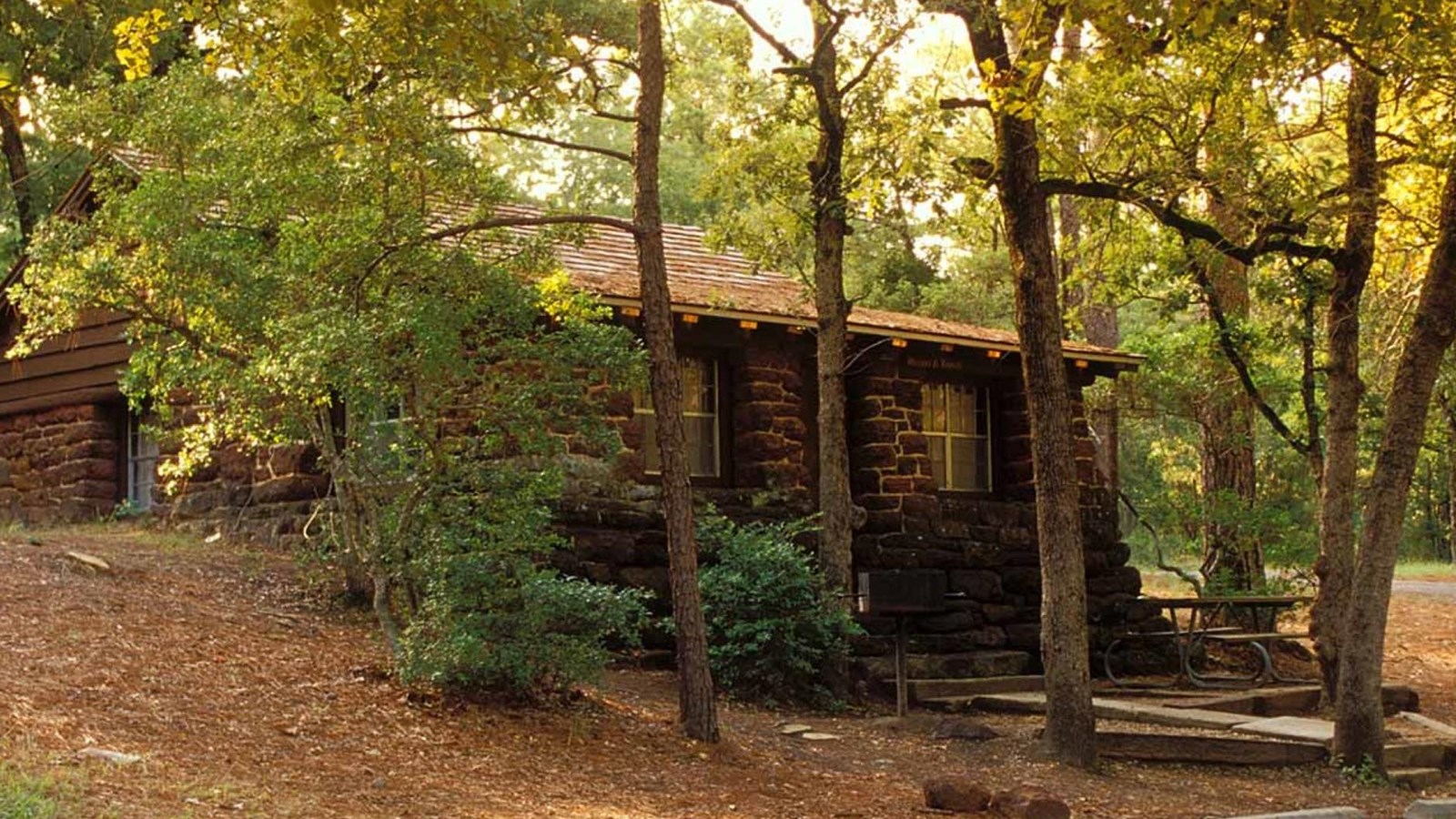
Logging diminished but did not destroy the Lost Pines. Around 34,400 hectares of pine remained in 1952 compared with around 36,400 hectares in 1880. Nevertheless, early conservationists recognized the importance of preserving this forest and petitioned for the creation of a state park on part of the original tract land granted to Austin by the Mexican government in 1832. The Civilian Conservation Corps (CCC) began eventually constructed the park that visitors enjoy today.[4] The architect of the project, Arthur Fehr, stressed the importance of using materials native to the area and other noninvasive design principles. This philosophy resulted in natural-looking structures crafted from lumber and stone found only in the park. In 1997, the park became only one of seven CCC-built state parks to attain National Historic Landmark status.[5]
The park today spans 6,600 acres of woodland, a living testament to the importance of early conservation efforts in America. However, a fire in 2011 damaged 96% of the wooded area. Fire crews saved the buildings constructed by the CCC from the blaze and, thanks to support from volunteers and park staff, the forest is steadily recovering. Now reopened to the public, visitors can travel through the same Lost Pines that have captured the imagination of visitors since time immemorial.[6]
Site Information
Location (100 Park Road 1A, Bastrop, Texas)
The park offers towering pines, historic cabins, and quiet spaces--less than an hour from the state capital.
More site information
El Camino Real de los Tejas National Historic Trail
[1] Mattie Austin Hatcher, "The Expedition of Don Domingo Teran de Los Rios into Texas,” Preliminary Studies of the Texas Catholic Historical Society, January, 1933, Vol. II, No. 1, (St. Edward's University, Headquarters of the Texas Knights of Columbus Historical Commission, 1933), 27.
[2] Paula Mitchell Marks, “Bastrop, Texas,” Handbook of Texas Online, accessed September 29, 2023, https://www.tshaonline.org/handbook/entries/bastrop-texas.
[3] Claire G. Williams, “Lost Pines Forest,” Handbook of Texas Online, accessed December 04, 2023, https://www.tshaonline.org/handbook/entries/lost-pines-forest.
[4] Ibid.
[5] Texas Parks and Wildlife Department, Bastrop State Park History, https://tpwd.texas.gov/state-parks/bastrop/park_history
[6] Ibid.