



Last updated: August 23, 2026
Place
Balclutha's Plimsoll Line
NPS/J.Woerner
Quick Facts
OPEN TO PUBLIC:
No
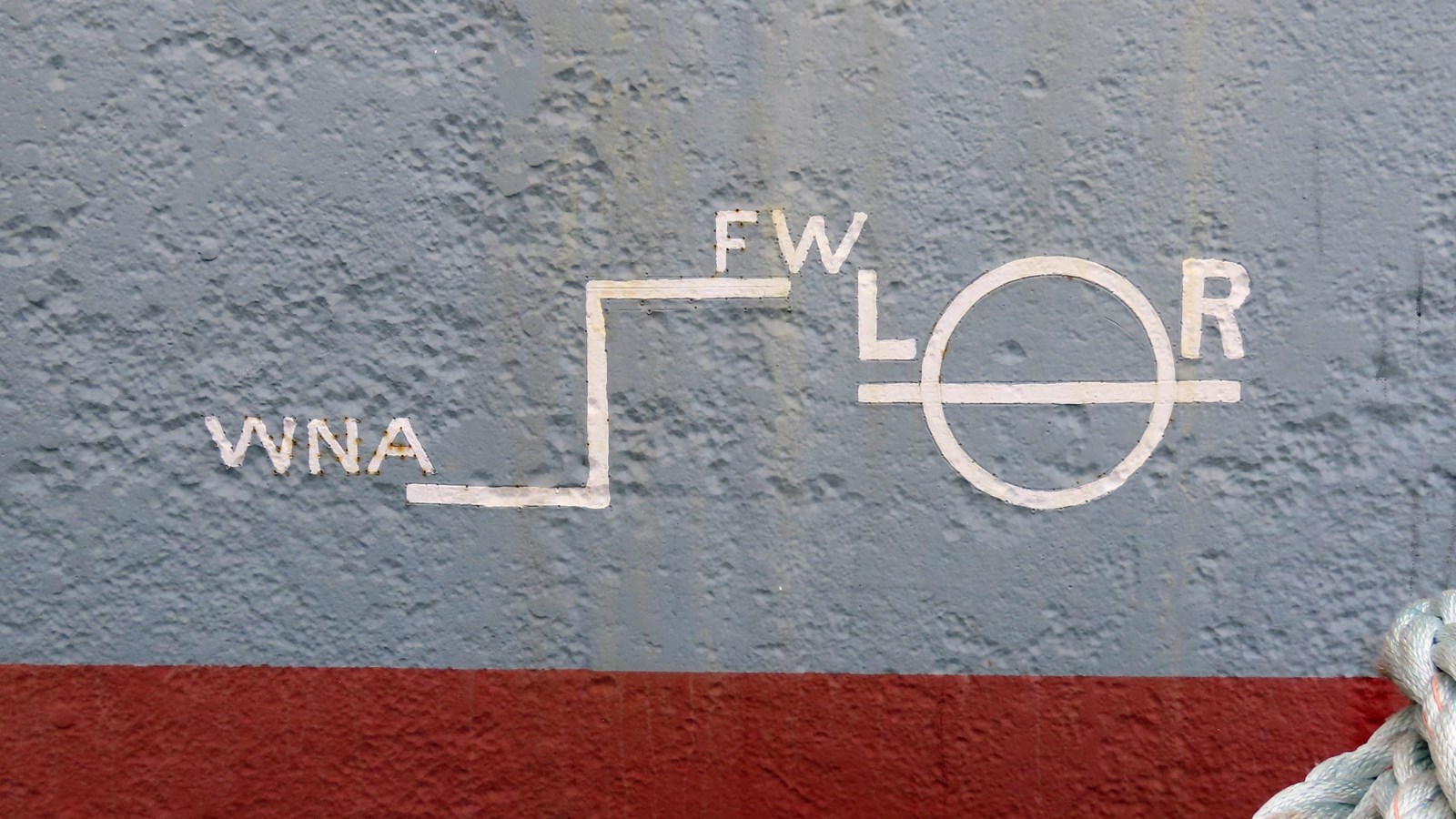
Can you spot the white markings on the gray part of the hull? Find the circle with the line through its center. For a cargo ship like Balclutha, that’s the all-important Plimsoll line.
A Plimsoll line marks the maximum depth a vessel can be safely immersed when loaded with cargo. This depth changes with a ship’s dimensions, type of cargo, the time of year, and the density of water a ship is in.
See the lines with the letters FA and WNA? They stand for “Fresh Water” and “Winter North Atlantic.” A ship shouldn’t be loaded past the FW mark if it’s in freshwater rivers or ports – or past WNA if it’s in the North Atlantic in winter. Which is where Balclutha often was!
The L and R stand for Lloyd’s Register, the British organization that still sets standards for maritime operations. “Plimsoll line” is named after Samuel Plimsoll, who, in the 1870s, advocated for safer loading practices to protect sailors.
Plimsoll understood the dangers of cargo shipping firsthand. He was a coal merchant. In the late 19th century, coal heated homes, powered factories, and fueled trains and boats. These included the warships built right here in Mare Island – hence the row of coal sheds just behind you near Balclutha.
But coal was one of the most dangerous cargoes at sea. It could combust or emit explosive gases. Even when properly loaded, it could move around on a voyage, causing vessels to list and capsize.
That happened to Balclutha in 1894 as it brought coal to Chile from England. A huge wave struck the vessel and it rolled on its side. The coal shifted belowdecks, making it harder to right the ship. Captain Alfred Durkee recalled, “We were lying over so far the men could not stand on deck without holding on.” Two sailors nearly died, but the crew managed to avert disaster.
Balclutha brought coal to San Francisco many times, including its first-ever voyage, in January 1887, when it arrived with 2,650 tons of Welsh coal. It also regularly brought the city coal from Australia in exchange for lumber from Puget Sound.
The coal sheds behind you opened while Balclutha served this trade. We can't say if any of its deliveries went to Mare Island, but, if it did, one trip could have brought enough coal to fill a single shed.