



Last updated: August 23, 2026
Place
Balclutha's Masts
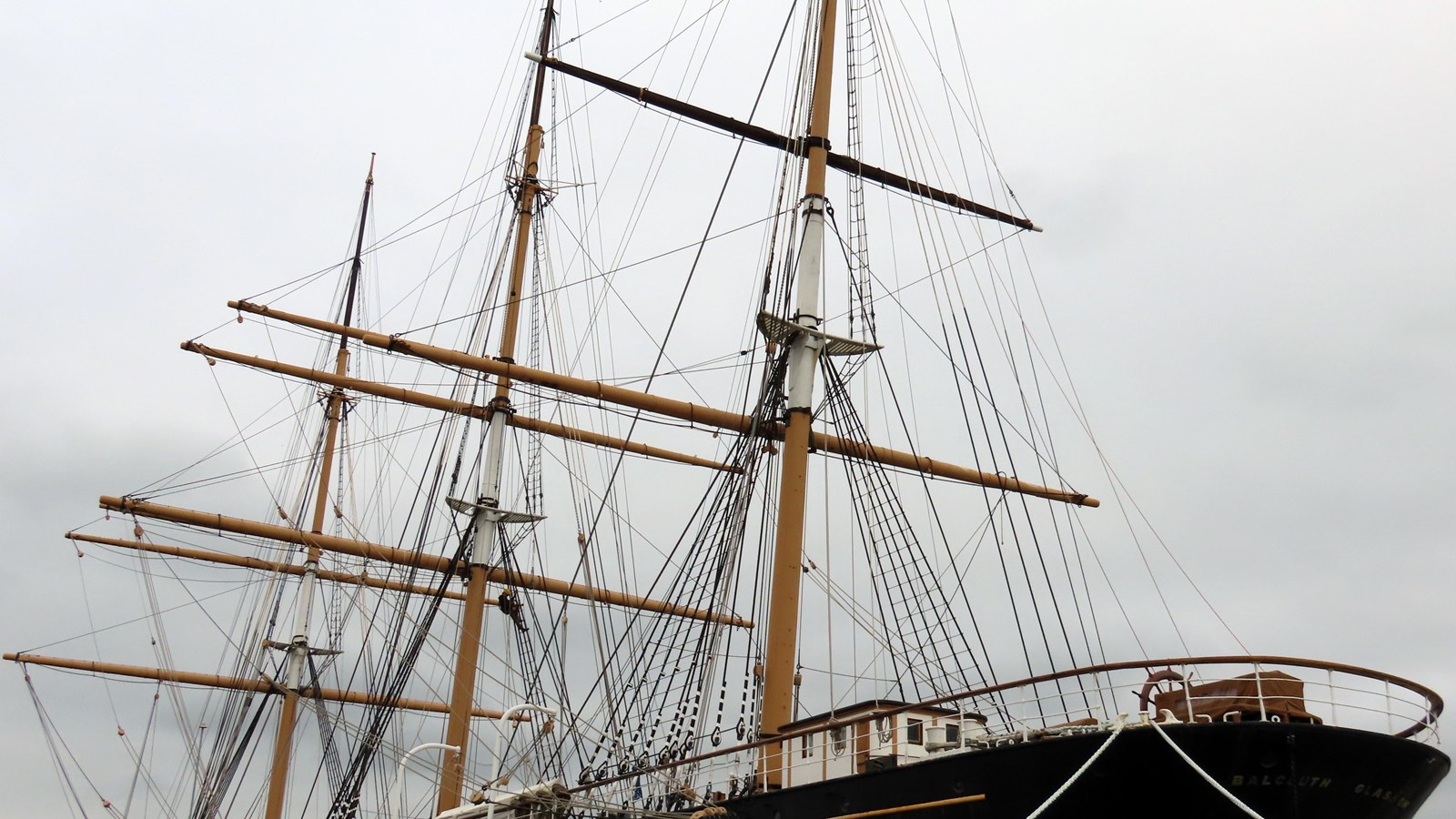
NPS/J.Woerner
Quick Facts
OPEN TO PUBLIC:
No
This vessel's engine is not on the ship, but above it!
Whether known as Balclutha, Star of Alaska, or Pacific Queen, this iron-hulled ship has always been powered by the wind. When fully rigged, it hoisted 25 sails. Fifteen of those were arranged square across the ship, on the horizontal spars on each mast. That’s why Balclutha is a type of vessel called a square-rigger: those sails generated the force that drove the ship at speeds of up to 16 knots, or 18 miles per hour.
The three course alone for Balclutha – the sails set closest to the deck – measured around 35 feet tall and 90 feet wide. To hold up tons of sailcloth, Balclutha's three masts – as well as the standing rigging that support them – are mostly made of steel.
But, look at the uppermost parts of the masts, called the topgallant and the royal. Soaring to over 120 feet, these were made of spruce or Douglas fir. That, too, is part of Balclutha’s engineering: wooden spars keep a vessel stable by decreasing the weight up top. They are also more flexible than metal ones – and thus less likely to snap when pummeled by 50-mile-per-hour gales. Wooden spars are also easier to repair and replace, whether the ship was safe at port – or the vessel’s fate hinged on the ship carpenter’s skill in the middle of the sea.