



Last updated: August 23, 2026
Place
Balclutha's Foremast and Focsle
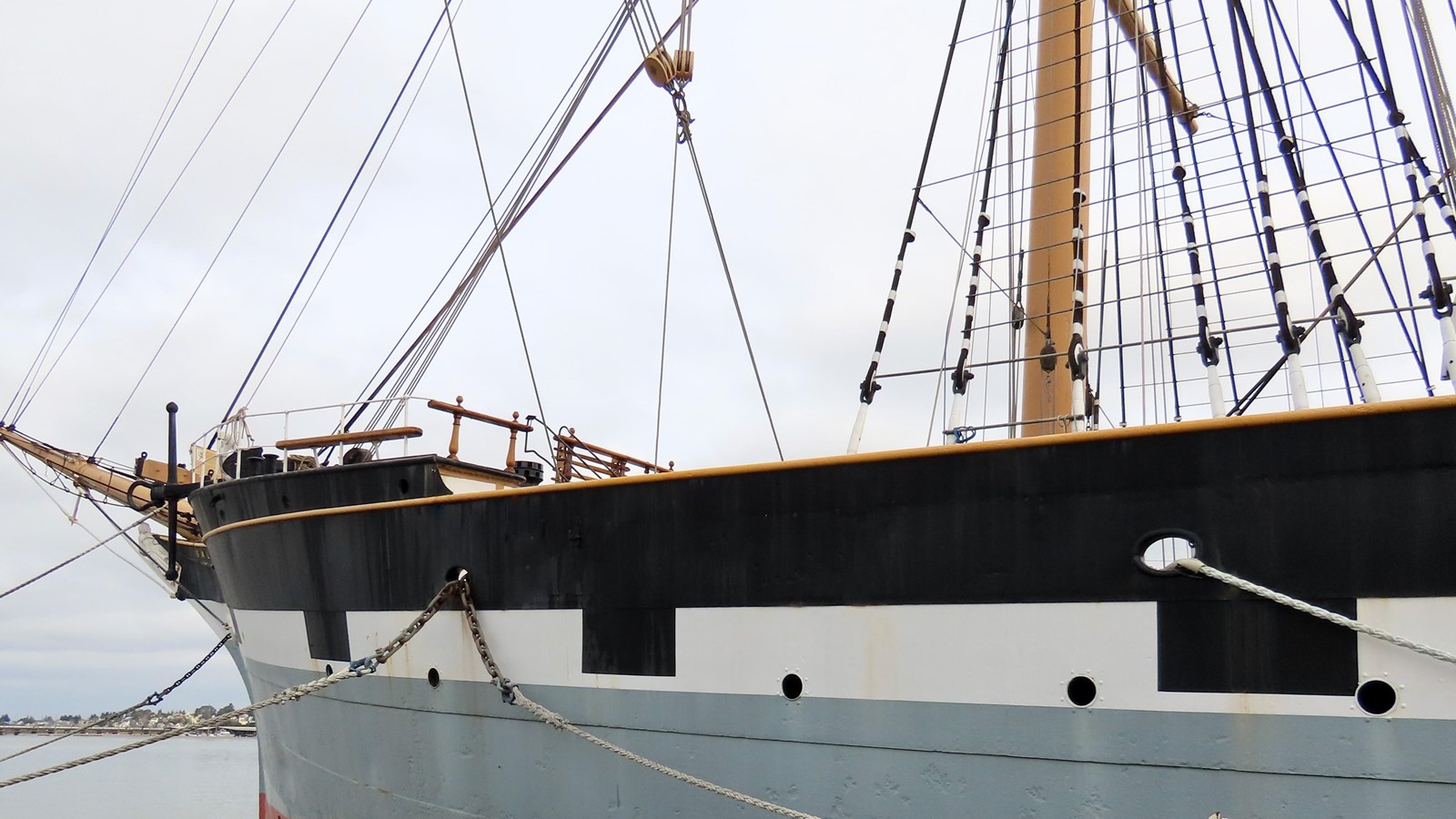
NPS/J.Woerner
Quick Facts
OPEN TO PUBLIC:
No
The ship’s foremast is the mast closest to the front, or bow, of the ship. Everything between this and the bow is called “before the mast.” Sailors traditionally occupied this part of the main deck; the captain and other officers stayed towards the back, or stern.
Before the mast, sailors slept, ate, mended or washed clothes, and otherwise kept busy when they were not on their shifts, or watches. They bunked inside the fo’c’s’le – the raised structure at the bow where you now see handrails for stairs.
On any vessel, the fo’c’s’le was uncomfortable, even dangerous. Sailors were wedged into the ship’s narrow nose. They endured little ventilation and little light — and thus greater risks of illness — and injury — should the ship run aground or get battered by a storm. Their beds were also cramped around the windlass, the hulking machine that raised and lowered the ship’s anchors.
Linked to the windlass, the anchor chains passed through openings in the fo’c’s’le, such as the one you see a mooring line going through today. Though these would be closed for most of the voyage, when open, they further exposed the interior to the wind, spray, and cold. Andrew Furuseth, a leader of the Sailors Union of the Pacific, said in 1905: “In jail my bunk would be no narrower, my food no worse, nor I more lonely than in the [fo’c’s’le].”
Balclutha's fo’c’sle was built to accommodate up to 32 men. Imagine, for a moment, how that many people fared on the open ocean. Then, imagine what it must have been like when, in its years as the Star of Alaska, over 100 men lived on this same ship.
Do you see the row of portholes on the hull, below either side of the foremast? They mark additional quarters on the deck between the ship’s main deck and lower hold. These quarters were made for cannery workers aboard the Star of Alaska from 1906 to 1929. Different from sailors or fishermen, these men gutted, cleaned, and canned fish at a cannery up north.
Ship drawings from the 1920s say there were bunks for 73 men, and contemporary accounts describe the hellish conditions they endured. If they could go elsewhere on the ship, they were only allowed above the fo’c’s’le – or anywhere else before the mast.