



Last updated: August 23, 2026
Place
Balclutha's Bow
NPS/J.Woerner
Quick Facts
OPEN TO PUBLIC:
No
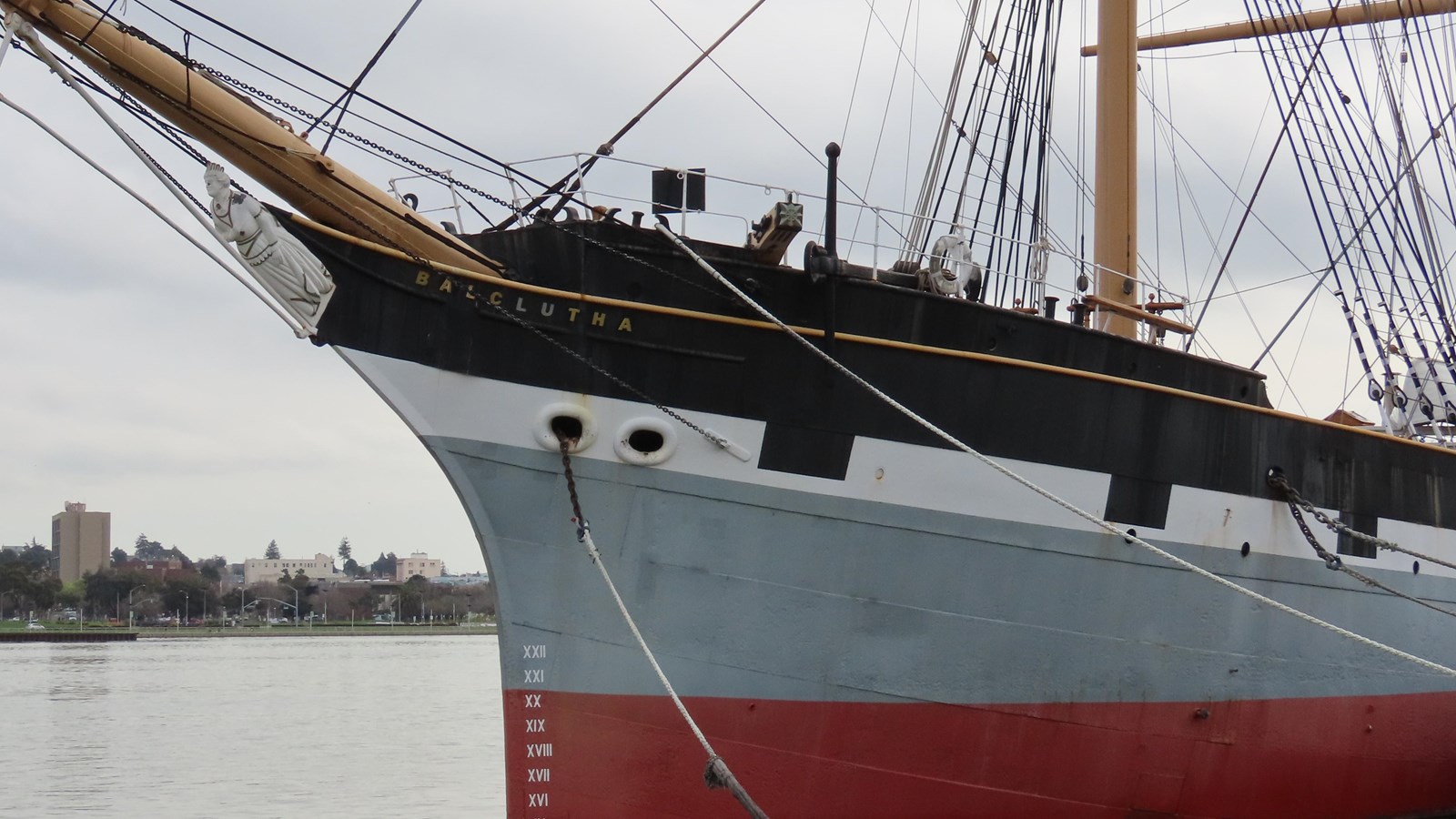
The front of the ship is called the bow. Notice the white figurehead, the ship’s name in gold letters, and the colors of the hull. Features like these reflect how Balclutha looked during its first career as a British merchant vessel, often bringing grain to Europe from California. In that period – from 1886 to 1899 – this ship called at ports on six continents and rounded the deadly Cape Horn 17 times.
As a sailing vessel, Balclutha was both distinct and typical for its time. Uniquely, though it used sail power, its hull was made of steel and iron, like a modern steamer. Yet it honored conventions like a graceful figurehead. Balclutha’s figurehead isn't identifiably a historical nor mythical figure, but, as became usual for the era, an anonymous Victorian woman.
The four-paint scheme was also typical. It distinguished British cargo vessels from naval ships. And it had practical use: red, copper-based coating helped keep marine organisms off the hull. White and light gray paint reflected heat and provided contrast with the water. Black was protective and cheap. Note the black rectangles on the white part of the hull – they are false gun ports. They’re more of a stylistic touch for Balclutha. But, in earlier decades, such gun ports were meant to create the impression a vessel was armed.
But Balclutha hasn’t always looked this way; it hasn’t always had that name. Different owners over the years modified this ship.
From 1906 to 1929, its hull was painted black, and its decks altered, for the Alaska Packers Association, which renamed Balclutha into Star of Alaska. This San Francisco-based company used the vessel as a transport ship and floating warehouse for the canned salmon industry.
Then, from 1933 to 1953, its hull was painted silver-white, its masts and yards oriole-red, and its portholes accented with a dainty blue. By that time, this vessel was one of the last active tall ships on the West Coast: it became an attraction called the Pacific Queen. It was also used in Hollywood movies, including as a warship for the Oscar-winning Mutiny on the Bounty. For this film, the starboard side – facing the camera – was painted black and white.
In 1954, this vessel became a museum. The founders of what is now San Francisco Maritime National Historical Park then made a decision. They determined the ship's first career as Balclutha was the most historically significant – and so they restored the vessel to its original name and appearance.