



Last updated: March 27, 2026
Place
Artillery Park
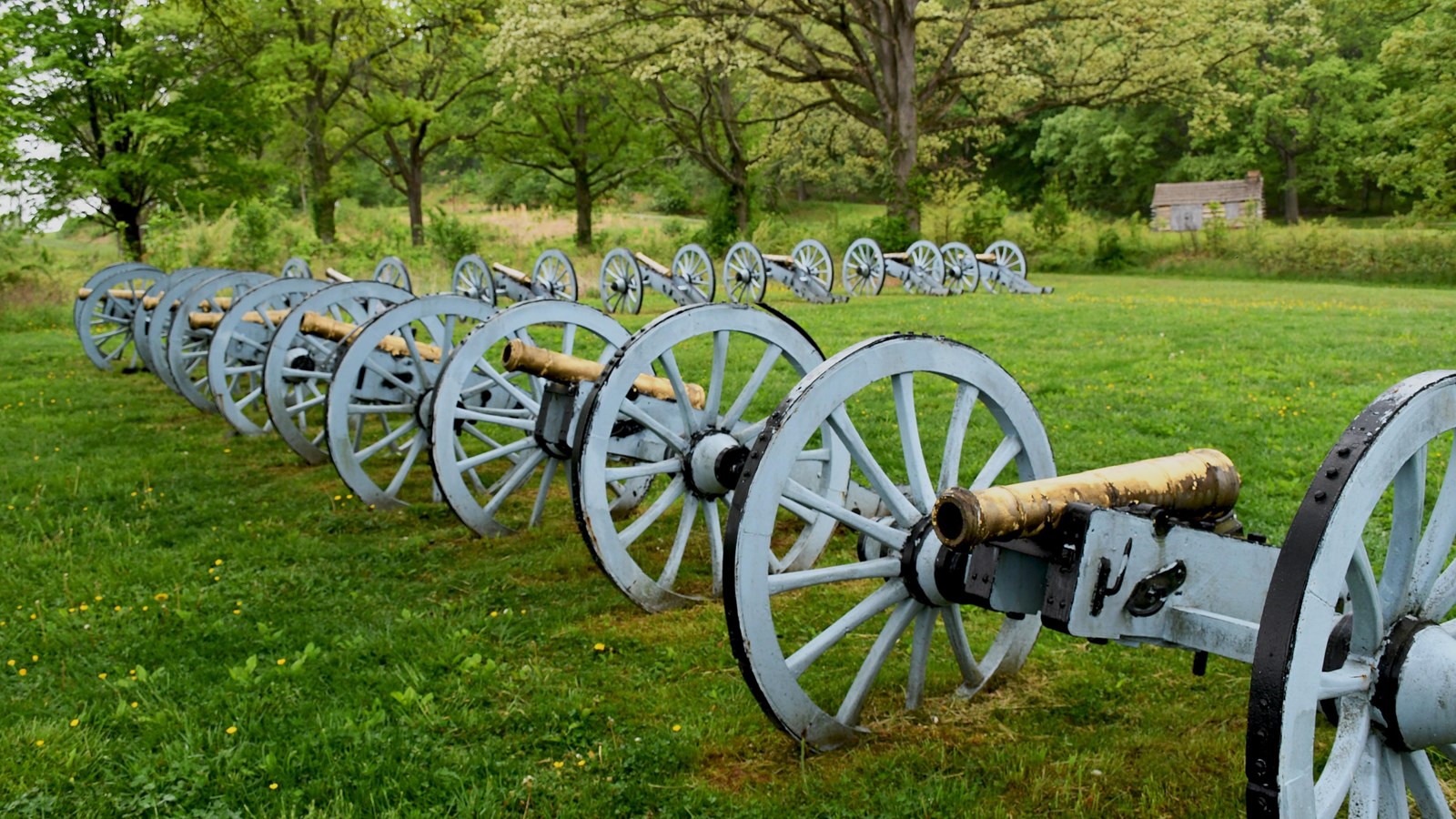
NPS Photo / G. Purifoy
Quick Facts
Location:
East Inner Line Drive
Significance:
Central location for artillery during the Valley Forge encampment
Designation:
Stop 7 on the self-guided Encampment Tour
Amenities
19 listed
Benches/Seating, Bicycle - Rack, Cellular Signal, Historical/Interpretive Information/Exhibits, Information - Maps Available, Information Kiosk/Bulletin Board, Parking - Auto, Parking - Bus/RV, Picnic Table, Recycling, Restroom, Restroom - Accessible, Restroom - Seasonal, Scenic View/Photo Spot, Toilet - Flush, Trailhead, Trash/Litter Receptacles, Water - Drinking/Potable, Wheelchair Accessible
“…After Orders. All the Artillery of the army is to be collected together at the park—the detachments are to march thither, to morrow morning at nine o’clock…” General Orders, 21 December 1777.
A Strategic Location
During the Valley Forge Encampment, most of the Continental Army’s cannons under General Washington were stored at Artillery Park, a strategic central location between the first and second lines of defense. From this position, the cannons could be rushed to the dirt mound defenses located throughout the camp to help stop an attack by the British. Even with this reliable and flexible defense, the army still had to coax starving horses to pull the cannons through deep muddy camp roads, a near impossible task.
Cannon Training
Brigadier General Henry Knox commanded and trained around 630 officers and soldiers from the 1st, 2nd, 3rd, and 4th Continental regiments of Artillery from this location. Each gun would have 14 to 15 men operating it.
The term “pounder” is used to describe the weight of the cannonball that would be fired out of the cannon. The most common cannon was the six-pounder, but there were also several three-, four-, and eight-pounder cannons, along with mortars and howitzers at Valley Forge.
Cannons acquired by the Continental Army came from a variety of sources; some were cast in America, many were supplied from France, while others were captured from the British. At the end of the encampment in June of 1778, General Knox had under his command 40 to 50 field pieces.
Today, visitors can see over a dozen replica cannons featured in three rows, overlooking the center of Valley Forge National Historical Park with views of the National Memorial Arch.
Sources
“General Orders, 21 December 1777,” Founders Online, National Archives, https://founders.archives.gov/documents/Washington/03-12-02-0599. [Original source: The Papers of George Washington, Revolutionary War Series, vol. 12, 26 October 1777 – 25 December 1777, ed. Frank E. Grizzard, Jr. and David R. Hoth. Charlottesville: University Press of Virginia, 2002, pp. 657–658.]
Peterson, Harold. Round Shot and Rammers. Stackpole Books, 1969. Print.
Stephenson, Michael. Patriot Battles: How the War of Independence Was Fought. New York: HarperCollins, 2007. Print.
Thibaut, Jacqueline. Valley Forge Historical Research Report Volume III: Brigade Encampments, Artillery Park, United States Department of Interior National Park Service, 1982. Print.
Valley Forge Park Alliance, “Brigade of Artillery” http://valleyforgemusterroll.org/brigades/artillery.asp, 2020.
Valley Forge Encampment Tour Route
10-mile driving loop comprised of 9 major tour stops and many opportunities to explore additional monuments, statues, and locations of historical importance.