



Last updated: April 2, 2026
Place
Apache Pass
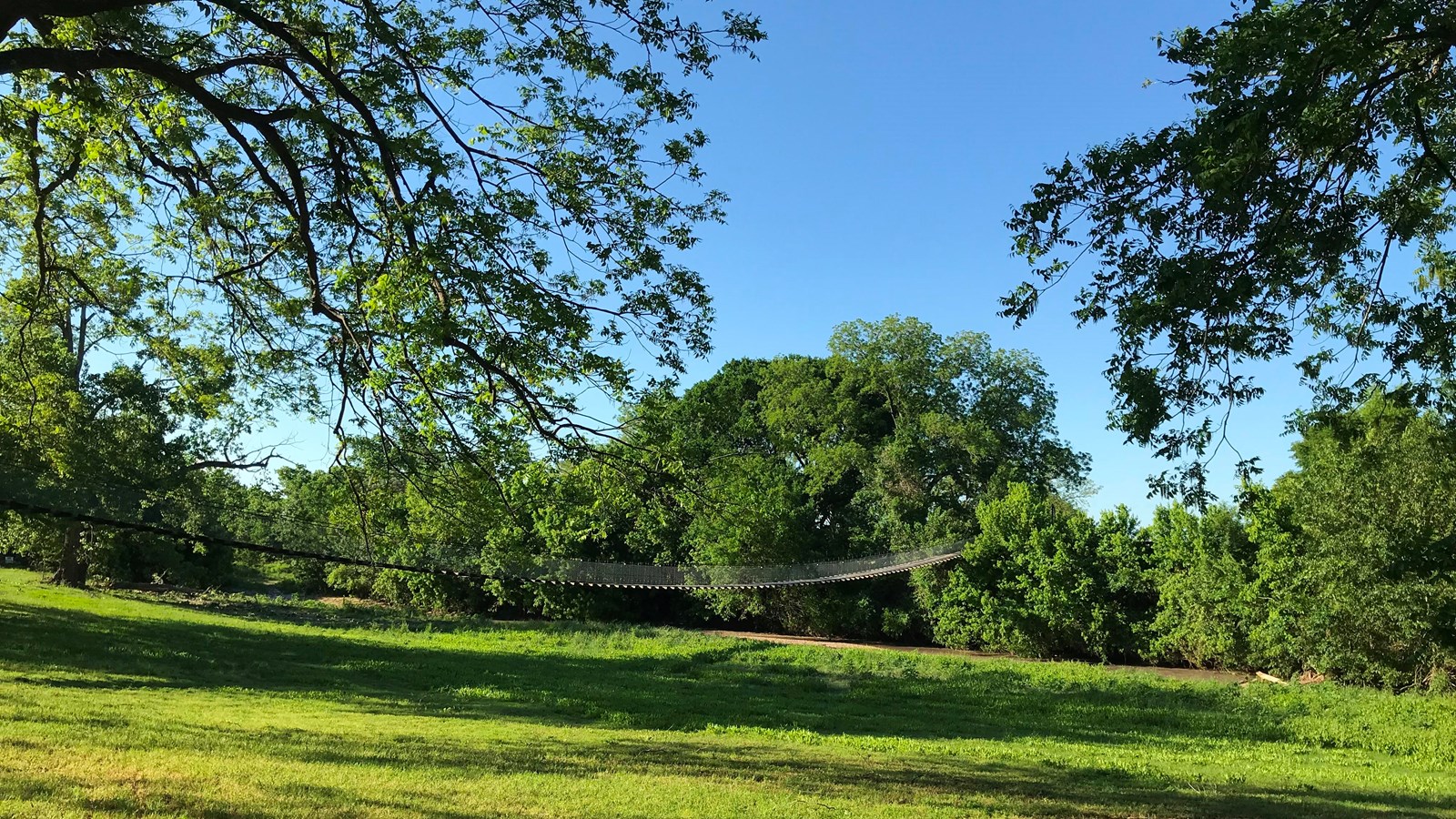
Photo/NPS
Quick Facts
Location:
9112 North Farm-to-Market Road 908, eight miles northwest of Rockdale, Texas
Significance:
Apache Pass provides a window into transportation logistics along El Camino Real, demonstraing how an array of factors combined to make certain locations popular with travelers.
Designation:
Certified Site
OPEN TO PUBLIC:
No
MANAGED BY:
Amenities
1 listed
Historical/Interpretive Information/Exhibits
On the San Gabriel River, just northwest of Rockdale, Texas, lies a shallow crossing point known as Apache Pass. Although a suspension bridge is now the more common means of crossing the river, the original gravel bar crossing served Native American and Spanish communities for centuries. This crossing facilitated the exchange of trade goods such as animal hides, as well as the movement of food and supplies to sustain mission communities.[1] Spanish diaries from the 1710s highlight the use of animals such as mules to cross the river, and the gravel bar and shallow waters at Apache Pass allowed for this to happen more easily than at other places.[2]
Apache Pass served several historic missions in the vicinity, including Mission Nuestra Señora de la Candelaria, Mission San Francisco Xavier de Los Dolores, and Mission San Ildefonso. During the founding of San Ildefonso in the winter of 1749, Spanish missionaries and soldiers affiliated with Father Santa Ana sought out the fresh water of the San Gabriel River at Apache Pass.[3] These missions were some of the many Spaniards developed in the region in the 17th and 18th centuries, institutions aimed at converting local Indigenous populations, including the Tonkawa and Karankawa peoples. Spanish missionaries also attempted to convert the Lipan Apache along what is now the San Gabriel River. The Apache, however, resisted Spanish colonial advances and organized attacks on settlements and missions.[4] As these attacks intensified, the Spaniards pulled back from the area in 1755.[5]
Apache Pass also served as a crossing for people coming to or leaving Mission San Xavier. In fact, Spanish explorers originally called the San Gabriel River the San Xavier River.[6] This Spanish mission was located near Apache Pass, northwest of Rockdale, Texas. It was erected in 1747 after Fray Mariano Francisco de los Dolores y Viana received a request from local Yojuane, Deadose, Mayaye, and Ervipiame groups to establish a mission. A presidio to protect the mission from stock raiding from Lipan Apaches was not built until 1751, and many among the mission felt the soldiers provided inadequate protection. The soldiers initially garrisoned at the site refused requests from the padres to locate and return Native peoples who had fled mission life. The later permanent force under the command of Felipe de Rábago y Terán was little different. The commander’s relationship with the padres was fraught and combative.[7]
In 1756, the Spanish authorities decided to bolster the garrison at San Xavier, but their intervention did little to improve the state of affairs at the mission. In a journal entry from that same year, Spanish explorer Bernardo de Miranda had described the presidio at San Xavier as being in a “deplorable” condition.[8] Not only did the Spanish settlers and officials fear the Lipan Apache, but they also worried about the possibility of French missionaries and colonists moving into the area from Louisiana. By this time, the Spanish military official in command was Don Pedro de Rábago y Therán, successor to his brother Felipe.[9] The two brothers were implicated and eventually acquitted in several murders that took place, one of an Indigenous person and another of a Spanish priest, near Apache Pass along the San Gabriel River.[10]
Today, visitors can connect with the history of Apache Pass by visiting the San Gabriel River. Near the site of the pass today, one can visit a local pecan and hay farm. While tours are offered for special events, the site does not have regular public hours.
Site Information
Location (9112 North Farm-to-Market Road 908, eight miles northwest of Rockdale, Texas)
Apache Pass is an inviting and shallow gravel crossing of the San Gabriel River surrrounded by gently sloping hillsides.
More site information
El Camino Real de los Tejas National Historic Trail
[1] Diana Hadley, Thomas H. Naylor, et. al., eds, “The Establishment of Permanent Missions and the First Presidios: (1716-1729),” in The Presidio and Militia on the Northern Frontier of New Spain: A Documentary History, Volume Two, Part Two: The Central Corridor and the Texas Corridor, 1700-1765, 378, (University of Arizona Press, 1997); (https://doi.org/10.2307/j.ctv1q16r9x.18.: accessed December 14, 2023).
[2] Ibid.
[3] Herbert E. Bolton, “The Founding of the Missions on the San Gabriel River, 1745-1749,” The Southwestern Historical Quarterly 17, no. 4 (1914), 378, (http://www.jstor.org/stable/30234610: accessed December 14, 2023).
[4] William Edward Dunn, “The Apache Mission on the San Sabá River; Its Founding and Failure,” The Southwestern Historical Quarterly 17, no. 4 (1914), 385, (http://www.jstor.org/stable/30234611: accessed December 14, 2023).
[5] “Apache Pass,” National Park Service, https://www.nps.gov/places/apache-pass.htm
[6] Frank D. Reeve, “The Apache Indians in Texas,” The Southwestern Historical Quarterly 50, no. 2 (1946), 195 (http://www.jstor.org/stable/30240669: accessed December 14, 2023).
[7] Kathleen Kirk Gilmore, “San Francisco Xavier de Gigedo Presidio,” Handbook of Texas Online, accessed February 02, 2024, https://www.tshaonline.org/handbook/entries/san-francisco-xavier-de-gigedo-presidio.
[8] Roderick B. Patten, “Miranda’s Inspection of Los Almagres: His Journal, Report, and Petition,” The Southwestern Historical Quarterly 74, no. 2 (1970), 244; (http://www.jstor.org/stable/30238102: accessed December 14, 2023).
[9] Dunn, “The Apache Mission on the San Sabá River; Its Founding and Failure,” The Southwestern Historical Quarterly 17, no. 4 (1914), 384.
[10] Weddle, Robert S., and Carol A. Lipscomb. “The Strange Case of the Headless Saint Francis: An Exercise in Historical Sleuthing.” The Southwestern Historical Quarterly 114, no. 3 (2011): 286–96. http://www.jstor.org/stable/23059167.