



Last updated: January 29, 2026
Place
A Gift from the Glaciers Wayside
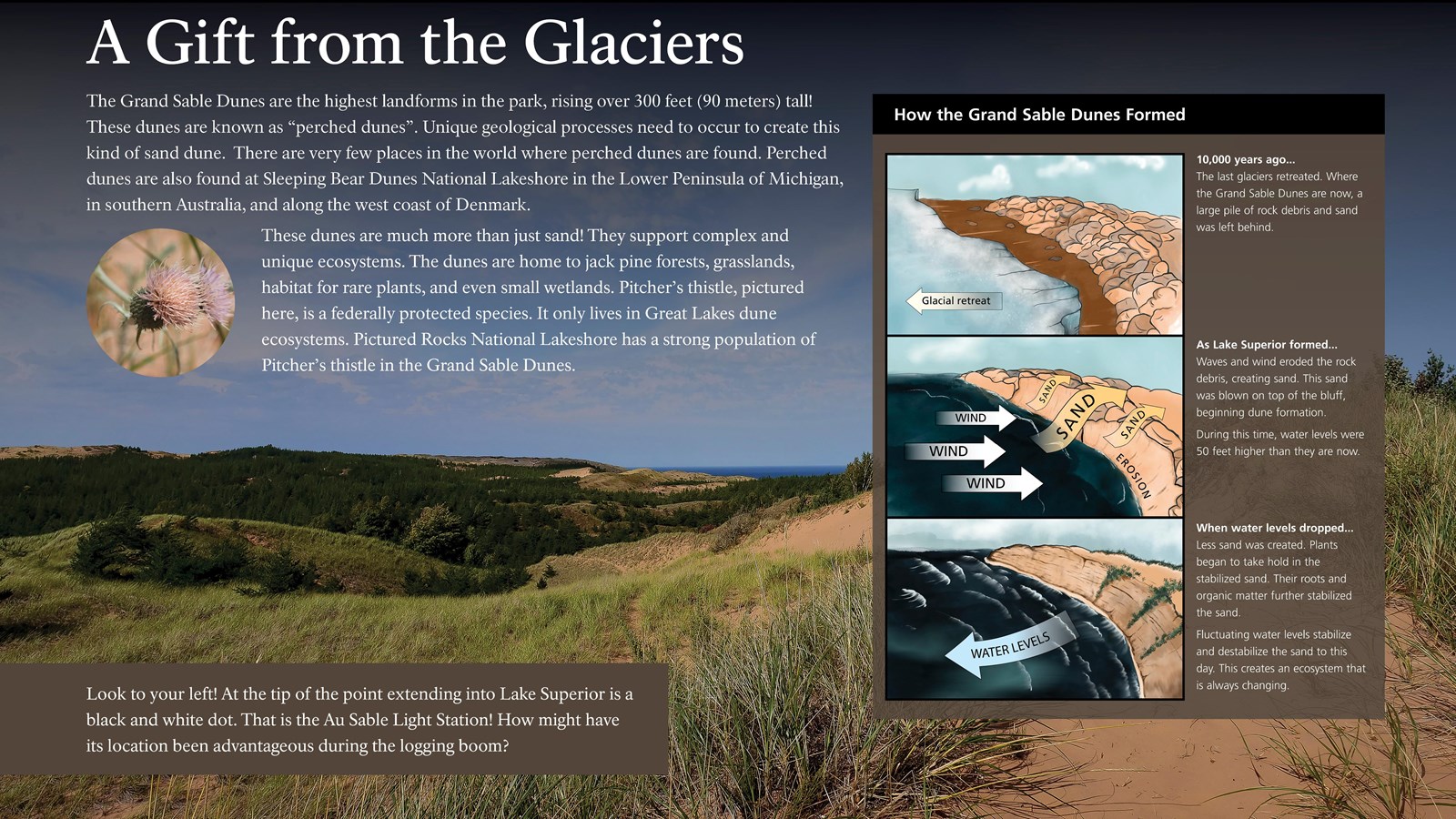
The Grand Sable Dunes are the highest landforms in the park, rising over 300 feet (90 meters) tall! These dunes are known as “perched dunes”. Unique geological processes need to occur to create this kind of sand dune. There are very few places in the world where perched dunes are found. Perched dunes are also found at Sleeping Bear Dunes National Lakeshore in the Lower Peninsula of Michigan, in southern Australia, and along the west coast of Denmark.
These dunes are much more than just sand! The support complex and unique ecosystems. The dunes are home to jack pine forests, grasslands, habitat for rare plants, and even small wetlands. Pitcher’s thistle, pictured here, is a federally protected species. It only lives in Great Lakes dune ecosystems. Pictured Rocks National Lakeshore has a strong population of Pitcher’s thistle in the Grand Sable Dunes.
Look to your left! At the tip of the point extending into Lake Superior is a black and white dot. That is the Au Sable Light Station! How might have its location been advantageous during the logging boom?
How the Grand Sable Dunes Formed
10,000 years ago...
The last glaciers retreated. Where the grand Sable Dunes are now, a large pile of rock debris and sand was left behind.
As Lake Superior formed...
Waves and wind eroded the rock debris, creating sand. This sand was blown on top of the bluff, beginning dune formation. During this time, water levels were 50 feet higher than they are now.
When water levels dropped...
Less sand was created. Plants began to take hold in the stabilized sand. Their roots and organic matter further stabilized the sand. Fluctuating water levels stabilize and destabilize the sand to this day. This creates an ecosystem that is always changing.