



Last updated: December 3, 2025
Place
Bas-Reliefs of Atlantic Theater
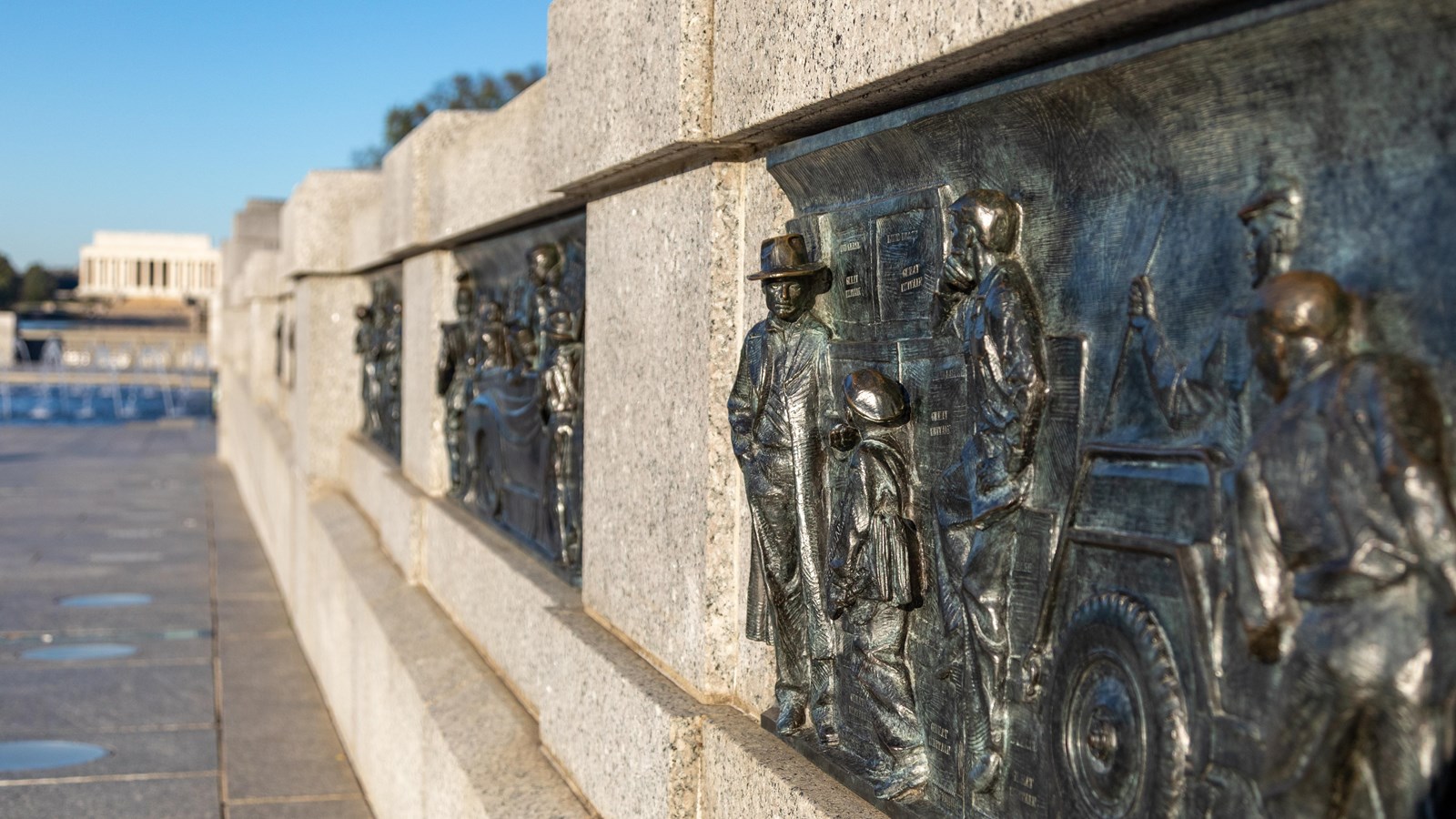
NPS / Claire Hassler
Quick Facts
Amenities
4 listed
Accessible Sites, Historical/Interpretive Information/Exhibits, Information - Ranger/Staff Member Present, Restroom
The bronze bas-reliefs at the National World War II Memorial were designed to tell the story of America’s experience in the war from mobilization on the home front to victory overseas. When the memorial was conceived in the late 1990s, planners wanted visitors entering from 17th Street, the memorial’s symbolic “front door," to pass through a visual narrative that captured the sweep of the conflict. Sculptor Ray Kaskey was selected to create 24 relief panels, with 12 panels on the north side representing the Atlantic Theater and 12 on the south side depicting the Pacific Theater.
Kaskey drew inspiration from historical photographs, wartime propaganda art, and the style of classical relief sculpture. He adopted an “isocephalic” approach, in which the major figures’ heads align horizontally across each panel, giving the series a unified rhythm despite the diversity of scenes. Together, the reliefs blend home-front and combat imagery to make a central point: that World War II required the full mobilization of the American people—factory workers, service members, medics, sailors, pilots, and engineers alike.
Installed in 2004 with the opening of the memorial, the Atlantic panels trace the war chronologically, beginning with pre-war support for the Allies and culminating in the final collapse of Nazi Germany. Their placement along the entrance corridor is intentional: as visitors move toward the central plaza, they follow the story of America’s march to war, the battles fought across Europe and the Atlantic, and the partnership of Allied nations that led to victory.
Atlantic Theater Bas-Reliefs (right to left):
- Lend-Lease – Shipment of American supplies to Allied nations before U.S. entry into the war.
- Women in Military Service – Women taking on new roles in uniform to support the war effort.
- Aircraft Manufacturing – Industrial mobilization and factory workers building bombers.
- Battle of the Atlantic – Convoys and escorts combating German U-boats.
- Air War in Europe – U.S. bombers and crews preparing for strategic bombing missions.
- Airborne Assault – Paratroopers preparing for and executing airborne operations.
- D-Day / Normandy Landing – Amphibious assault on the beaches of Normandy on June 6, 1944.
- Armored Advance – Tank crews supporting the ground campaign across France and into Germany.
- Medics in the Field – Front-line medical personnel treating wounded soldiers under fire.
- Battle of the Bulge – The harsh winter 1944–45 German offensive and the Allied stand.
- Meeting at the Elbe – American and Soviet troops joining at the Elbe River, signaling Nazi Germany’s collapse.
- Final Push to Victory / Home-Front Support – Closing symbol of national unity and the collective American effort.