



Last updated: January 12, 2026
Place
Survey Lodge
Quick Facts
OPEN TO PUBLIC:
No
Amenities
1 listed
Bicycle - Rental
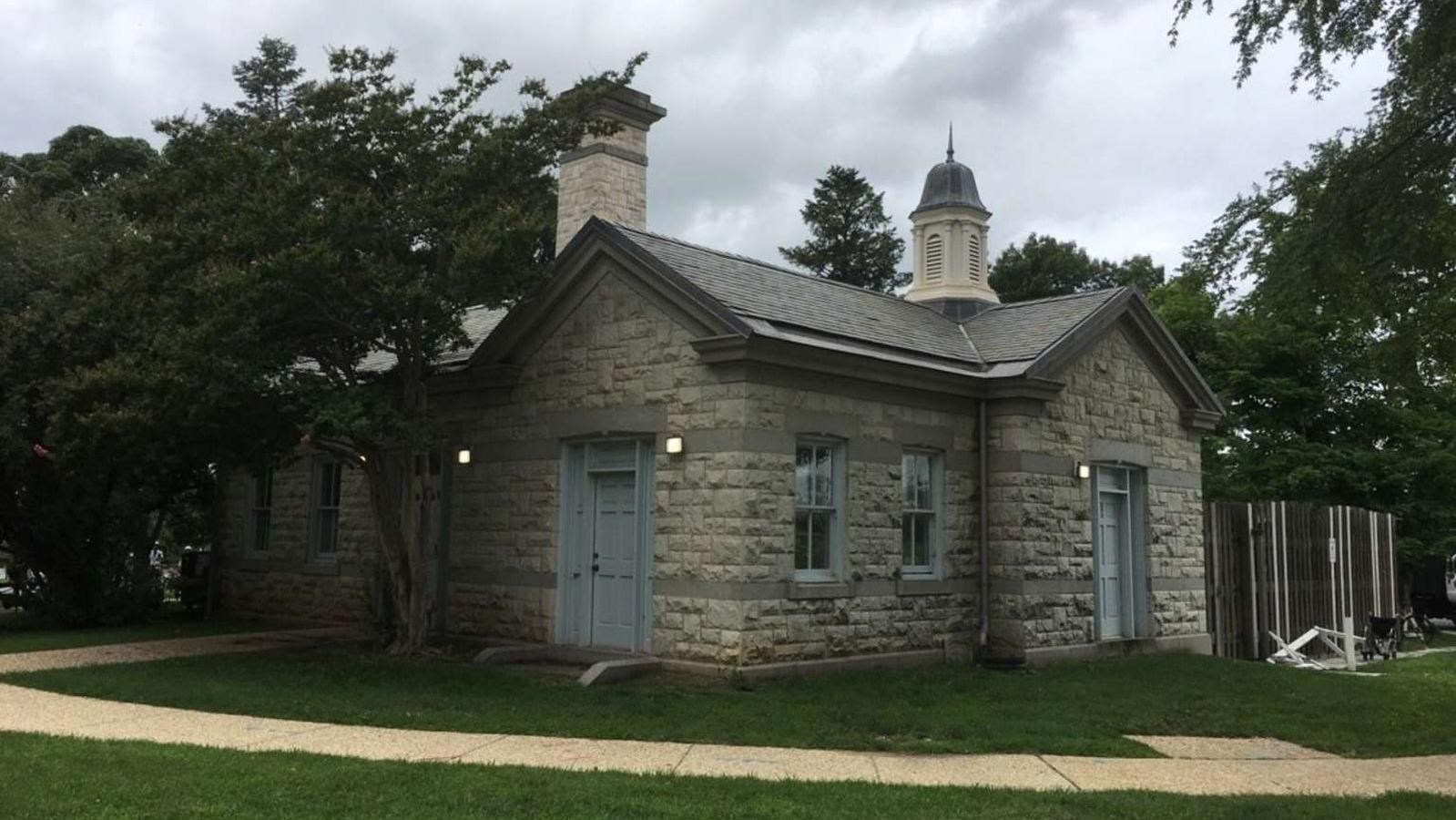
The Washington Monument Lodge occupies a pivotal place in the operational and scientific history of the Washington Monument, reflecting the evolution of the monument from a monumental engineering project into a national symbol and major public destination. Constructed in 1886, just prior to the monument’s opening to the public, the building was originally erected as a boiler house to support the monument’s innovative steam-powered elevator system.
As preparations were made to complete and open the monument, the original boiler house located closer to the shaft was dismantled, and its boilers were relocated to a newly constructed structure southwest of the monument—today known as the Survey Lodge. From this new boiler house, steam was supplied to engines housed in a separate engine house, which powered the elevator lifting visitors inside the monument. The boilers and engines were connected by steam pipes running through a brick-lined underground tunnel, an arrangement that improved safety and efficiency by separating heat-generating equipment from the monument itself. Construction of the new boiler house, engine house, and steam-pipe tunnel was completed in August 1886, marking a critical milestone in the monument’s readiness for public use.
Following the monument’s opening in 1888, the lodge continued to support elevator operations during the era of steam power, which lasted into the early 20th century. As elevator technology advanced and the system was converted to electric operation in 1901, the building’s mechanical role diminished. At the same time, the monument itself had already assumed an additional and unexpected function as a cornerstone of federal surveying and geodetic science. The Washington Monument served as a primary triangulation point for the U.S. Coast and Geodetic Survey (a precurser to today's National Geodetic Survey, a part of NOAA), and the former boiler house was adapted for use by surveyors as a workspace and shelter for precision instruments and records (and assumed the name Survey Lodge). Through this work, the monument became a fixed reference for mapping Washington, D.C., and for broader national surveying efforts.
With the establishment of National Park Service management of the Washington Monument in 1933 and the growing importance of visitor management and interpretation, the lodge again evolved in function. During the mid-20th century, it was repurposed as a ranger station and operational facility, supporting monument staff responsible for visitor services, security, and daily operations. Interior modifications reflected these changing needs while preserving the building’s exterior character and its historical relationship to the monument.
Today, the Washington Monument Lodge stands as a rare surviving example of the invisible infrastructure that made the monument functional as well as symbolic. From powering a pioneering steam elevator, to supporting national scientific measurement, to serving generations of National Park Service rangers, the lodge tells a layered story of innovation, adaptation, and stewardship at the heart of the National Mall.
NOTE: The building is not open to the public.