



Last updated: January 28, 2026
Place
World War I Memorial
NPS
Quick Facts
Location:
Washington, DC
Designation:
Memorial
Amenities
2 listed
Historical/Interpretive Information/Exhibits, Scenic View/Photo Spot
The World War I Memorial honors the 4.7 million Americans who served during the First World War and the 116,516 who made the supreme sacrifice in the Great War. What is now the memorial evolved over nearly a century from earlier efforts to commemorate America’s role in that seminal global conflict and was formally re-dedicated as the national memorial in the 2010s.
The site for the memorial is Pershing Park,a 1.76-acre site along Pennsylvania Avenue NW between 14th and 15th Streets, directly across from the White House Visitor Center. Originally conceived and dedicated in 1981as the American Expeditionary Forces (AEF) Memorial, it honored the roughly two million U.S. troops commanded by General John J. Pershing, the commander of the American Expeditionary Forces during World War I. The AEF Memorial featured a stone plaza, a bronze statue of Pershing, and granite walls bearing battle maps and inscriptions describing American contributions on the Western Front.
In 2014, Congress redesignated Pershing Park as the National World War I Memorial, acknowledging that no memorial in Washington, D.C., had comprehensively commemorated America’s service in World War I. A national design competition led to a broader vision that would integrate the existing Pershing elements with new commemorative features telling a more complete story of the American experience in the war.
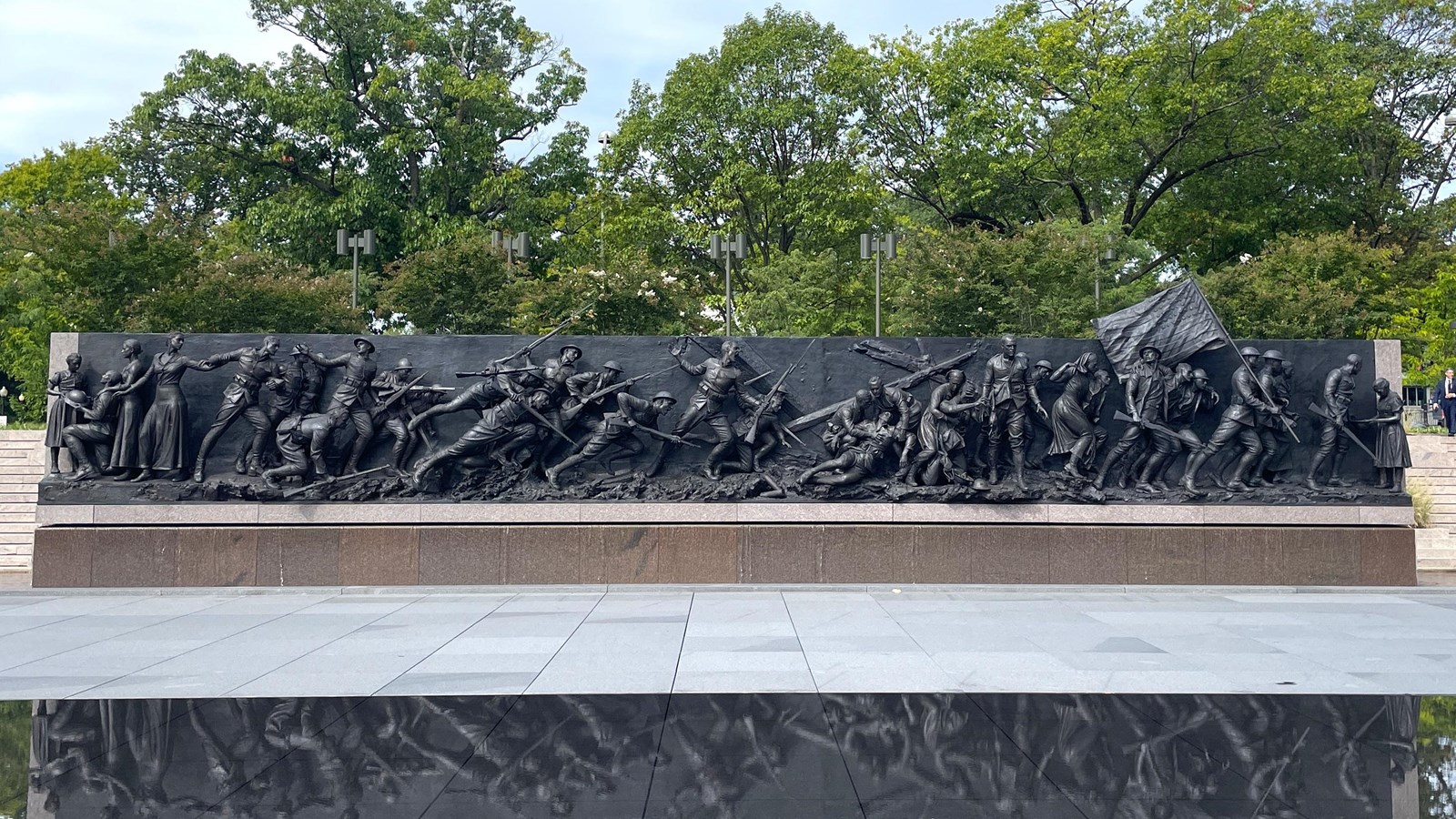
At the heart of the renewed memorial is “A Soldier’s Journey,” a dramatic 58-foot-long bronze bas-relief sculpture by Sabin Howard, installed in 2024. The high-relief work depicts a continuous narrative of an American soldier’s experience—from departure and training, through the brutal realities of combat, and finally to return home—symbolizing the wider human cost and endurance of the war. The scenes include images of fellow soldiers in anguish, advance, and fatigue, and empty helmets at the soldier’s feet evoke both loss and the passage of those who did not return.
Architect Joseph Weishaar’s design retains and incorporates the existing elements of Pershing Park, including the bronze statue of General Pershing standing resolute as a symbol of leadership and the collective effort of the American forces, and the granite walls with maps and inscriptions that ground the memorial in historical context.
Another significant feature is the Peace Fountain, a cascading water element adjacent to an excerpt from Archibald MacLeish’s poignant poem “The Young Dead Soldiers Do Not Speak.” This fountain symbolizes the memorial’s contemplative purpose: to acknowledge both the sacrifices of war and the enduring hope for peace.
The memorial’s Belvedere serves as a conceptual center, offering panoramic views of the Pershing statue, the sculpture wall, and surrounding memorial elements. Inscribed quotes, engraved references to major campaigns, and interpretive panels further guide visitors through the breadth of America’s World War I experience, from training and mobilization to battlefields and legacy.
Together, the architectural form, sculpture, inscriptions, and water features of the World War I Memorial transform Pershing Park from a tribute focused on a single commander into a national space of reflection that honors all who served—soldiers, sailors, airmen, and civilians alike—and underscores the transformative impact of the First World War on the United States and the world.