



Last updated: December 30, 2025
Place
Mahatma Gandhi Memorial
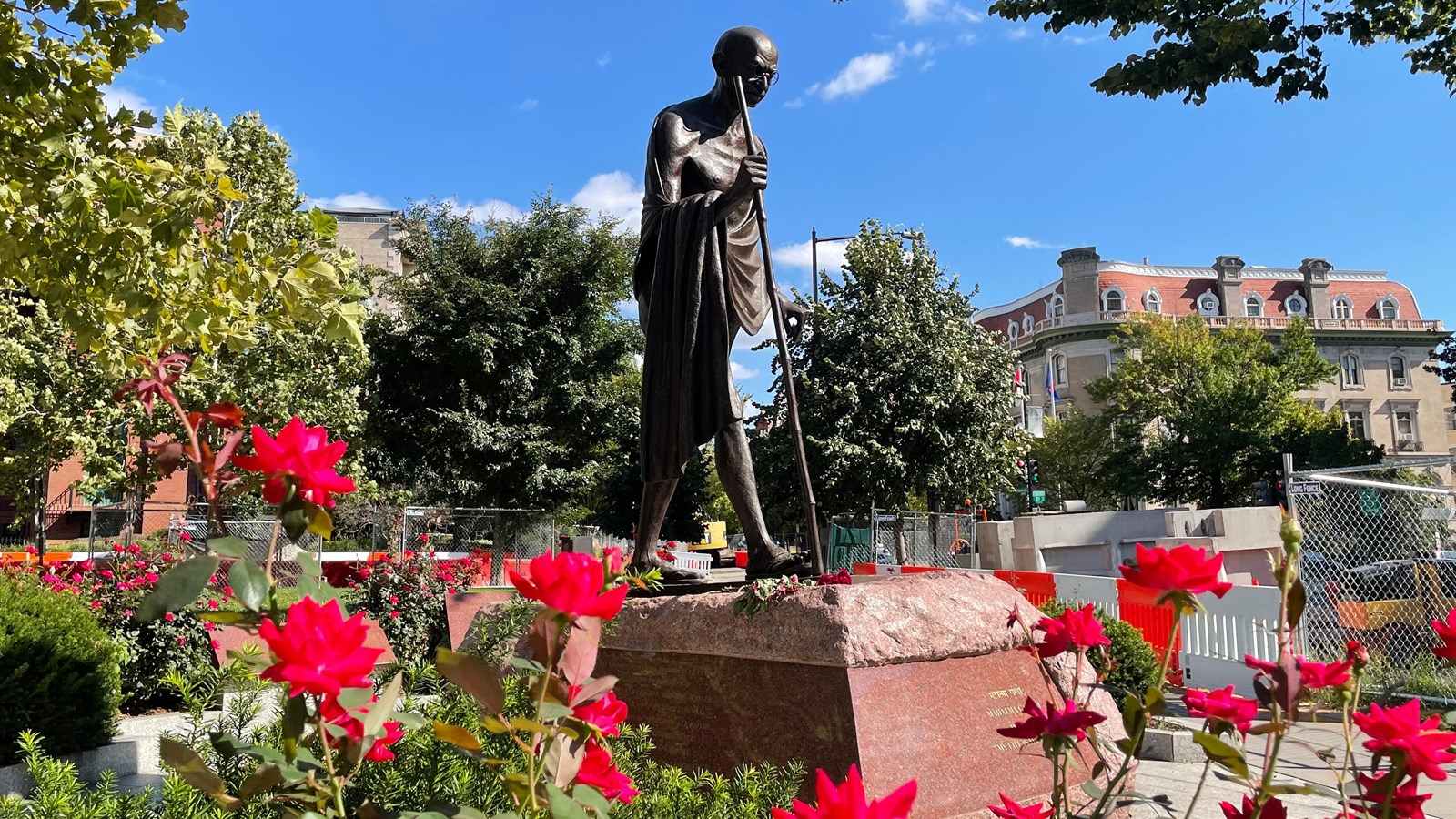
National Park Service photo by Nathan Adams
Quick Facts
Location:
Washington, DC
Amenities
2 listed
Historical/Interpretive Information/Exhibits, Wheelchair Accessible
The Mahatma Gandhi Memorial honors one of the most influential figures of the 20th century whose life and philosophy reshaped global movements for justice, freedom, and nonviolent resistance. Mohandas Karamchand Gandhi, widely known as Mahatma (“great soul”), was born on October 2, 1869, in Porbandar, India. Trained as a lawyer, Gandhi first developed his philosophy of satyagraha, or nonviolent resistance, while advocating for civil rights in South Africa. Returning to India in the early 20th century, he became the central leader of the Indian struggle for independence from British rule, advocating for self-sufficiency, civil disobedience, and peaceful protest. His leadership of mass movements such as the Salt March in 1930 and the Quit India movement in 1942 galvanized millions and inspired subsequent civil rights leaders around the world, including Martin Luther King, Jr. and Nelson Mandela. Gandhi’s commitment to simplicity, truth, and nonviolence until his assassination in 1948 made him a global symbol of ethical resistance.
The Washington memorial stands on a small triangular island along Massachusetts Avenue NW, directly across from the Embassy of India. It was created as a gift from the Indian Council for Cultural Relations and followed congressional authorization in October 1998 allowing the Government of India to establish and maintain a memorial to Gandhi on federal land in the nation’s capital. The memorial was dedicated on September 16, 2000, during a state visit by Indian Prime Minister Atal Bihari Vajpayee in the presence of President Bill Clinton.
The centerpiece of the memorial is an 8-foot-8-inch bronze statue of Gandhi wearing ascetic garb, a reference to his historic 1930 Salt March against colonial salt taxation, a defining moment in the Indian independence movement. The statue was designed by Gautam Pal, a sculptor from Kolkata, and stands on a substantial 16-ton plinth of ruby granite from Ilkal, Karnataka. Behind the figure are three slabs of Karnataka red granite bearing inscriptions in honor of Gandhi’s memory, and in front rests a red granite seat that provides a space for quiet thought. One prominent inscription on the statue’s base quotes Gandhi’s response to a journalist who asked for his message to the world: “My life is my message.”
The design of the memorial emphasizes simplicity and serenity, aligning with Gandhi’s own lifestyle and philosophical commitments. The choice of natural stone, the contemplative seating area, and the unadorned bronze figure reflect the values of humility and inner strength that Gandhi championed. The memorial is one of the few in Washington dedicated to a foreign leader, signaling the universal impact of Gandhi’s life and ideals and the shared aspirations for peace and justice between the United States and India.