



Last updated: August 15, 2026
Place
John Ericsson Memorial
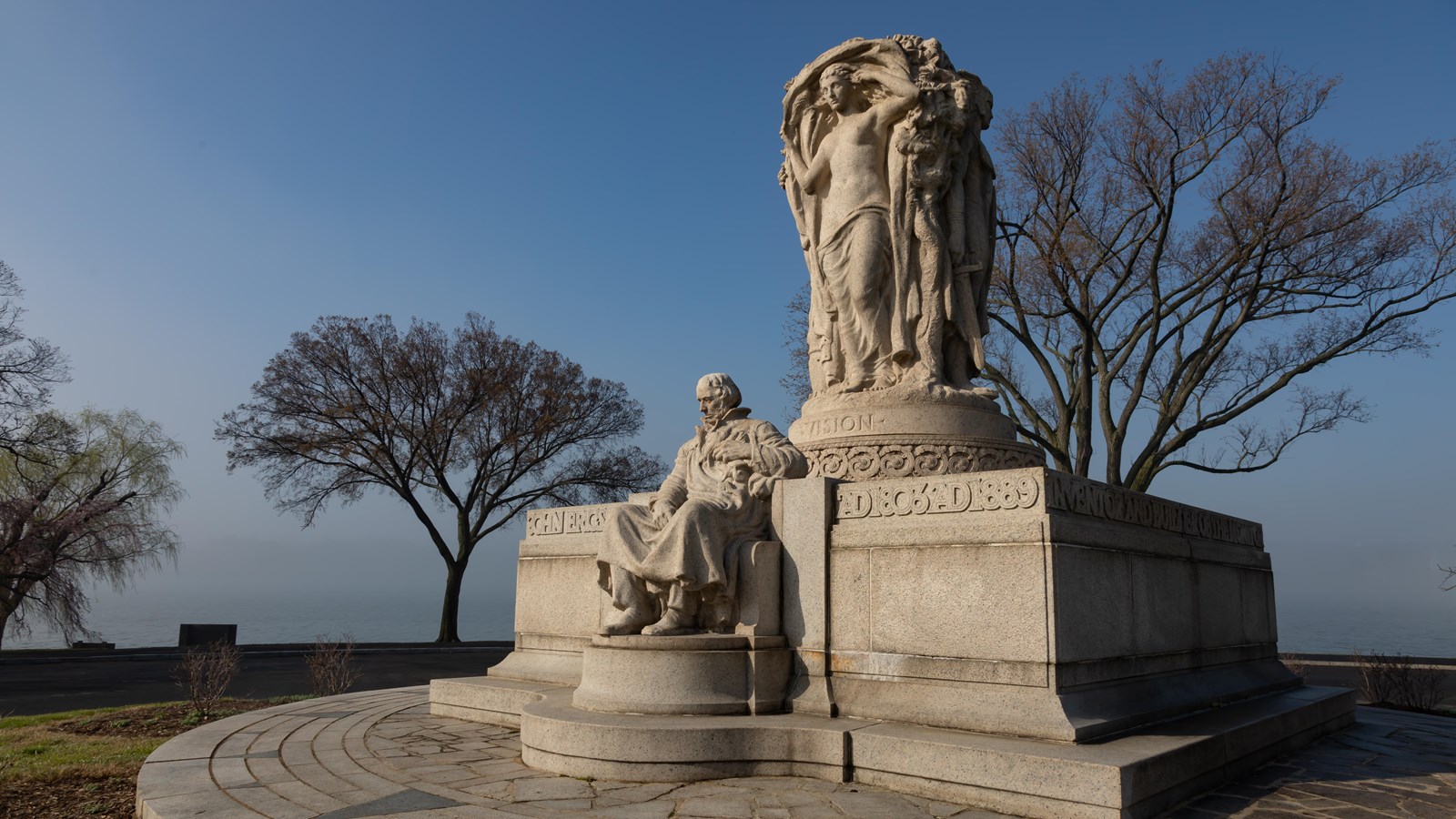
NPS / Kelsey Graczyk
Quick Facts
Location:
Washington, DC - Intersection of Ohio Drive SW and Independence Ave. SW.
Designation:
Memorial
Amenities
2 listed
Historical/Interpretive Information/Exhibits, Parking - Auto
The John Ericsson Memorial commemorates a brilliant engineer‑inventor whose innovations helped shape naval history and whose life story reflects the promise of ingenuity and opportunity in America. Set near just south of the Lincoln Memorial at the intersection of Ohio Drive and Independence Avenue SW, the memorial honors John Ericsson, a Swedish‑born engineer whose work had an outsized impact on the U.S. Navy and maritime technology in the 19th century.
John Ericsson was born in Sweden in 1803 and showed early promise as an engineer. After emigrating to the United States in 1839, he became one of the foremost inventors and mechanical thinkers of his day. Ericsson perfected the screw propeller, a technology that revolutionized marine propulsion and replaced the older paddlewheel systems, profoundly shaping the future of naval and commercial shipping. His most celebrated contribution came during the American Civil War, when he designed the ironclad warship USS Monitor. The Monitor’s engagement with the Confederate ironclad CSS Virginia at the Battle of Hampton Roads in March 1862 marked a dramatic shift in naval warfare, demonstrating the superiority of armored, steam‑driven ships and weaponry. Beyond the Monitor and the propeller, Ericsson’s prolific career spanned innovations in engines, naval armaments, and even experiments in solar power.
In recognition of Ericsson’s achievements and responding to advocacy among Scandinavian‑Americans, in 1916 Congress authorized the creation of a memorial in his honor and appropriated funds for its construction. The memorial’s design was entrusted to sculptor James Earle Fraser, one of the nation’s leading public artists, with architectural contributions from Albert Randolph Ross. The memorial was formally dedicated on May 29, 1926, in a ceremony attended by President Calvin Coolidge and Crown Prince Gustaf Adolf of Sweden, underscoring Ericsson’s ties to both his adopted and native countries. Because the full granite carving was not complete at the dedication ceremony, Fraser made innovative use of a full‑scale plaster model painted to resemble the finished stone, allowing the unveiling to proceed as planned during the Swedish royal visit. Final carving of the memorial from pink Milford granite was completed in 1927.
The design of the John Ericsson Memorial elegantly blends portraiture and allegory. At its center sits a larger‑than‑life figure of Ericsson, depicted seated in thoughtful repose with a cloak draped around him, as if deep in consideration of the engineering challenges that defined his life’s work. Behind him rises an artistic vertical element that references the Norse mythic Tree Yggdrasill, linking Ericsson’s Scandinavian heritage to universal themes of growth and connection. Around this central axis stand three allegorical figures representing “Vision,” “Adventure,” and “Labor,” symbolic of the intellectual foresight, daring spirit, and practical effort required to achieve technological breakthroughs.
The memorial occupies a broad circular base of granite, 150 feet in diameter, into which a mariner’s compass is inlaid—a fitting tribute to a man whose innovations transformed navigation and propulsion. The entire ensemble reaches some 20 feet in height, its pink granite surface echoing the classical and monumental materials of nearby memorials yet distinguished by its layered symbolism and narrative richness.
John Ericsson was born in Sweden in 1803 and showed early promise as an engineer. After emigrating to the United States in 1839, he became one of the foremost inventors and mechanical thinkers of his day. Ericsson perfected the screw propeller, a technology that revolutionized marine propulsion and replaced the older paddlewheel systems, profoundly shaping the future of naval and commercial shipping. His most celebrated contribution came during the American Civil War, when he designed the ironclad warship USS Monitor. The Monitor’s engagement with the Confederate ironclad CSS Virginia at the Battle of Hampton Roads in March 1862 marked a dramatic shift in naval warfare, demonstrating the superiority of armored, steam‑driven ships and weaponry. Beyond the Monitor and the propeller, Ericsson’s prolific career spanned innovations in engines, naval armaments, and even experiments in solar power.
In recognition of Ericsson’s achievements and responding to advocacy among Scandinavian‑Americans, in 1916 Congress authorized the creation of a memorial in his honor and appropriated funds for its construction. The memorial’s design was entrusted to sculptor James Earle Fraser, one of the nation’s leading public artists, with architectural contributions from Albert Randolph Ross. The memorial was formally dedicated on May 29, 1926, in a ceremony attended by President Calvin Coolidge and Crown Prince Gustaf Adolf of Sweden, underscoring Ericsson’s ties to both his adopted and native countries. Because the full granite carving was not complete at the dedication ceremony, Fraser made innovative use of a full‑scale plaster model painted to resemble the finished stone, allowing the unveiling to proceed as planned during the Swedish royal visit. Final carving of the memorial from pink Milford granite was completed in 1927.
The design of the John Ericsson Memorial elegantly blends portraiture and allegory. At its center sits a larger‑than‑life figure of Ericsson, depicted seated in thoughtful repose with a cloak draped around him, as if deep in consideration of the engineering challenges that defined his life’s work. Behind him rises an artistic vertical element that references the Norse mythic Tree Yggdrasill, linking Ericsson’s Scandinavian heritage to universal themes of growth and connection. Around this central axis stand three allegorical figures representing “Vision,” “Adventure,” and “Labor,” symbolic of the intellectual foresight, daring spirit, and practical effort required to achieve technological breakthroughs.
The memorial occupies a broad circular base of granite, 150 feet in diameter, into which a mariner’s compass is inlaid—a fitting tribute to a man whose innovations transformed navigation and propulsion. The entire ensemble reaches some 20 feet in height, its pink granite surface echoing the classical and monumental materials of nearby memorials yet distinguished by its layered symbolism and narrative richness.