



Last updated: December 22, 2025
Place
Japanese Pagoda
NPS / Kelsey Graczyk
Quick Facts
Amenities
2 listed
Historical/Interpretive Information/Exhibits, Wheelchair Accessible
The Japanese Pagoda tucked along the Tidal Basin near the Franklin Delanor Roosevelt Memorial may not have the height or grandeur of the city’s great memorials, but its history and symbolism make it a poignant expression of international friendship and cultural exchange.
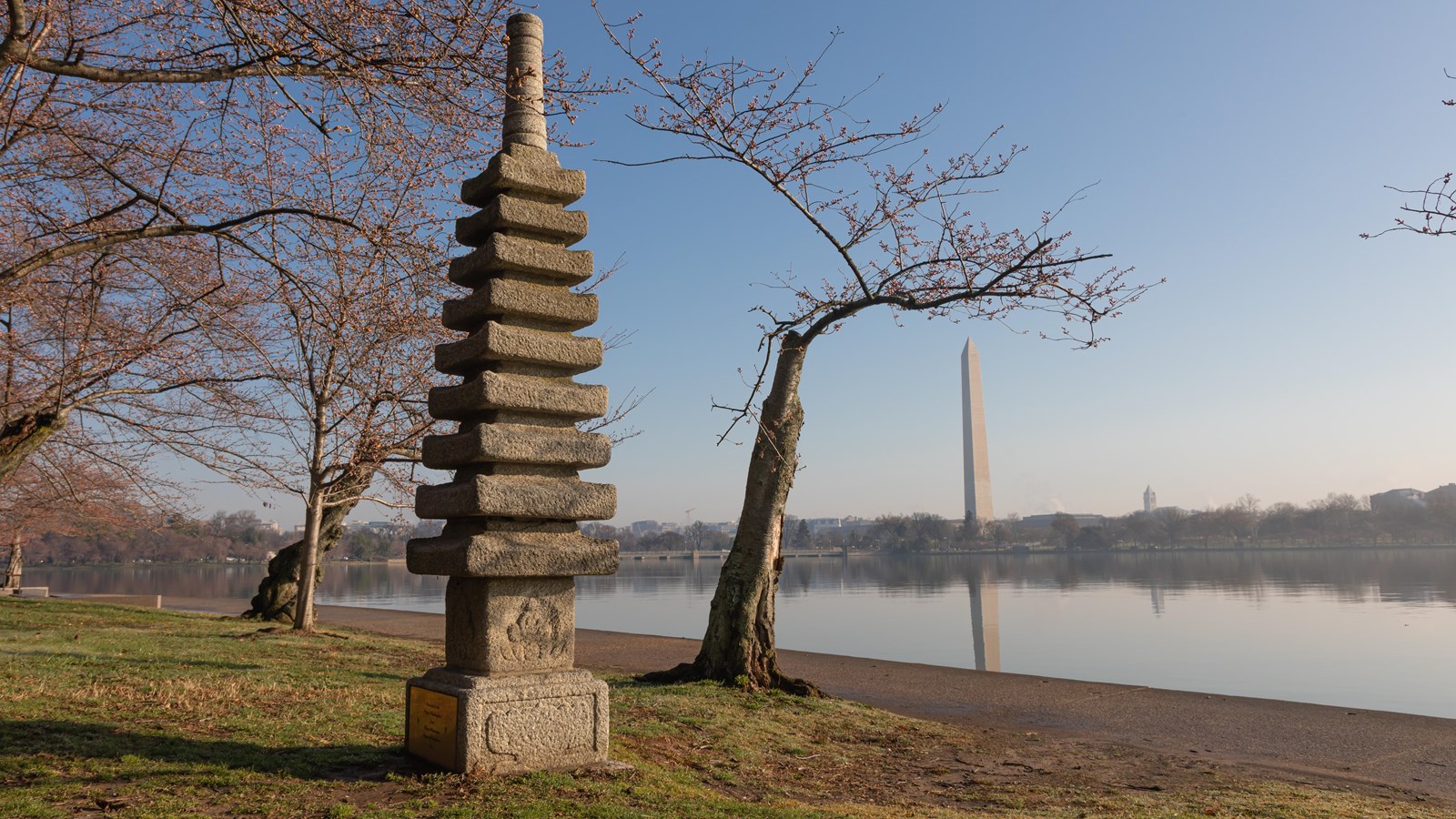
The pagoda itself dates back to the 17th century and is carved from solid granite, weighing roughly 3,800 pounds. The stone sculpture is composed of nine graduated, square slabs stacked from largest at the base to smallest at the top, capped by a ribbed cylindrical finial. At its base are carved images of a seated Buddha on a lotus flower, a motif that reflects its spiritual inspiration and echoes the Buddhist roots of pagoda architecture. Symbolically, the structure represents the five traditional elements—earth, water, fire, wind, and sky—progressing from bottom to top, a sequence that evokes balance and harmony.
Although ancient in origin, the pagoda’s presence in Washington is entirely modern. In 1957, the Mayor of Yokohama presented it as a gift to the people of Washington, D.C. The gift was intended to commemorate the 100th anniversary of peaceful relations established between the United States and Japan through the Treaty of Peace, Amity, and Commerce signed at Yokohama on March 31, 1854, a pivotal moment that opened Japan to diplomatic engagement with the West. A brass plaque set into the pagoda’s base dedicates it to that spirit of friendship.
When the pagoda arrived in the United States, it came in five separate shipping crates with no assembly instructions. The pieces lay like a stone puzzle until experts at the Library of Congress helped decipher how to reconstruct the structure. It was dedicated on April 18, 1958.
The pagoda stands near the water’s edge, surrounded by the iconic cherry trees originally gifted by Japan in 1912, so that in spring its stony form is framed by delicate blossoms and reflected in the basin’s waters. Its setting underscores the theme of renewal and friendship, inviting visitors to pause among the blooms and reflect on the intertwined histories of two nations.