



Last updated: December 1, 2025
Place
Holodomor Memorial
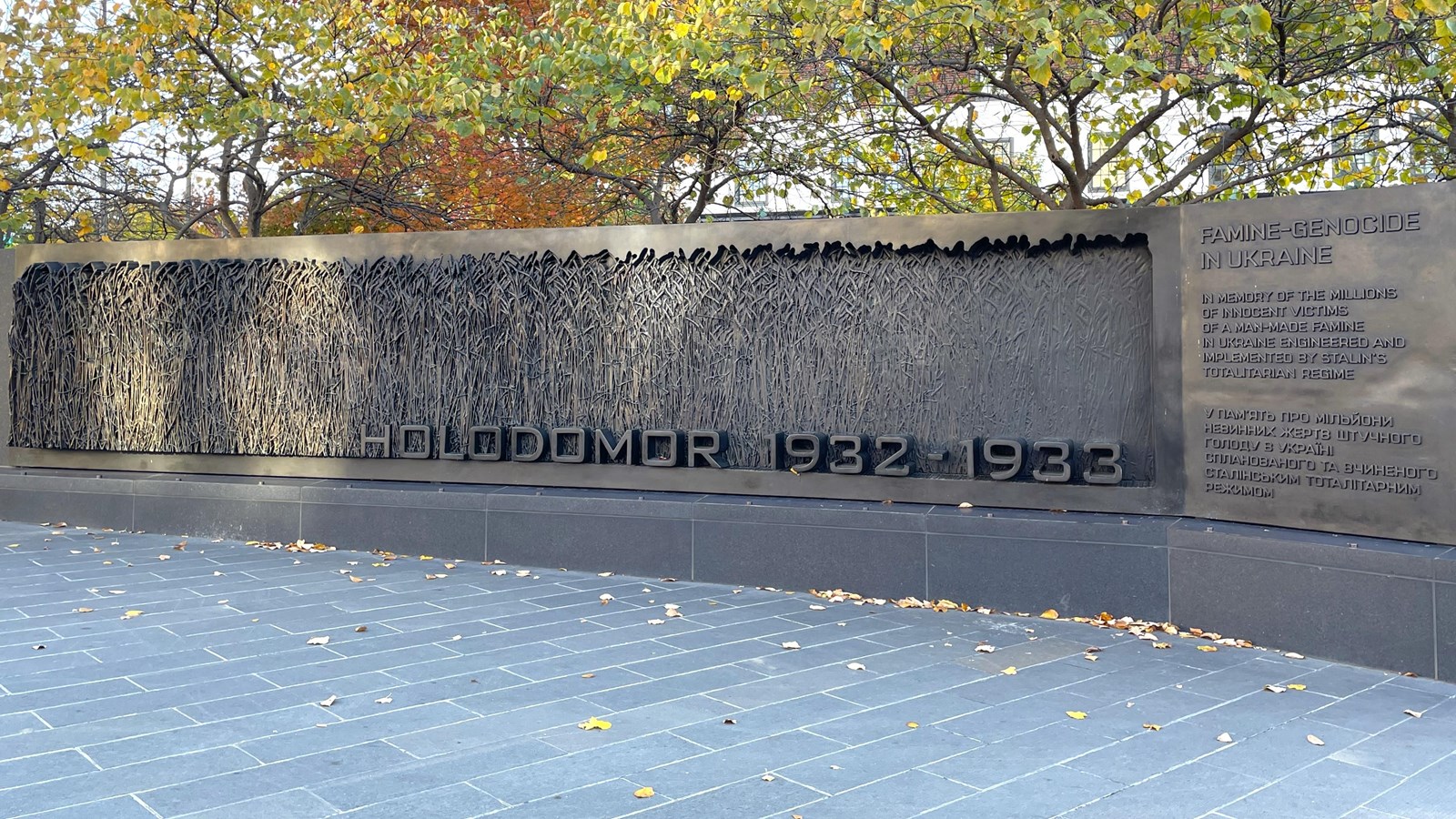
National Park Service photo by Nathan Adams
Quick Facts
Amenities
4 listed
Bicycle - Rental, Historical/Interpretive Information/Exhibits, Public Transit, Wheelchair Accessible
The Holodomor Memorial in Washington, D.C., is a powerful tribute to the millions of Ukrainians who died during the famine-genocide of 1932–1933, known as the Holodomor. The memorial opened on November 7, 2015, having been authorized by the U.S. Congress (Public Law 109-340 in 2006) and built on a triangular parcel of federal land near the intersection of North Capitol Street, Massachusetts Avenue, and F Street NW, just a short walk from Union Station and the Capitol.
Designed by Ukrainian-American architect and sculptor Larysa Kurylas (with Hartman-Cox Architects as architect of record), the memorial’s focal point is a 30-foot-long bronze bas-relief titled “Field of Wheat.” The relief begins with deeply sculpted, lush wheat on the left, symbolizing abundance, but as one's gaze moves to the right, the stalks gradually fade and recede into negative space until they vanish entirely. At the base of the receding wheat, the inscription “HOLODOMOR 1932–1933” emerges. This subtle shift from plentiful harvest to emptiness is meant to symbolize the deliberate starvation inflicted on Ukrainians — transforming wheat from a source of life into a weapon of death.
Behind the bronze wall, granite panels etched with geometric designs derived from a 1933 folk-textile pattern by Ukrainian architect Vasyl Krychevsky add another layer of symbolism. Their angular, almost “barbed” quality evokes sealed borders and reflects the suppression of Ukrainian culture that accompanied the famine.
The memorial’s site layout and landscaping were also carefully considered: the horizontal alignment of the sculpture respects the historic sightlines along Massachusetts Avenue, and native trees (including purple-leafed redbuds) frame the memorial, creating a quiet, contemplative setting — a space intended for reflection by individuals or groups alike.
The Holodomor Memorial is a restrained but deeply symbolic work of civic art. Its modest presence and evocative design invite viewers to remember a tragedy often overlooked in Western memory, and to reflect on the catastrophic human cost of famine used as political oppression.