



Last updated: June 30, 2026
Place
Freedom Plaza
NPS / Claire Hassler
Quick Facts
Amenities
2 listed
Historical/Interpretive Information/Exhibits, Public Transit
For information about the current statuary display in Freedom Plaza, see A Celebratory Exhibition: Spirit of ’76 at Freedom Plaza.
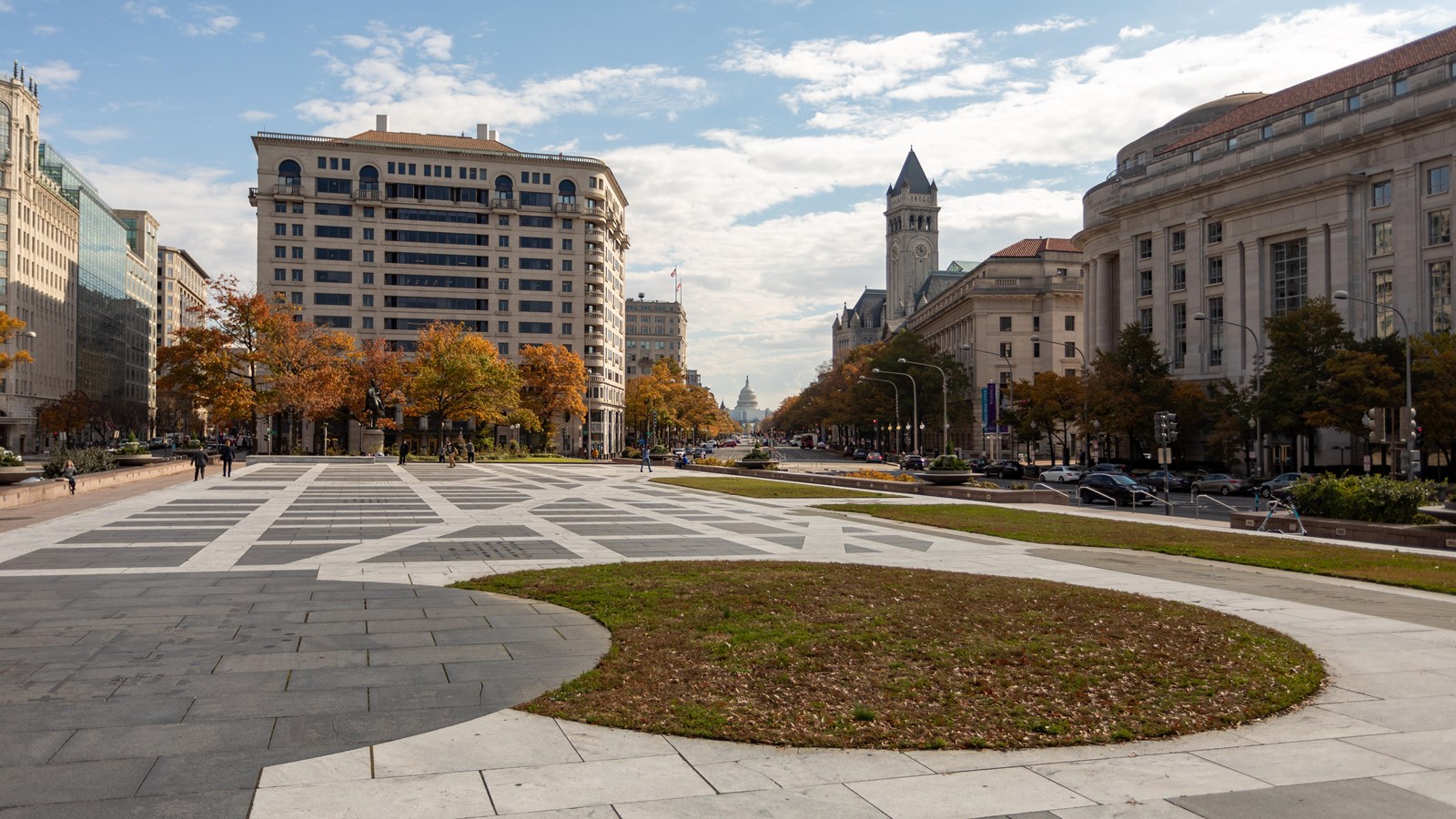
Freedom Plaza, located along Pennsylvania Avenue NW between 13th and 14th Streets, is one of Washington's most recognizable civic spaces. Completed in 1980 and originally named Western Plaza, the site was renamed in 1988 in honor of Martin Luther King, Jr., who had outlined plans for a “Poor People’s Campaign” on the steps of the Lincoln Memorial and was scheduled to lead a demonstration on the site before his assassination.
The plaza was designed by architect Robert Venturi and landscape architect George Patton as part of the larger Pennsylvania Avenue redevelopment. Its most striking feature is its broad granite and marble surface inlaid with a giant, map-like representation of Pierre L’Enfant’s 1791 plan for the city of Washington. Streets, avenues, and the Potomac shoreline are marked in black granite, while inscriptions and compass points add to the impression of walking across an oversized city blueprint. Bronze plaques set into the pavement highlight key sites and historical references, blending art, cartography, and civic memory.
Freedom Plaza includes raised terraces, low stone seating walls, and planters that frame views toward the U.S. Capitol in one direction and the White House in the other. A large equestrian statue of Kazimierz Pułaski, the Polish-born Revolutionary War cavalry officer, stands at the northeast corner, tying the space visually to the avenue’s string of historic monuments. The plaza’s open layout, with its wide, uninterrupted central expanse, was intended to serve as a grand public forum and event space.
Today, Freedom Plaza functions exactly as its designers envisioned: a flexible gathering place used for rallies, demonstrations, festivals, performances, and civic celebrations. Its prominent location along “America’s Main Street” has made it a frequent site for political expression, from large national marches to small grassroots events. Office buildings, hotels, and federal agencies surround it, giving the plaza a steady flow of workers, visitors, and passersby throughout the day.
Though primarily paved, its edges include shade trees and seating areas that offer respite from the busy avenue. Ongoing maintenance and occasional redesign discussions underscore its importance as both a symbolic and practical public space in the heart of the nation’s capital. Freedom Plaza remains a distinctive blend of historic homage, civic function, and monumental urban design.