



Last updated: December 1, 2025
Place
Edmund Burke Statue
NPS / Kelsey Graczyk
Quick Facts
Amenities
1 listed
Historical/Interpretive Information/Exhibits
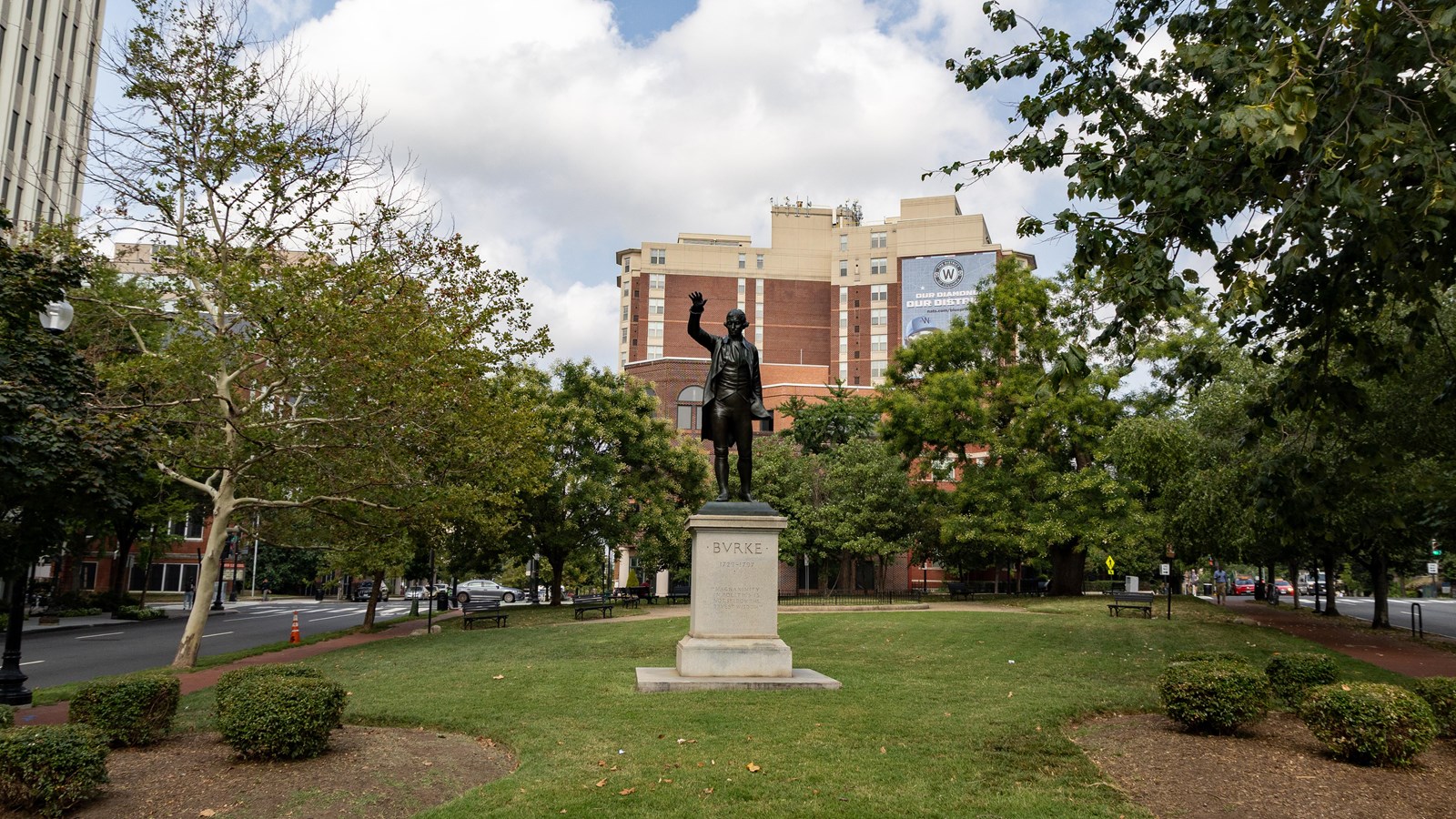
Revolutions make for strange bedfellows, which helps explain why a statue of 18th-century British parliamentarian Edmund Burke stands at 11th Street and Massachusetts Avenue NW. An Enlightenment-era philosopher and statesman, Burke was one of America’s strongest allies in Britain, defending the colonies’ calls for liberty from within Parliament. As a sign of esteem for his support, he is now honored in the American capital.
Born in Dublin in 1729 to a prominent family divided between Catholic and Protestant traditions, Burke followed the Anglican Church but advocated strongly for the rights of disenfranchised Catholics. After graduating from Trinity College in 1748, he moved to London to study law. Though he never practiced, he emerged as a major political thinker. Elected to Parliament in 1765, he served for 30 years, representing three constituencies.
During the American Revolution, Burke’s Whig Party was out of power while Lord North’s Tory government imposed taxes on the colonies without their consent. Burke believed these acts violated British liberties and threatened the empire’s stability. Representing the port city of Bristol, which was deeply tied to American trade, he argued passionately against coercive policies. While he did not endorse independence, he warned that it would become inevitable if Britain continued to ignore American grievances.
As tensions escalated into war, Burke sought compromise and later encouraged peaceful relations and free trade with the new United States. He admired how elements of British law were incorporated into the U.S. Constitution. After a long public career, Burke died in Beaconsfield, England, in 1797.
The Washington statue is a copy of an 1894 work in Bristol by Welsh sculptor John Harvard Thomas, known for his meticulous detail. Presented to the United States in 1922 by London’s Lord Mayor Charles Wakefield shortly after Britain and America fought as allies in World War I, it stands as a reminder of the historic ties and enduring friendship between the two nations.