



Last updated: August 15, 2026
Place
Samuel Hahnemann Memorial
NPS / Kelsey Graczyk
Quick Facts
Location:
Washington, DC
Amenities
2 listed
Historical/Interpretive Information/Exhibits, Public Transit
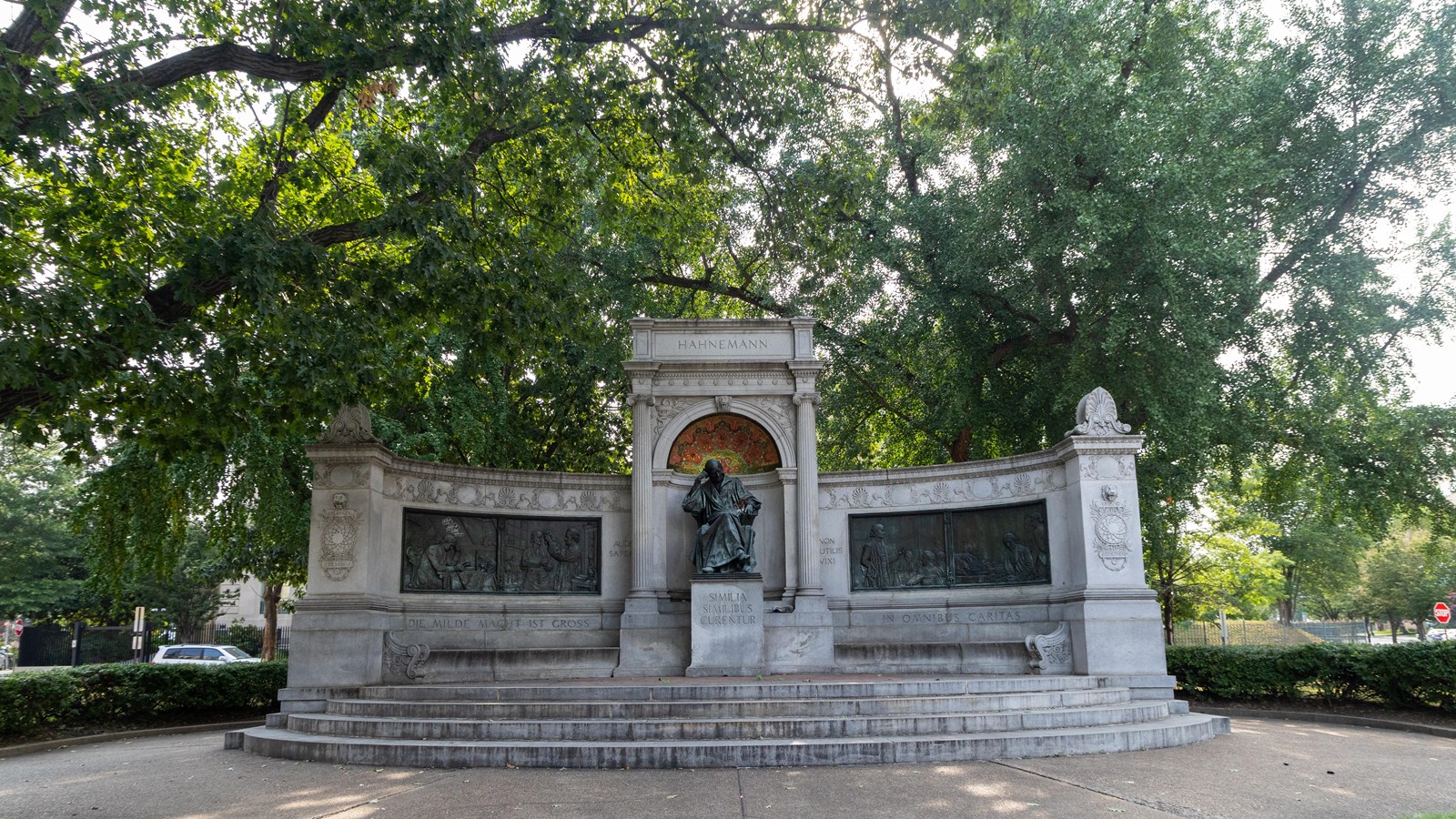
The Samuel Hahnemann Memorial, located near Scott Circle, honors the German physician Samuel Hahnemann (1755–1843), founder of homeopathy. Born in Meissen, Germany, Hahnemann trained as a physician but grew dissatisfied with the medical practices of his era. Through years of experimentation, he developed the principle of “like cures like,” the idea that substances causing symptoms in healthy individuals could, in highly diluted form, treat similar symptoms in the sick. This concept, along with his belief that serial dilution and shaking increased a remedy’s potency, shaped homeopathy—an approach that spread widely in the 19th century and drew both devoted followers and strong critics. Hahnemann’s 1810 treatise, The Organon of the Healing Art, became the foundation of homeopathic medicine, and his methods gained popularity in Europe and the United States.
Commissioned by the American Institute of Homeopathy—which secured congressional approval in 1897 to erect the nation’s first monument to a medical doctor—the memorial was designed by sculptor Charles Henry Niehaus and architect Julius Harder. Harder created the semicircular granite exedra, an elegant architectural setting with a central niche. Within it sits a 10-foot bronze statue of Hahnemann, shown seated and contemplative with a book on his knee to signify his contributions to medical scholarship. Behind him, bronze relief panels illustrate key moments in his life and the development of his theories. Its prominent location reflected the influence of homeopathic schools, hospitals, and professional institutions in the United States at the turn of the 20th century.
Dedicated on June 21, 1900, before thousands of physicians attending the International Homeopathic Congress, the memorial celebrated both the prominence of homeopathy at the time and the profession’s desire to honor a major figure from its intellectual past. Today it remains a striking example of turn-of-the-century public art and marks an important chapter in American medical history, even as scientific views of homeopathy have evolved. Modern medical consensus holds that homeopathic remedies have no demonstrated efficacy beyond placebo, and while many people continue to use them, they are considered complementary or alternative practices rather than evidence-based medicine.
Thus, the Hahnemann Memorial occupies a distinctive place in Washington’s landscape: a finely crafted Beaux-Arts monument that commemorates an influential medical thinker while reflecting how scientific understanding changes over time.