



Last updated: December 8, 2025
Place
Daniel Webster Memorial
NPS / Kelsey Graczyk
Quick Facts
Location:
Washington, DC
Amenities
2 listed
Historical/Interpretive Information/Exhibits, Public Transit
The Daniel Webster Memorial in Washington, D.C., honors one of the most influential American statesmen of the 19th century. Daniel Webster (1782–1852) was born in New Hampshire and rose to national prominence as a lawyer, senator, orator, and Secretary of State. Known for his constitutional brilliance and unmatched eloquence, Webster argued landmark Supreme Court cases and became a central voice for national unity during a time of rising sectional tension. In the Senate, his speeches—especially the famed “Second Reply to Hayne”—cemented his reputation as a champion of the Union. As Secretary of State, he negotiated the Webster–Ashburton Treaty, resolving the U.S.–Canada boundary in the Northeast. His long public career, grounded in a belief in the permanence of the Union, made him one of the most respected political figures of his era.
Congress authorized a memorial to Webster in 1898 after advocacy from the New England Society of Washington, D.C. Italian sculptor Gaetano Trentanove created the monument, which was dedicated on January 18, 1900. Standing in Scott Circle at the intersection of Massachusetts Avenue, Rhode Island Avenue, and 16th Street NW, it reflects the late-19th-century movement to commemorate national leaders who shaped the country’s constitutional and diplomatic identity.
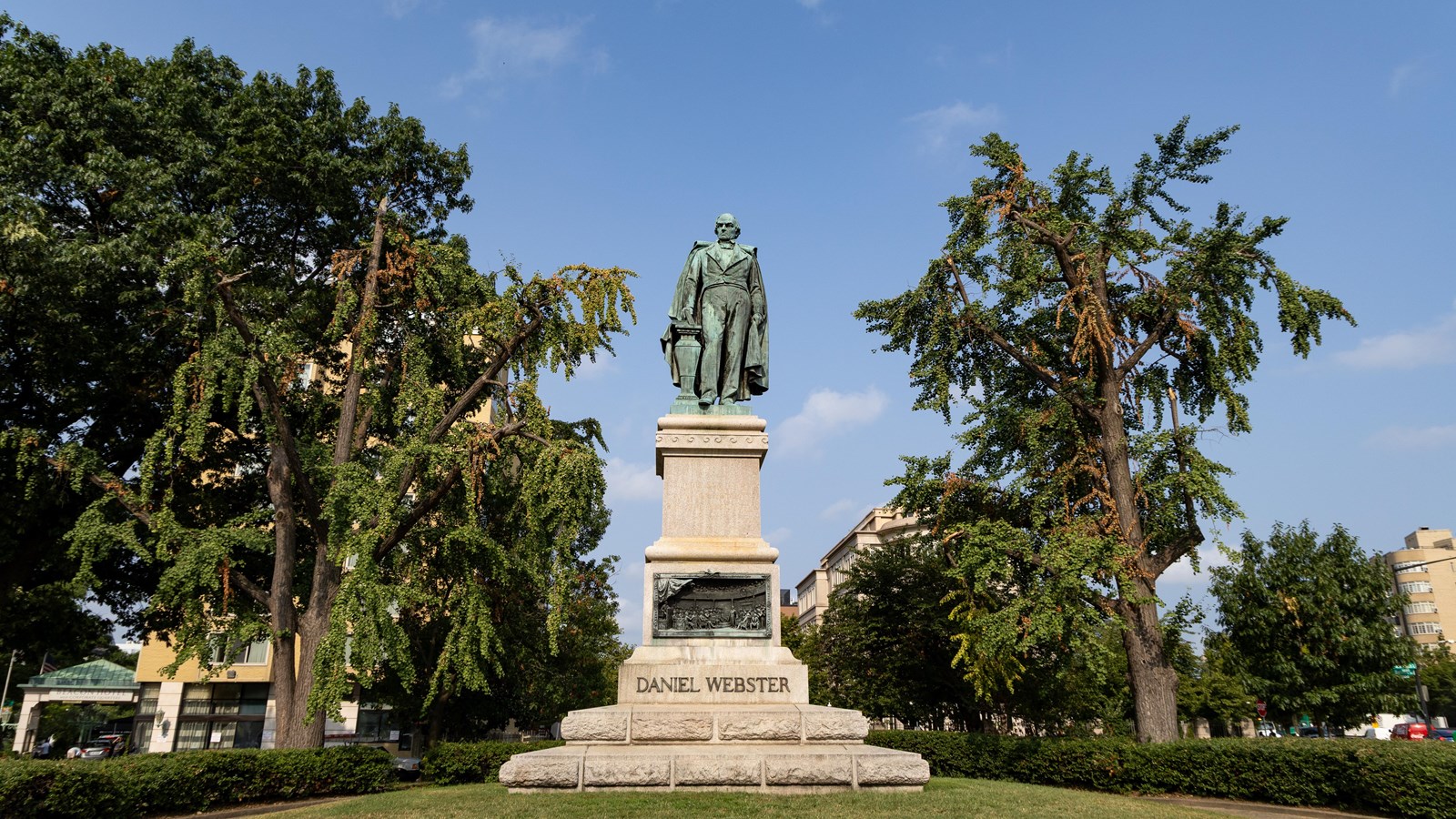
Trentanove’s bronze statue portrays Webster as a modern American statesman rather than a mythologized classical figure. He stands upright in contemporary dress, one arm extended in the pose of a Senate address. The gesture evokes his oratorical power and devotion to the principles of Union and constitutional government. The statue rises from a tall granite pedestal inscribed with Webster’s most significant public roles. The memorial’s design is intentionally restrained, focusing attention on the expressiveness of the figure.
On the reverse side is a bronze bas-relief allegory of “The Union,” the ideal Webster defended throughout his career. A classical female figure, representing national unity, appears with symbolic elements such as the U.S. shield and a scroll, reinforcing Webster’s identity as a constitutional guardian whose arguments emphasized federal authority and national cohesion.
The Daniel Webster Memorial stands as both a tribute to a major architect of American political thought and a reflection of Washington’s tradition of honoring national leaders in its public spaces. It remains an integral part of the city’s monumental landscape, representing themes of union, statesmanship, and the enduring power of democratic debate.