



Last updated: December 15, 2025
Place
Columbus Fountain
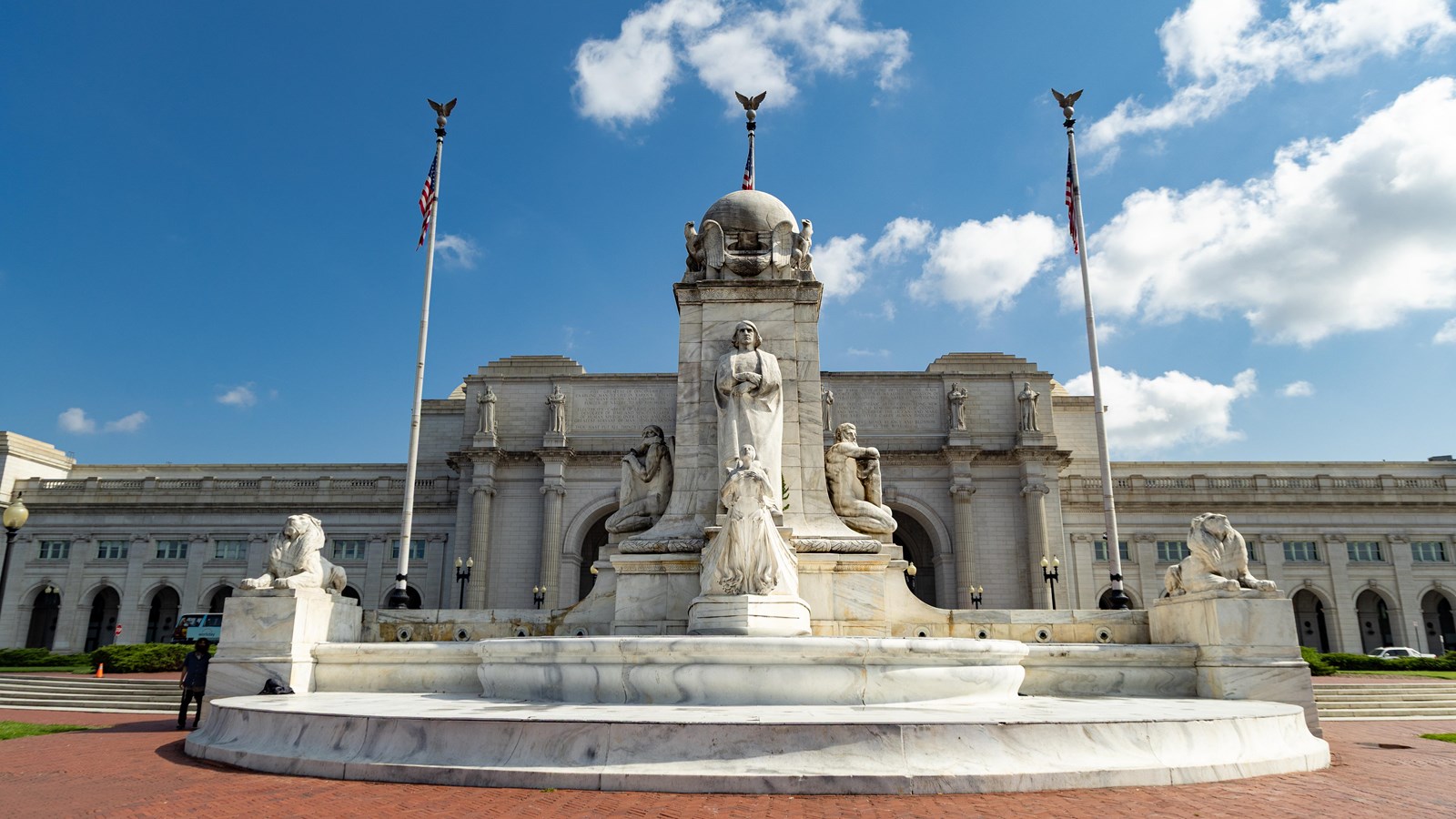
NPS / Kelsey Graczyk
Quick Facts
Location:
Washington, DC
Amenities
2 listed
Historical/Interpretive Information/Exhibits, Public Transit
The Columbus Fountain, standing directly in front of Washington’s Union Station, is a prominent Beaux-Arts monument honoring Christopher Columbus and commemorating his 1492 voyage. Designed by architect Daniel Burnham—who also planned Union Station—and sculpted by Lorado Taft, the fountain was dedicated on June 8, 1912, as part of the national celebrations marking the 400th anniversary of Columbus’s landing in the Americas. Its placement before the grand façade of the newly completed station was intended to create a ceremonial gateway to the capital city, linking exploration, progress, and the expanding reach of the United States.
The monument’s design reflects classical influences and symbolic layers. At its center stands a granite pylon crowned with a globe, its poles marked by tiny eagles symbolizing the far reach of American power and exploration. At the base of the pylon is a restrained, contemplative figure of Columbus, depicted as a seafarer looking ahead with steady resolve. Behind him, the flowing lines of his mantle echo the billowing forms of ship sails.
Flanking Columbus are two allegorical figures. To his right sits a masculine representation of the Old World, muscular and grounded, evoking tradition and ancient civilization. To his left is a youthful figure representing the New World, alert and dynamic, embodying potential and discovery. Beneath them, a stylized ship’s prow projects forward, its form cutting into the broad lower basin. At the prow stands a carved figurehead depicting a Native American, intended at the time to symbolize the peoples encountered during European exploration.
Together, the fountain, plaza, and surrounding architecture form an integrated composition that has greeted travelers arriving in Washington for more than a century. Despite evolving perspectives on Columbus’s legacy, the fountain remains an important historic landmark, reflecting early 20th-century artistic ideals and the city’s effort to craft a grand civic entrance befitting the nation’s capital.
NOTE: Columbus Plaza is currently closed until June 2026 for renovation of the park and repair of the fountain.