



Last updated: December 1, 2025
Place
John Marshall Park
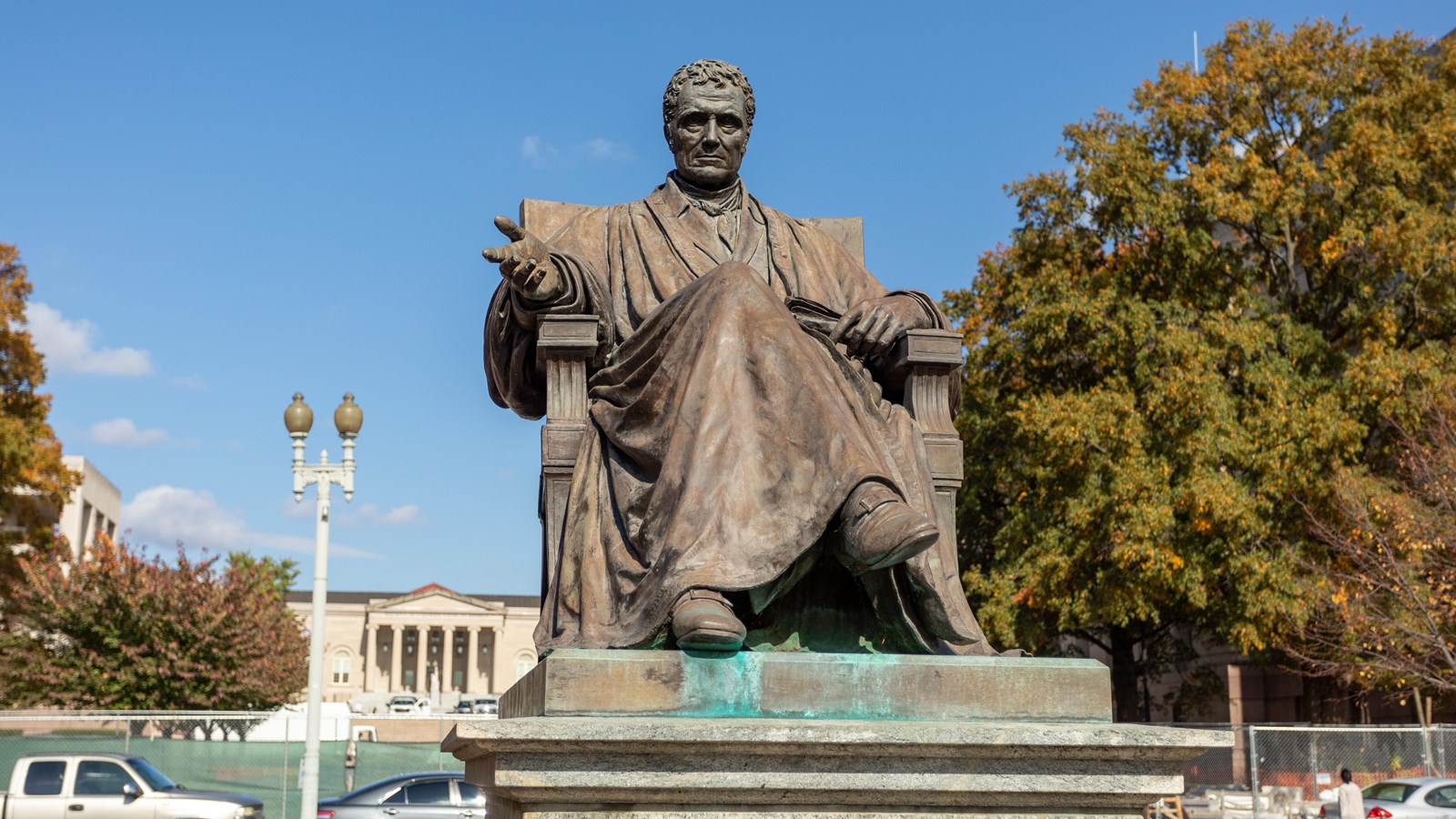
NPS / Claire Hassler
Quick Facts
Location:
Washington, DC
Amenities
1 listed
Historical/Interpretive Information/Exhibits
John Marshall Park is closely tied—both symbolically and physically—to the courthouses that surround it. Situated directly beside the E. Barrett Prettyman U.S. Courthouse and near the H. Carl Moultrie I Superior Court building, the park forms part of a civic landscape centered on law and justice. Its dedication to Chief Justice John Marshall reinforces this connection: Marshall’s legacy as a defining figure in the early Supreme Court mirrors the modern judicial activity taking place just steps away. As a result, the park functions not only as a public green space but also as a quiet extension of the courthouse environment, offering a contemplative setting for attorneys, jurors, staff, and visitors reflecting on ongoing legal proceedings.
At the north end of the park stands a bronze statue of John Marshall, a recast of the 1883 sculpture by William Wetmore Story. The statue depicts Marshall seated in judicial robes on a granite pedestal, his right hand extended as if delivering an opinion while a folded document rests in his left—an apt portrayal of a man who helped define federal judicial power and shape American constitutional law. Because Marshall once lived near this site, the statue and the park together act as a symbolic bridge between the city’s legal-historical foundations and its active contemporary judiciary.
The park’s terraces, fountains, and additional sculptures—such as the life-size bronze “Chess Players”—enhance its atmosphere of reflection and civic dignity, making it a welcoming space for jurists, lawyers, courthouse visitors, and neighborhood residents alike. Designed as a long, linear green space along Pennsylvania Avenue NW, John Marshall Park subtly frames the judicial institutions around it. Its walkways and terraced levels are oriented so that the statue of Marshall occupies a prominent position, facing toward the nearby federal courts. From this vantage point, the sculpture appears to preside over the stretch of Pennsylvania Avenue that links the Supreme Court, the Capitol, and the surrounding federal and district courthouses. The formal character created by broad steps, stone walls, and symmetrical plantings mirrors the architecture of these civic buildings, allowing visitors to experience a gradual transition from open urban space to the solemn world of the judiciary.