



Last updated: December 16, 2025
Place
Charles & Martha Treat Farm
NPS credit
Park to access the farm on Norconk Road, where the road turns south at the Tweddle Farm.
44.79284456367236, -86.05788485792482
Leashed pets are allowed at this site.
A hike through the woods along an old road leads to this fascinating old farmhouse and related buildings. Exploring beyond the farm buildings to the west is not advised. The Lake Michigan shoreline bluff is unstable and is prone to landslides.
Charles Treat was a farmer and an engineer. He and his wife Martha, purchased 220 acres, including several buildings, from John Tweddle (of the nearby Tweddle Farm) in 1912.
The farm is of historic and cultural importance and is also one of the most beautiful areas for spring wildflowers in Michigan.
The farmhouse is a white two story building built by the Tweddles. Later the Treats rebuilt the front porch, adding a concrete foundation and a workshop with a metalworking forge under the porch. There was no running water at the house and a deep well dug to provide running water silted up quickly and completely. The Treats modified the gutter system of the house to direct rainwater from the roof to a cistern built into the ground in the back of the house and then hand pumped water into the kitchen.
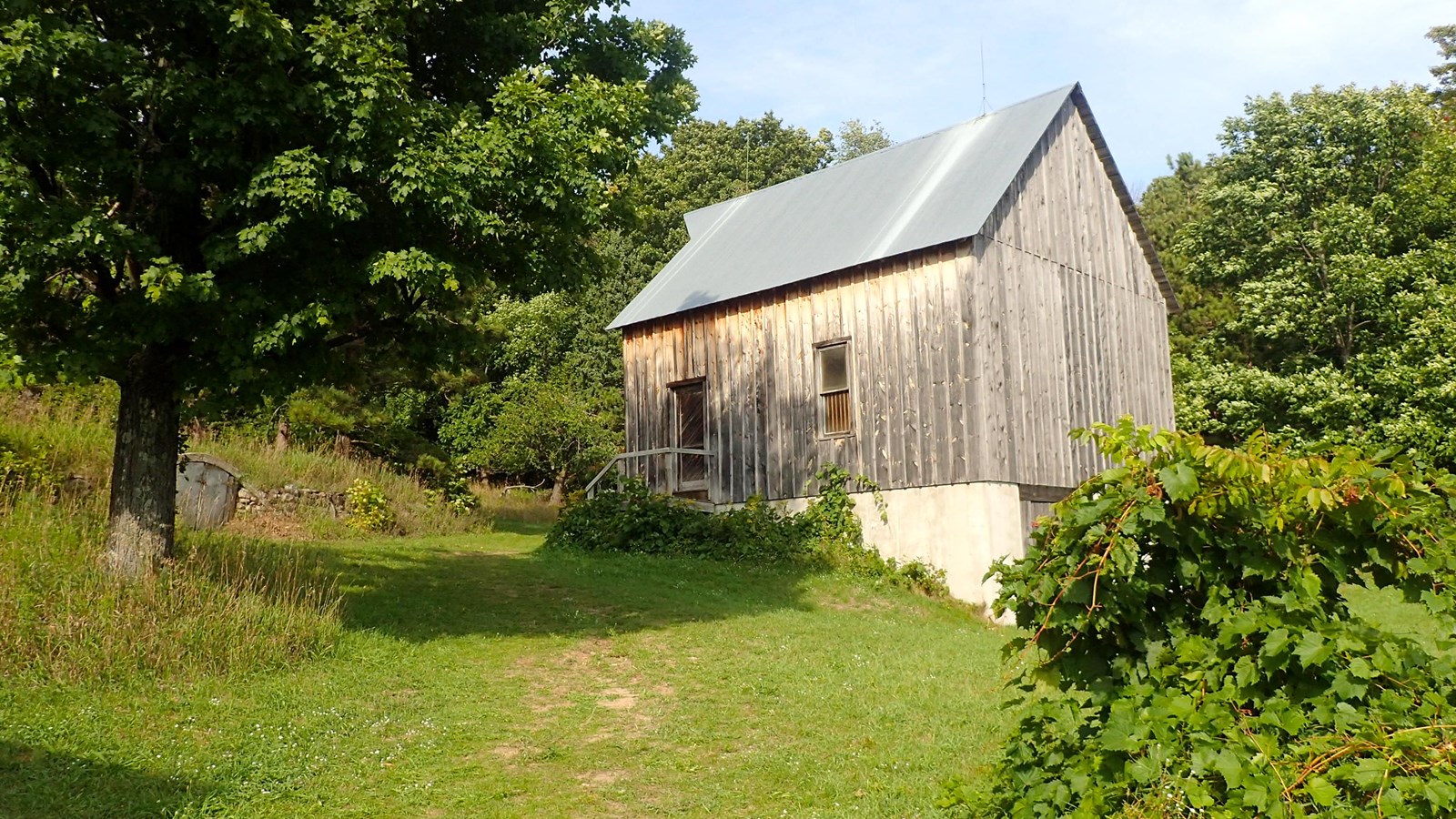
The barn, restored in 2004, is a steep roofed vertically planked structure with an imposing prow covering the barn's pulley, which was "mostly used for raising hay into the hayloft." Treat bought the barn in the Detroit area. He had it disassembled, had each piece numbered, and had it shipped to the farm where he reassembled it on a concrete foundation which he poured.
A concrete root cellar built into a hill is the smaller of two structures which show Treat's ongoing interest in working with reinforced concrete.
There is a larger circular garage which Treat built using four-inch thick reinforced concrete wall, poured a bucket of concrete at a time. The roof was 2.5 inches thick made of reinforced concrete with a frame of heavy cedar and a hand set spiral network of steel bar for reinforcement.
There are several other buildings including a woodshed and machine sheds for storing farm equipment.
The Treat Farm was primarily a subsistence farm. They grew asparagus, beans, plums, apples, potatoes and raspberries among other plants, mostly for their own consumption. They raised corn and hay for animal feed. They maintained a small dairy herd and raised chickens as well, and despite the poor soil, continued farming into the 1930's.